

Command one of Britain's last working trains. Build an evacuation route from London to Glasgow across the real UK rail network, manage a community under pressure, and decide who gets passage as infection and collapse transform every journey.

Sign in to add this item to your wishlist, follow it, or mark it as ignored

Coming Soon To Early Access

The developers of this game intend to release as a work in progress, developing with the feedback of players.

Note: Games in Early Access are not complete and may or may not change further. If you are not excited to play this game in its current state, then you should wait to see if the game progresses further in development. Learn more

What the developers have to say:

Why Early Access?

“Mercyrail is being developed by one person. The full journey from Waterloo to Glasgow is already playable, including route planning, train building, passengers, supplies, scavenging, infection, side quests, bandit encounters, and narrative events.

These systems are closely connected. A small change to fuel use can alter route choices, while a change to passenger demand can affect carriage space, crew, food, and morale for the rest of a run. Early Access provides a much wider range of complete journeys than solo testing can. That feedback will be used to improve balance, explain difficult systems more clearly, and identify parts of the route that need more attention.

Development during Early Access will also add more station stories, passenger encounters, survivor encounters, side quests, event chains, accessibility options, and quality-of-life improvements.”

Approximately how long will this game be in Early Access?

“Early Access is planned to last approximately 12 months. This is an estimate rather than a fixed release date. The game will leave Early Access when the campaign content, balance, accessibility, performance, and platform support are ready for a full release.”

How is the full version planned to differ from the Early Access version?

“The full version is planned to have more station situations and branching event chains across the Waterloo-to-Glasgow campaign, along with more passenger stories, survivor encounters, faction responses, and persistent consequences. Player feedback will guide further balancing of routing, scavenging, infection, resources, morale, and reputation.

Accessibility, onboarding, quality-of-life options, presentation, audio, performance, and stability will continue to improve. Steam Achievements and Steam Cloud support are also planned, along with completed controller-only and Steam Deck validation.

Priorities may change as feedback reveals which parts of the game need the most work.”

What is the current state of the Early Access version?

“The main single-player campaign is playable from London Waterloo to Glasgow Central. You can configure the opening train, accept or refuse named passenger groups, recruit railway workers, manage supplies, travel through the connected rail network, scavenge with named crew, encounter survivors, take on side quests, deal with bandit crews, repair the train, treat sick passengers, respond to spreading infection, and make choices with lasting consequences. Runs can be saved and continued locally.

The campaign has a complete beginning and ending, but it is not yet content-complete or fully balanced. Major locations currently have more bespoke stories than many smaller stations. Onboarding, accessibility, controller support, performance, and Steam integration will also continue to improve during Early Access.”

Will the game be priced differently during and after Early Access?

“The price may increase when the game leaves Early Access if the finished game has grown significantly through new content, features, and improvements. Any change will be announced in advance.”

How are you planning on involving the Community in your development process?

“Steam Discussions and the official Discord server will be the main places to report bugs, share feedback, and describe how a run played out. Development updates will explain what is changing and which parts of the game are currently being worked on.

Community feedback will help identify balance problems, unclear systems, accessibility needs, performance issues, and stations or routes that need more attention. Reports from complete runs will be especially useful because decisions made early in the journey can have consequences much later. Feedback will be considered alongside the direction and scope of the game rather than treated as a promise that every suggestion will be added.”
Read more
This game is not yet available on Steam

Planned Release Date: Q3 2026

Interested?
Add to your wishlist and get notified when it becomes available.
 
See all discussions

Report bugs and leave feedback for this game on the discussion boards

About This Game

Britain is collapsing under a fast-spreading infection. You command Mercyrail, one of the last services still running. Starting at London Waterloo, build a northbound evacuation route across surviving rail connections and try to reach Glasgow Central, a refuge at the far end of a country coming apart.

The train is more than transport. It is a moving community and one of the last public services people can still depend on. Across the journey, you decide who gets passage, what you can afford to give up, and what kind of authority you create by keeping the route alive.

Route Across a Real Rail Network

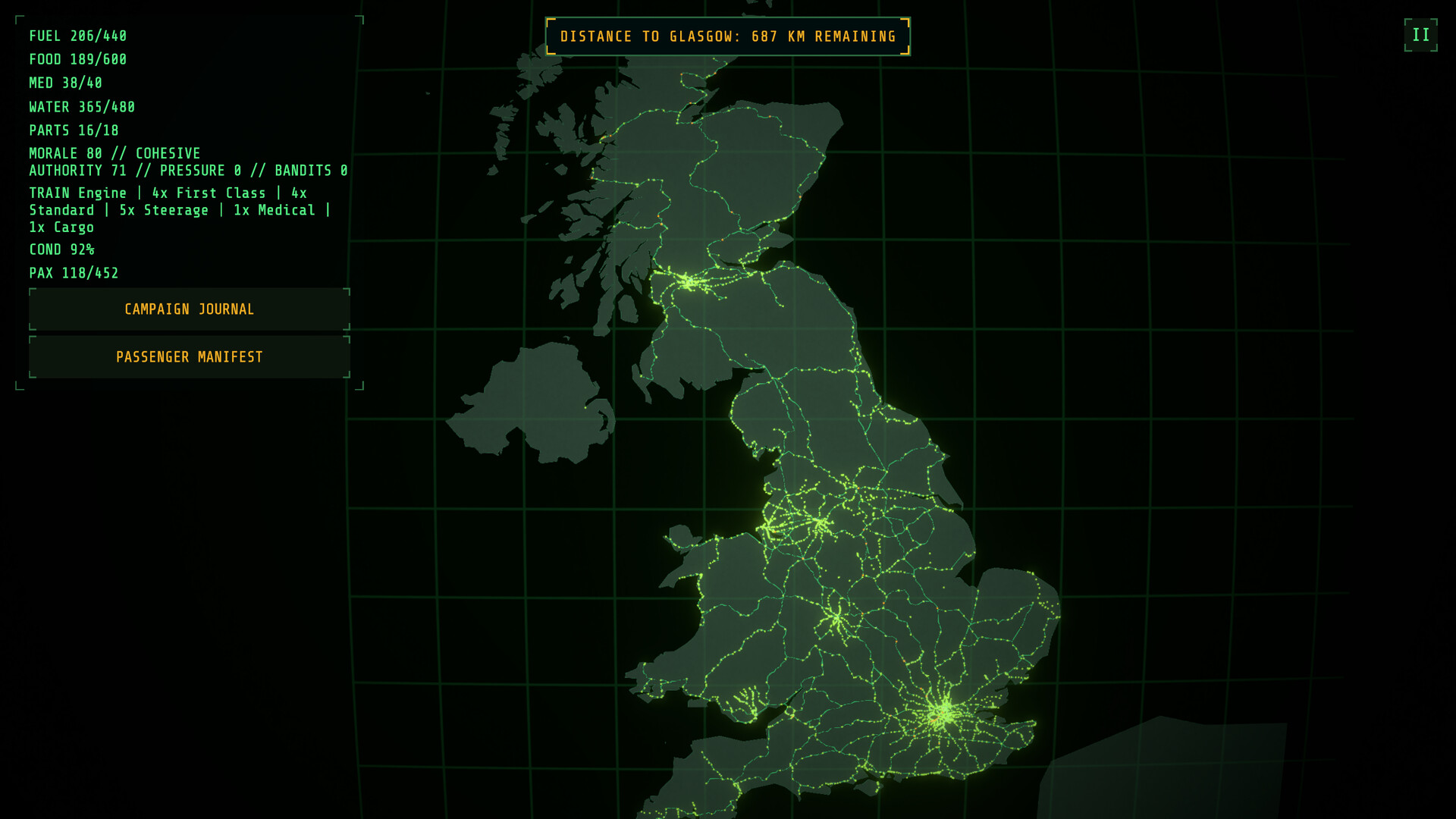
The map uses OpenStreetMap railway data. Its stations, connections, and routes follow the real UK network rather than an invented game map. Discover neighbouring stations, commit to multi-stop journeys, and change course as infection, failed points, damaged track, barricades, flooding, and contested corridors alter the risk of travelling north. Distance and intermediate stations matter: a route is a journey through the network, not a choice from a destination menu.

Railway data (c) OpenStreetMap contributors, licensed under ODbL 1.0.

Build and Sustain Your Train

Build your train from passenger, medical, and cargo carriages. Balance food, fuel, medicine, water, spare parts, storage, train condition, and the crew needed to keep a longer train moving. Repair at depots, treat sick passengers, and decide whether another carriage is worth the extra weight and work it adds.

Decide Who Gets Passage

Some stations have named people and groups waiting for a way out. Others may be empty. First, Standard, and Steerage seats are class-bound, so the train you build determines who it can carry. Accepting, refusing, or leaving people behind changes public trust and the community aboard. Railway workers can join the crew, but every worker also needs a seat.

Send Named Crew Into the Ruins

At each stop after London, assemble a search party and send it out for supplies. They may stumble across survivors who need a seat, even when nobody was waiting at the station. Push deeper for a larger haul and rare opportunities, or call the party back before rising danger turns into wounds, infection, or death. Crew members gain Scouting, Fieldcraft, and Salvage experience across expeditions, making the people you risk part of the train's long-term story.

Manage an Infection That Keeps Moving

Infection spreads between connected stations and changes the places you revisit. Medicine can protect passengers during dangerous arrivals, while a medical carriage treats illness over time. Neglect has a human cost: sickness can spread aboard, and untreated passengers can die. Critical stations remain choices rather than arbitrary locked doors, but their local control, exposure, and physical hazards may make stopping there desperate.

Make Choices That Leave a Record

Narrative events confront material conflicts rather than simple good and evil. Work with rail crews, medical networks, passenger councils, government remnants, and commercial interests. Choices alter supplies, morale, reputation, authority, faction relationships, and later events. The campaign journal keeps a record of what happened and what your service became.

Watch the Country Change Around You

Waterloo begins as a strained evacuation terminal, but the remaining national coordination falls apart once the train leaves London. Stations become functioning holdouts, survivor enclaves, abandoned ground, contested territory, or bandit-controlled corridors. Infection spreads, local control changes, and places visited earlier may not be the same when you return. Glasgow Central is the destination. Reaching it with the train moving and people still alive is the challenge.

System Requirements

Windows
SteamOS + Linux
    Minimum:
    • Requires a 64-bit processor and operating system
    • OS: Windows 10 64-bit
    • Processor: Intel Core i3-6100 or AMD FX-8350
    • Memory: 4 GB RAM
    • Graphics: DirectX 11-compatible GPU with 1 GB VRAM
    • DirectX: Version 11
    • Storage: 1 GB available space
    • Additional Notes: 1920x1080 display recommended
    Recommended:
    • Requires a 64-bit processor and operating system
    • OS: Windows 11 64-bit
    • Processor: Intel Core i5-8400 or AMD Ryzen 5 2600
    • Memory: 8 GB RAM
    • Graphics: NVIDIA GTX 1050, AMD RX 560, or equivalent
    • DirectX: Version 11
    • Storage: 1 GB available space
    • Additional Notes: 1920x1080 display recommended
    Minimum:
    • OS: Ubuntu 22.04 LTS or equivalent 64-bit distribution
    • Processor: Intel Core i3-6100 or AMD FX-8350
    • Memory: 4 GB RAM
    • Graphics: Vulkan-capable GPU with 1 GB VRAM
    • Storage: 1 GB available space
    Recommended:
    • OS: Ubuntu 24.04 LTS or equivalent 64-bit distribution
    • Processor: Intel Core i5-8400 or AMD Ryzen 5 2600
    • Memory: 8 GB RAM
    • Graphics: NVIDIA GTX 1050, AMD RX 560, or equivalent
    • Storage: 1 GB available space
Review Filters