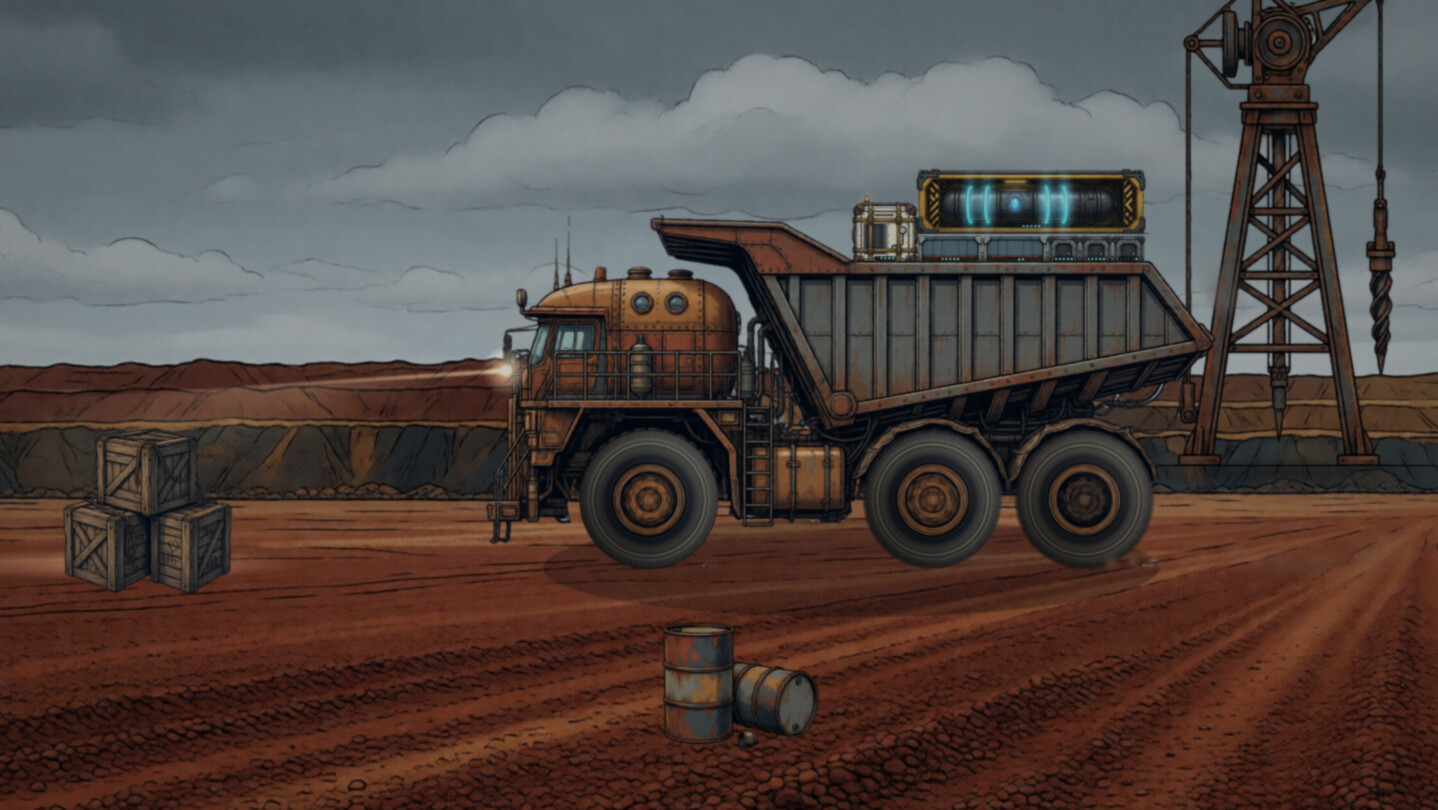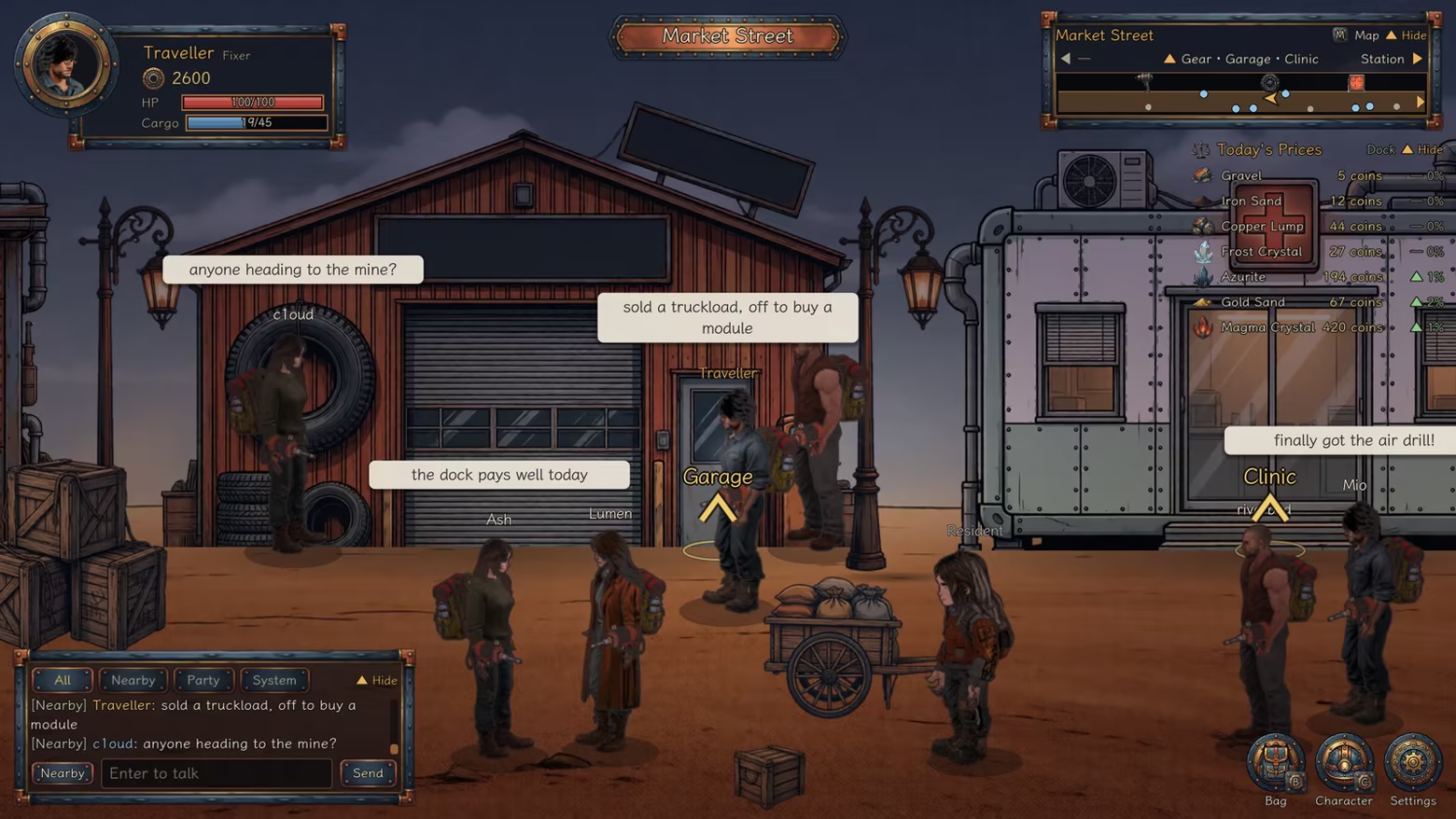

A small online town on a barren planet. Drill ore out of the rock face, haul the crates by truck and tractor beam, sell them at the dock or smelt them down, and fly mining ships out to the big field. Fifty townsfolk keep their own days. Two hand-painted deckbuilding voyages included.

Sign in to add this item to your wishlist, follow it, or mark it as ignored

Buy Farewell


About This Game

Still in active development

Hi. The game is simple, so there is no tutorial. Bugs will happen — tell me, loudly; I fix things often. If it isn't fun, say that too.

A small town on a barren planet

Farewell has three paths on its main menu. The first is the town: red ground, a rock wall, a few streets, and it is online — the other travellers in the street are real players, under their Steam names. You dig ore, load it, haul it and sell it, and the money turns into a better drill, a bigger truck, a storeroom, a smelter, a ship. What you do with the day is up to you.

Four characters to choose from: the Hauler, the Runner, the Shopkeeper and the Fixer.

The rock face: crack, collapse, catch

Out past the GATE is the mine: one long rock face, veins of ore running through its layers, your truck parked at the foot. There are no cards here. Just a drill, and your hands.


  • Crack — hold the drill on a section and a white-hot crack starts to run along the seam. Keep the crosshair on its tip and it runs fast; lose the tip and it only grinds. Hard knots slow it down. Brittle stretches make it jump.
  • Collapse — the middle of a long vein is the keystone. Bring it down and the sections beside it split, and rock comes down from above. The shadows show you where. Get out from under them.
  • Catch — when a slab breaks, chunks of ore fly out. Right-click to catch them in the tractor beam before they land. The ones that hit the ground are gone.

Cut section after section cleanly and the drill speeds up. Eight drill modules each change one thing about it. The Belt Scanner shows dark copper veins hidden in the rock, and rich seams that give double.

Crates, trucks and the tractor beam

The ore drops into crates at the foot of the wall, not into your pockets. Every crate is moved by hand with the tractor beam: lift it, swing it over the truck bed, set it down. Crates come in different sizes and weights, and they stack in layers on the bed.


  • Two trucks: a small one, and a big one with room for the long crates. A truck stays where you parked it.
  • The Heavy Tractor Beam lifts the heaviest crates. In the mine, the Twin Clamp picks up a matching pair at once.
  • Some ore won't wait. Frost crystal starts melting the moment it is dug, and only the storeroom or the dock stops it. Azurite and magma start to resonate the moment they leave the rock — take too long and they blow.

The dock, and what the day pays

Behind the GATE is the Sell Dock. Back the truck into the bay, beam the crates onto the lift one by one, and press the terminal: the plate sinks, and the coins come up. Prices change once every real-world day, the same for everyone. Some days you sell. Some days you don't.


  • Buy a Home Storeroom and stack crates in it until the price is right. (It won't take ore that is resonating.)
  • Set up a Vending Stand at home: anyone who walks in can buy crates out of your storeroom.

A smelter of your own

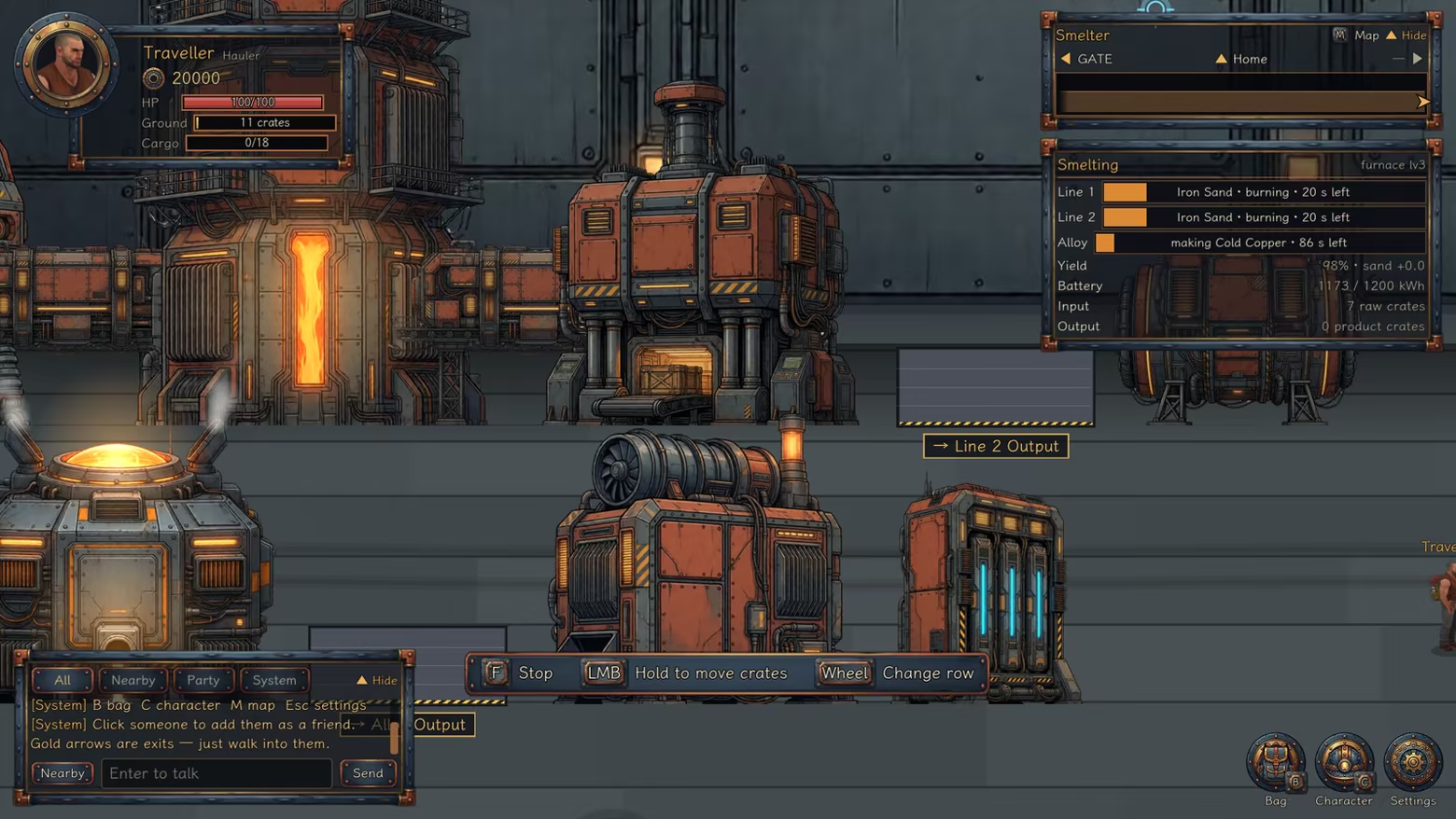
A door in your home's back wall, and a roller door in the GATE, lead to your own smelter: a long hall with a feed table and an output table, and big machines you buy and upgrade one at a time — crusher, smelting tower, packer. Ingots, prisms and cores are worth three times the raw ore or more, though fewer pieces come out than go in. Frost comes out as prisms that no longer melt; azurite and magma as cores that no longer resonate.


  • The dangerous batches need someone at the furnace, keeping the temperature in the green band. The line jams, and someone has to walk over and clear it — two people clear it twice as fast.
  • Slag goes into a silo, and a generator burns it for power.
  • A second line, and an alloy furnace for cold copper and star gold.
  • The line keeps running while you are away, and settles up when you come back.

Mining ships

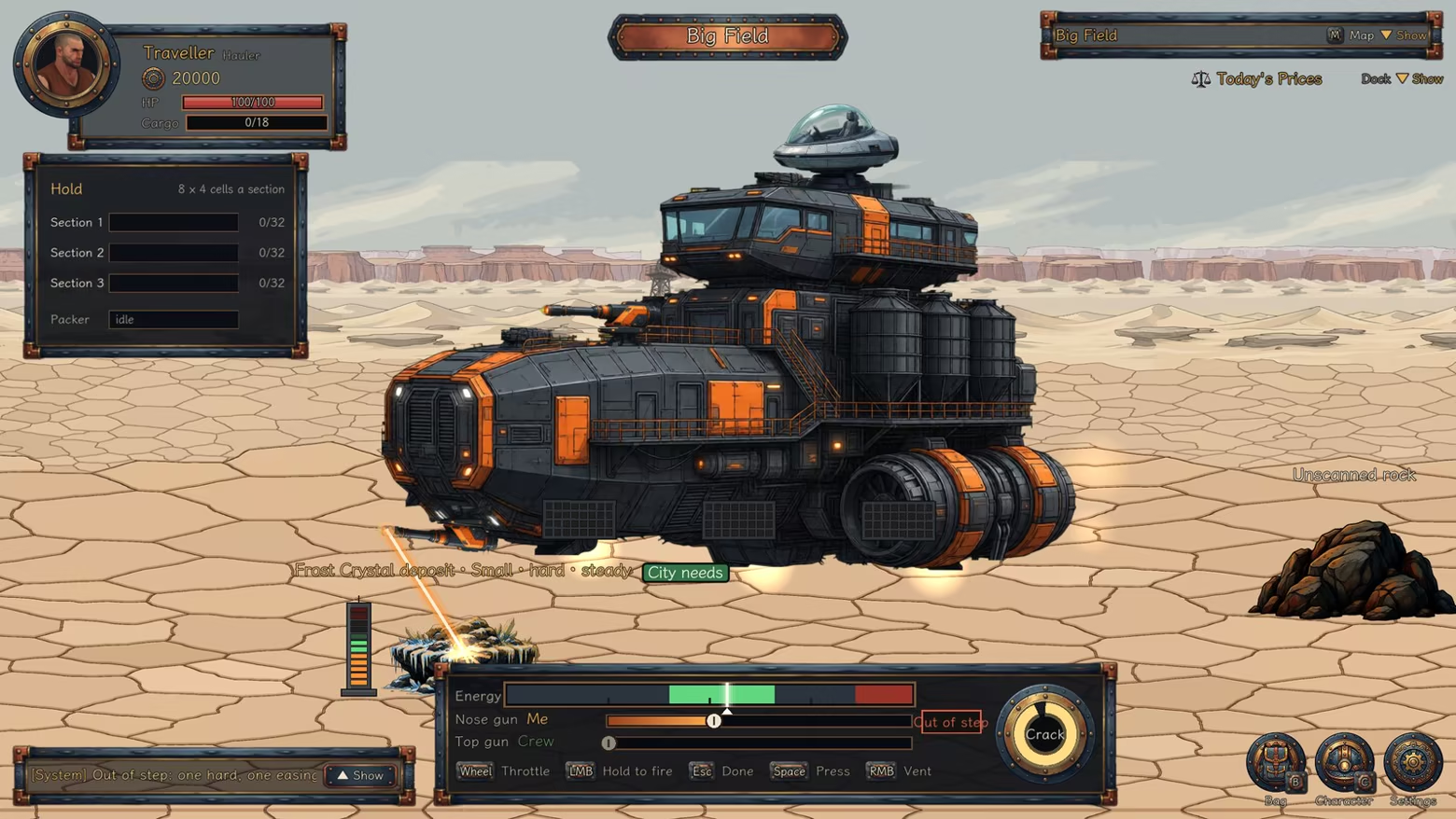
Out through the Hangar's big door is the Big Field: a dry lakebed full of grey-shelled rocks, and nothing tells you what is inside them.


  • Scan — fly low and scan a rock. The grey shell cracks and falls away, and shows you the ore inside — or that there is nothing.
  • Press — fire into the deposit and hold the energy in the green. It goes from cold, to hot amber, to smoking red. Push past it and it overloads: the ship is thrown back and the turret smokes.
  • Take it in — the broken ore is pulled into the ship and packed into crates in the hold.

Fly home and land on a hangar pad, then sell the load, send it to your storeroom, or send it to your smelter. Two ships: the one-seat Beetle, and the Rig — three seats, two turrets and a stabilizer dome, and a big deposit takes both turrets pressing together. Both take parts: laser heads, scanner antennas, packers, an extra hold. Flying alone, one-use stabilizer cards and mining spikes help.

Better with other people

Parties of up to four.

  • Ride in a teammate's truck. When the driver goes through a door, you go too.
  • Load each other's trucks, and beam crates onto the same lift together. Whoever presses Sell keeps the money; a crate belongs to whoever's storeroom it goes into.
  • Dig the same rock face — more people, more ore on the wall. Crew the Rig. Clear the smelter's jams in half the time.
  • Hand money straight to someone: wages for a crew, or chipping in for a ship.

Chat has Nearby and Party tabs. Click another player in the street to add them as a friend.

A town that keeps its own hours

Fifty townsfolk live here, with names, homes and jobs, and more neighbours in work clothes fill the other posts. Each keeps their own day: work, meals, a visit, home to bed — walking from map to map the way you do. Two real hours make one town day, the same for everyone: there is a dusk, a short night and a morning, and the street lamps come on at their time. Now and then someone does something you would not expect, and says why.


On PCs that can run it, a small AI on your own computer decides what each of them does next, so no two towns go quite the same way. Without a capable graphics card they follow their routines instead, and nothing else changes. You can turn it off in the Esc menu.

Also here: two voyages

Farewell began as a hand-painted deckbuilding roguelike at sea. Both voyages are still on the same main menu.

Maiden Voyage — a small boat and twenty cards through three stretches of open sea, with a hard fight at the end of each. The sea changes every few turns: in a Race everything you play lands harder; in Deep Water your Block holds better, but you have one less Energy. Fog hides what your enemies mean to do. Spend Energy to read one of them, or, as the Lamplighter, light the lantern and burn the whole bank away at once. After a fight you go below to the Galley: rest, mend the sail, or cook what you have gathered and pack it into a lunchbox for the next fight. The Galley is the one place on the boat that is entirely yours.

Two people, two decks. The Ballast carries weight and sets it down again and again as damage or Block. The Lamplighter banks the fire and lets it go all at once. There are five endings at the far side.

Long Voyage — the Maiden Voyage's tower climb: twenty floors, one deck across all of them, new enemies, floor guardians, cards and relics. A card that wins the early floors may not get you high; six archetypes only come together if you build for them. One route a day, the same for everyone, and a daily board where you can open other players' decks and see how they built them.

In this build

  • The Town: 7 ores (3 by hand, 4 by ship), 8 drill modules, 2 trucks, 2 mining ships, a smelter with two lines and an alloy furnace, 50 named townsfolk, parties of up to 4, 4 playable characters
  • Maiden Voyage: 148 cards, 39 relics, 22 recipes, 24 enemies, 4 boss fights, 5 endings
  • Long Voyage: 42 more cards, 14 more relics, 25 new enemies including 4 floor guardian fights, 20 floors, a daily route and a global board
  • 19 achievements
  • Hand-painted watercolour at sea, flat inked art in the town. English and Simplified Chinese.

The town is still growing.


[hr][/hr]

This started as a present for one person and turned into a game. You do not need to know who to play it through.

System Requirements

    Minimum:
    • Requires a 64-bit processor and operating system
    • OS: Windows 10 (64-bit)
    • Processor: Quad-core CPU
    • Memory: 8 GB RAM
    • Graphics: 2 GB of video memory, or recent integrated graphics (Intel Iris Xe / AMD Radeon 680M or newer), with OpenGL 3.3
    • Network: Broadband Internet connection
    • Storage: 3 GB available space
    • Additional Notes: 1280x720 display or larger. Keyboard and mouse required. The townsfolk's local AI needs more than this (see Recommended); without it they follow their routines, and everything else plays the same.
    Recommended:
    • Requires a 64-bit processor and operating system
    • OS: Windows 11 (64-bit)
    • Processor: 6-core CPU
    • Memory: 16 GB RAM
    • Graphics: DirectX 12 graphics card with 6 GB of video memory (GeForce RTX 3060 / RTX 4060 class)
    • DirectX: Version 12
    • Network: Broadband Internet connection
    • Storage: 3 GB available space
    • Additional Notes: 1920x1080 display. SSD recommended. Keyboard and mouse required. The townsfolk's local AI runs on your graphics card through DirectML (Windows 10/11): it needs a DirectX 12 card with 2.5 GB of free video memory and 8 GB of RAM, and can be turned off in the Esc menu.
Review Filters