


Guide your state through a fictional industrial world where economic power becomes global influence. Use merchants, companies, politics, intelligence, and trade networks to control the flow of resources and decisions. Conquest is an option; true power lies in controlling the economy.

Daftar masuk untuk menambah item ini ke senarai hajat anda, ikuti atau tandakannya sebagai diabaikan

Bahasa Bahasa Melayu tidak disokong

Produk ini tidak menyokong bahasa tempatan anda. Sila semak senarai bahasa yang disokong di bawah sebelum membuat pembelian

Permainan ini belum tersedia di Steam lagi

Akan datang

Berminat?
Tambah ke senarai hajat anda dan terima pemberitahuan apabila permainan sudah tersedia.
 

Tentang Permainan Ini

About This Game

Armies change borders. Merchants change the world.

Dawn of Imperialism is a real-time grand strategy game about how the Industrial Revolution transformed economic power into global influence.

This is not a game about conquest.

In the medieval world, power was largely tied to land. More territory meant more people, more taxes, and larger armies.

The Industrial Age changed that equation.

Factories demanded raw materials. Growing production required larger markets. Railways, ports, capital, and trade networks became new sources of state power.

Dawn of Imperialism asks a simple question: what truly makes a state powerful?

Its territory?
Its armies?
Its governments?
Or the merchants capable of directing the flow of resources, capital, and trade across the world?

A Fictional Industrial World

Dawn of Imperialism does not depict real countries or historical figures.

The game takes place in a fully fictional world inspired by the Industrial Revolution and the rise of imperialism in the 19th century.

Its states, cities, political parties, merchants, generals, diplomats, and other characters belong entirely to the game world.

Rather than recreating historical events, the goal is to let players experience the economic and political forces that gave rise to imperialism through stories created by their own campaigns.

You Are the State

You do not play as a ruler, dynasty, or political party.

You play as the State itself.

Governments may change. Parties may lose power. Generals may die. Merchants may go bankrupt. Diplomats may shift their loyalties.

The State remains.

Your role is not to directly command every individual character, but to protect the long-term interests of the state through laws, institutions, economics, diplomacy, intelligence, and relationships.

Control the Economy, Control the Power

In Dawn of Imperialism, merchants are not minor characters sitting on the edge of the economy.

They are the carriers of imperial power.

Merchants can:

  • establish companies,

  • accumulate capital,

  • build factories,

  • invest in foreign states,

  • create trade networks,

  • enter strategic industries,

  • build economic influence abroad.

The state can encourage a merchant to enter a particular market or invest in a strategically important sector.

But merchants are not your employees.

They have their own interests, ambitions, and relationships. They may refuse your requests. They may receive support from foreign states. A company that has grown for decades under your protection may eventually become an instrument of a rival power.

A state that understands how to guide its merchants can build lasting influence over foreign economies without ever moving an army across the border.

A Living Economy

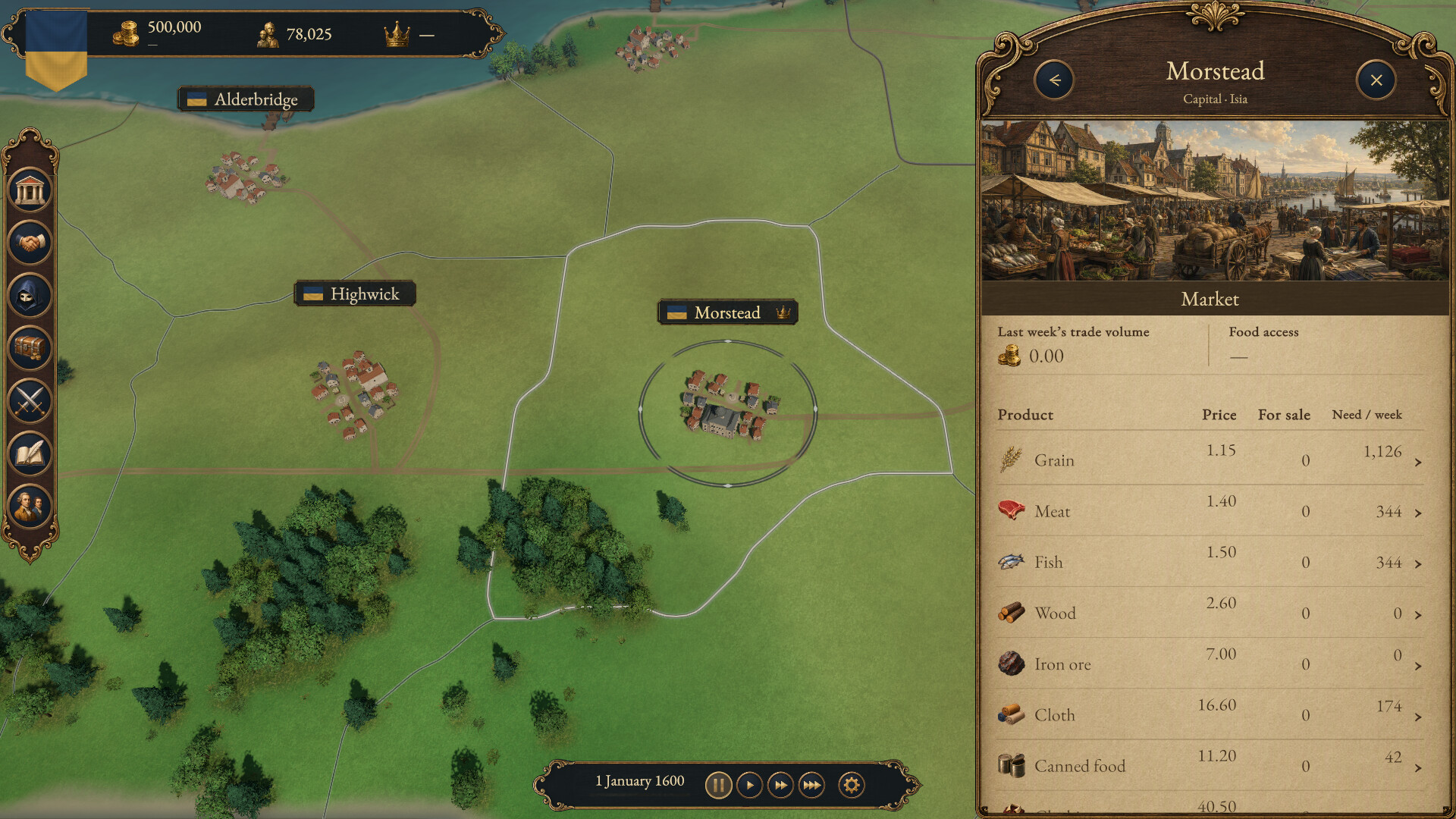
Goods do not magically move through an invisible national market.

Every city has its own:

  • production,

  • storage,

  • market,

  • prices,

  • transport capacity.

Factories require actual raw materials.

If grain is cheap in one city and expensive in another, an invisible system does not automatically balance the difference.

Real merchants and companies do.

They buy the goods, use transport capacity to move them, and sell them in another market.

Roads gradually evolve into railways. Ports connect distant markets. Transport capacity can become just as strategically important as the resources being transported.

A shortage in one city may not simply be caused by insufficient production.

Perhaps the goods are sitting in another city.
Perhaps the railway is operating at full capacity.
Perhaps merchants have found another market more profitable.
Perhaps a foreign state is deliberately disrupting your trade flows.

Politics Is an Extension of Economics

As economic power grows, political power begins to shift with it.

Cities send representatives to parliament. Political parties compete for control. Laws determine the rules surrounding trade, investment, taxation, elections, and military authority.

Even though you represent the State, you cannot simply do whatever you want.

When legitimacy weakens, political opposition may grow, characters may become more willing to reject your demands, and the loyalty of your generals may come into question.

Foreign states are also competing for influence over those same politicians, generals, and merchants.

Intelligence and Intrigue

Sometimes the path to another country's iron mines does not begin with war.

It begins with the right person.

Agents can investigate:

  • merchants,

  • diplomats,

  • generals,

  • party leaders,

  • members of parliament.

You may discover that a merchant is being financed by a foreign state.

You may uncover secret meetings involving a diplomat.

You may learn that a general's loyalty to the government is beginning to weaken.

A rumour may become an intelligence report, and an intelligence report may eventually become hard evidence.

What you discover can be used to:

  • build influence,

  • negotiate,

  • expose secrets,

  • blackmail characters,

  • weaken your rivals.

Living Characters, Dynamic Stories

Important characters have shared personality traits as well as abilities specific to their roles.

Loyalty, morality, intelligence, ambition, and other traits influence how characters behave.

A diplomat's charm and ability to build connections, a merchant's business instincts, or a general's command ability can lead to very different outcomes.

Their relationships and actions can generate dynamic stories throughout a campaign.

Secret meetings, commercial rivalries, foreign support, personal relationships, scandals, betrayals, and political intrigue may all develop as the world evolves.

Selected dialogue, rumours, intelligence reports, and narrative events are dynamically generated by a locally running generative AI system, grounded in the characters' actual traits, relationships, and events taking place within the simulation.

War Is a Tool, Not the Goal

Occupying a country may be easy.

Holding it for decades can be far more expensive.

Your army may need to remain there. Unrest must be contained. New territories may need representation within your political system.

The true reward of war is therefore not always territory.

Sometimes all you need is:

  • the right to exploit a mine,

  • access to a strategic port,

  • favourable trade terms,

  • foreign investment rights,

  • military restrictions,

  • the exclusion of a rival state from a market,

  • a government friendly to your interests.

Your army can leave. Your influence can remain.

Control the Flow, Not the Land

In Dawn of Imperialism, power is not measured only by the size of your borders.

The real question is:

How much of the world's resources, capital, trade, and political decision-making moves in the direction you want?

You do not need to change another country's flag.

If its mines are operated by your companies, its merchants depend on your markets, its government needs your support, and your rivals can no longer reach its resources...

perhaps there was never any need to conquer it at all.

Keperluan Sistem

    Minimum:
    • OS: Windows 10 64-bit
    • Pemproses: Intel Core i5-8400 / AMD Ryzen 5 2600
    • Memori: 16 GB RAM
    • Grafik: NVIDIA GTX 1060 6 GB / AMD RX 580 8 GB
    • DirectX: Versi 11
    • Storan: 15 GB ruang tersedia
Penapis Ulasan