
Your king's life is your currency. Every soldier you summon is carved out of him, and every enemy you kill comes back as blood. No dice, no misses — you see the exact result before you commit. Four kings. One board that keeps growing.

Sign in to add this item to your wishlist, follow it, or mark it as ignored

This game is not yet available on Steam

Planned Release Date: Q1 2027

Interested?
Add to your wishlist and get notified when it becomes available.
 

About This Game


There is one bar on the screen and it is everything: your treasury, your army and your defeat, all at once. Summoning a warrior carves the cost out of your king. Killing an enemy soldier returns their essence to him. Landing a hit on the enemy king does not just wound him — it takes away what he needs to summon.

The whole game fits in one sentence: you bet pieces of your king to take another king's ground.


Damage is fixed. There is no hit chance, no critical roll, nothing to blame. Every attack shows you the exact result before you commit — 8 → 5, or 3 → DEAD. When you lose a piece, you chose to lose it.


You do not travel between maps. Beat a king and the edge of the world falls back, revealing the ground the next one holds. Your king carries whatever life he has left and whatever troops survived. There is no shop, no restock, no reset between fights — the army you finished the last king with is the army you start the next one with.


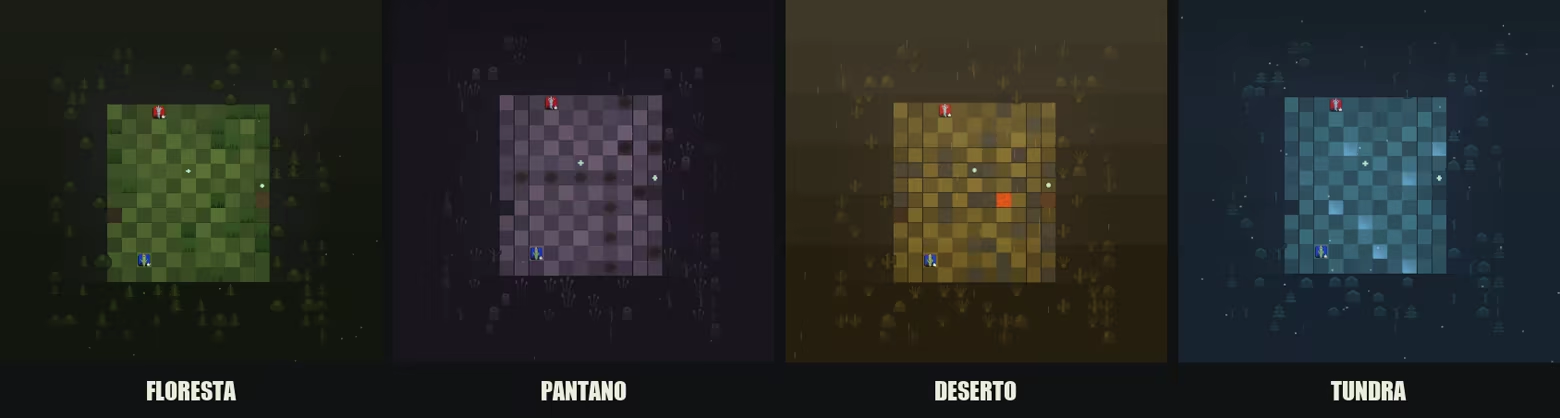
Each region brings its own rule, and none of them is a number:

  • Forest — tall grass blocks line of fire but not movement. Cover you can stand in.
  • Swamp — mud holds your arm: whoever stands in it cannot attack, and a king in it cannot summon.
  • Desert — scorched squares heat up and burn whoever stands there. They always warn you one turn ahead, because a game with no dice does not get to surprise you.
  • Glacier — ice slides any piece that steps on it to the next square, and the next, until it runs out of ice.


  • The Brute marches, hits, and never retreats. Predictable on purpose — he is teaching you the grid.
  • The Miser builds a wall of defenders, hoards his own life and feeds you his wounded.
  • The Rain bleeds you from range and pulls her archers back the moment you close.
  • The Mirror reads what you are building and summons whatever runs over it — and thinks a move ahead.

Their weights were trained, not chosen. Each king's decision-making was tuned by running thousands of simulated games against a target win rate, not by a designer nudging numbers until it felt right. They are as hard as they are supposed to be, and no harder.


After the fourth king, the board is fully open and kings start arriving in pairs — and they fight each other as well as you. Up to four at once, each with a mind of its own. The run ends when your king falls, and only then.


Beat a king and you can play as him for the rest of time. Each of the five reigns changes a rule, not a number:

  • The Glacier — a warrior that kills takes the dead one's square.
  • The Swamp — any defender of yours already shields whoever stands beside it.
  • The Cavern — the arrow finds a way: your archers shoot over walls.
  • The Ossuary — your troops wear the fallen king, inheriting the trait of the last one you brought down.
  • The Goblins — nothing. What you have is what everyone has.


You pick before the first turn and it holds for the whole run. Wrong pick, wrong run.


Every king is offered three ways. The Duel is one king, head on — always the safe read. Their War puts two kings on the board who hate each other more than they hate you. The Siege is one far stronger king, and the territory pays double. The choice changes the battle, never the prize — except when it does.


Undo is a button, not a cheat: a deterministic game owes you the move you meant to make. And twice per campaign the board hides an hourglass — find it and you can rewind an entire round, after you have already seen how it went wrong.


Five troop types, all of them from the first turn. Nothing is locked behind progress — the only gate is your king's life, and it is a real gate. One action per piece per turn — move or attack, never both. Stack four of a kind and the stack learns something new. The depth is in the scarcity, not in a catalogue.

System Requirements

    Minimum:
    • OS: Windows 10 64-bit
    • Processor: Any 64-bit dual-core from 2015 onward
    • Memory: 4 GB RAM
    • Graphics: Integrated graphics with DirectX 11 support
    • DirectX: Version 11
    • Storage: 400 MB available space
    • Additional Notes: Mouse and keyboard required. 1280x720 minimum resolution.
    Recommended:
    • OS: Windows 11 64-bit
    • Processor: Any 64-bit quad-core
    • Memory: 8 GB RAM
    • Graphics: Any dedicated GPU with DirectX 11 support
    • DirectX: Version 11
    • Storage: 400 MB available space
    • Additional Notes: 1920x1080 or higher.