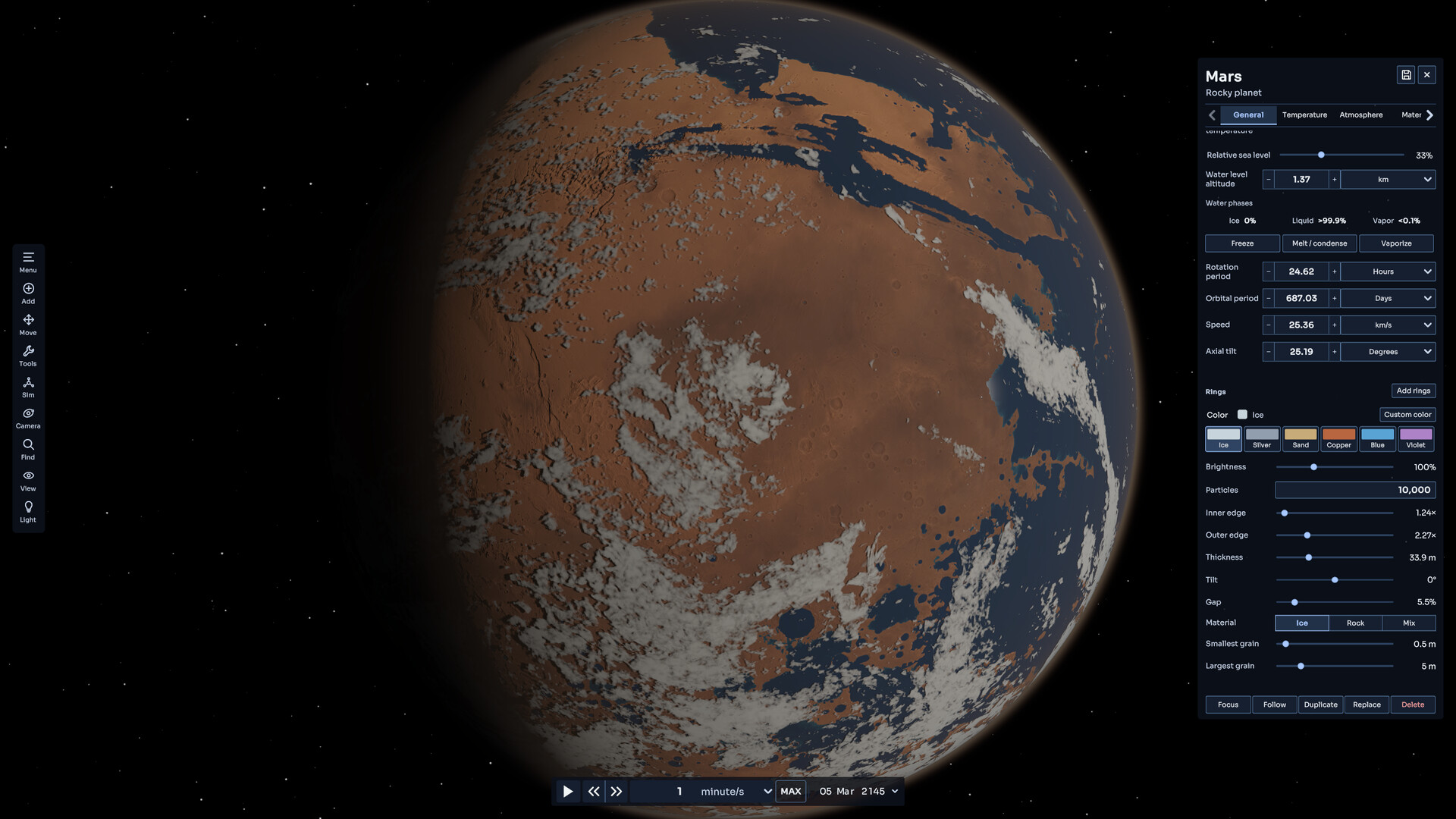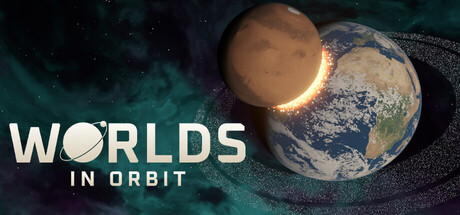

Collide planets and disrupt solar systems in a space simulator built on Newtonian N-body gravity. Create your own worlds, change their mass, rotation, and atmospheres, and watch oceans freeze or evaporate as temperatures change.

Sign in to add this item to your wishlist, follow it, or mark it as ignored

This game is not yet available on Steam

Coming soon

Interested?
Add to your wishlist and get notified when it becomes available.
 

About This Game

Worlds in Orbit is a space simulator where you collide planets, build solar systems, and create your own worlds. Stars, planets, and moons interact through Newtonian N-body gravity, so changing one body can reshape the orbits around it. Change a world’s mass, rotation, atmosphere, or temperature and watch how it responds.

Make your own worlds

Create temperate, arid, frozen, volcanic, cratered, or alien worlds. Start with a procedurally generated world or a bare sphere. Shape mountains, plateaus, canyons, rifts, volcanoes, craters, lake basins, and seabeds.

Forests, grasslands, deserts, wetlands, tundra, and ice give each world its own character. Terrain and surface cover have separate layers, with undo and redo for revising individual regions.

Adjust ocean levels, clouds, and atmosphere, along with your planet’s mass, size, tilt, and rotation.

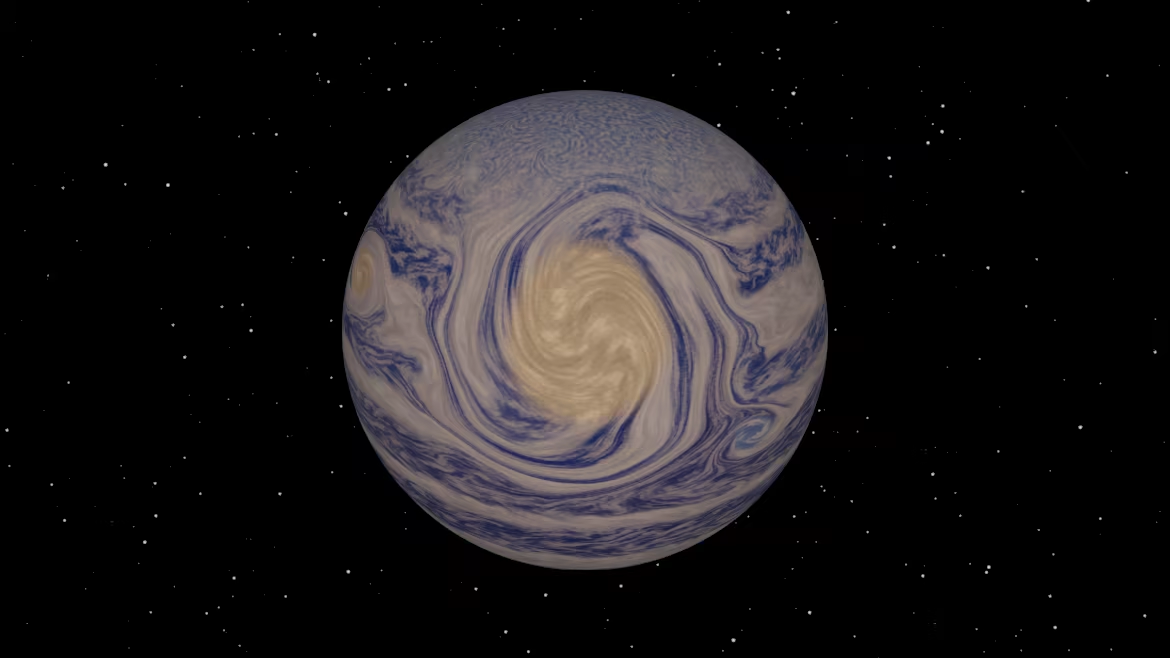
Gas and ice giants have their own editor for cloud bands, colors, and storms.

The worlds you create respond to gravity, heating, cooling, and collisions. Save them to your object library and reuse them in other simulations.

Build your own solar system

Build solar systems from catalog objects and worlds you’ve made, with moons orbiting planets and planets orbiting stars. Each body pulls on the others through Newtonian gravity. Changes to mass, speed, or direction can reshape nearby orbits, lead to captures, or send worlds toward a collision.

Surround planets with rings of ice and rock. Stars have adjustable temperatures, brightness, mass, and size. Black holes can have gas discs that respond to close encounters.

The simulation can be paused, slowed down, or sped up.

A changing climate

A planet’s temperature changes as it receives energy from its star and loses heat to space. Its orbit and atmosphere affect that balance. Surface temperature can also be adjusted directly.

Oceans can freeze, ice can melt, and water can evaporate as conditions change. Atmospheric pressure and gas composition influence these processes. Snow, sea ice, and cloud cover respond too, while vegetation changes color as the world warms or cools.

Water, gases, rock, and metal can be added or removed. Icy and rocky impacts can also deliver new material, changing a planet’s composition.

A habitable zone guide marks where liquid water may be possible, depending on the planet’s atmosphere and surface conditions.

Worlds under stress

Tidal forces during a close encounter can stretch a moon and tear material away, sending fragments onto new paths.

Planetary collisions heat surfaces and throw material into space. The bodies’ sizes, impact speed, and angle affect the outcome. Merging stars can leave a surviving star surrounded by expanding gas.

Rotation also changes a world’s shape. Faster spin can flatten its poles, widen its equator, and shift shorelines as the ocean surface adjusts.

From orbit to the surface

Explore rocky worlds from orbit down to ground level. Descend to mountain slopes, follow coastlines, and see the terrain up close.

Save your simulations and custom worlds to revisit a favorite system, continue an experiment, or compare different versions of it.

AI Generated Content Disclosure

The developers describe how their game uses AI Generated Content like this:

AI assisted with drafting and editing the English Steam store description. The developer reviewed and revised the final text. No AI-generated artwork or audio is used in the game.

System Requirements

    Minimum:
    • OS: Windows 10 21H1 or newer, 64-bit
    • Processor: Intel Core i5-8400 or AMD Ryzen 5 2600
    • Memory: 8 GB RAM
    • Graphics: NVIDIA GeForce GTX 1650 (4 GB) or AMD Radeon RX 570 (4 GB)
    • DirectX: Version 11
    • Storage: 10 GB available space
    • Additional Notes: Requires a 64-bit processor and operating system. Performance and maximum simulation speed depend on the number of objects and simulation complexity.
    Recommended:
    • OS: Windows 11, 64-bit
    • Processor: Intel Core i5-12400 or AMD Ryzen 5 5600
    • Memory: 16 GB RAM
    • Graphics: NVIDIA GeForce RTX 2060 (6 GB) or AMD Radeon RX 6600 (8 GB)
    • DirectX: Version 11
    • Storage: 10 GB available space
Review Filters