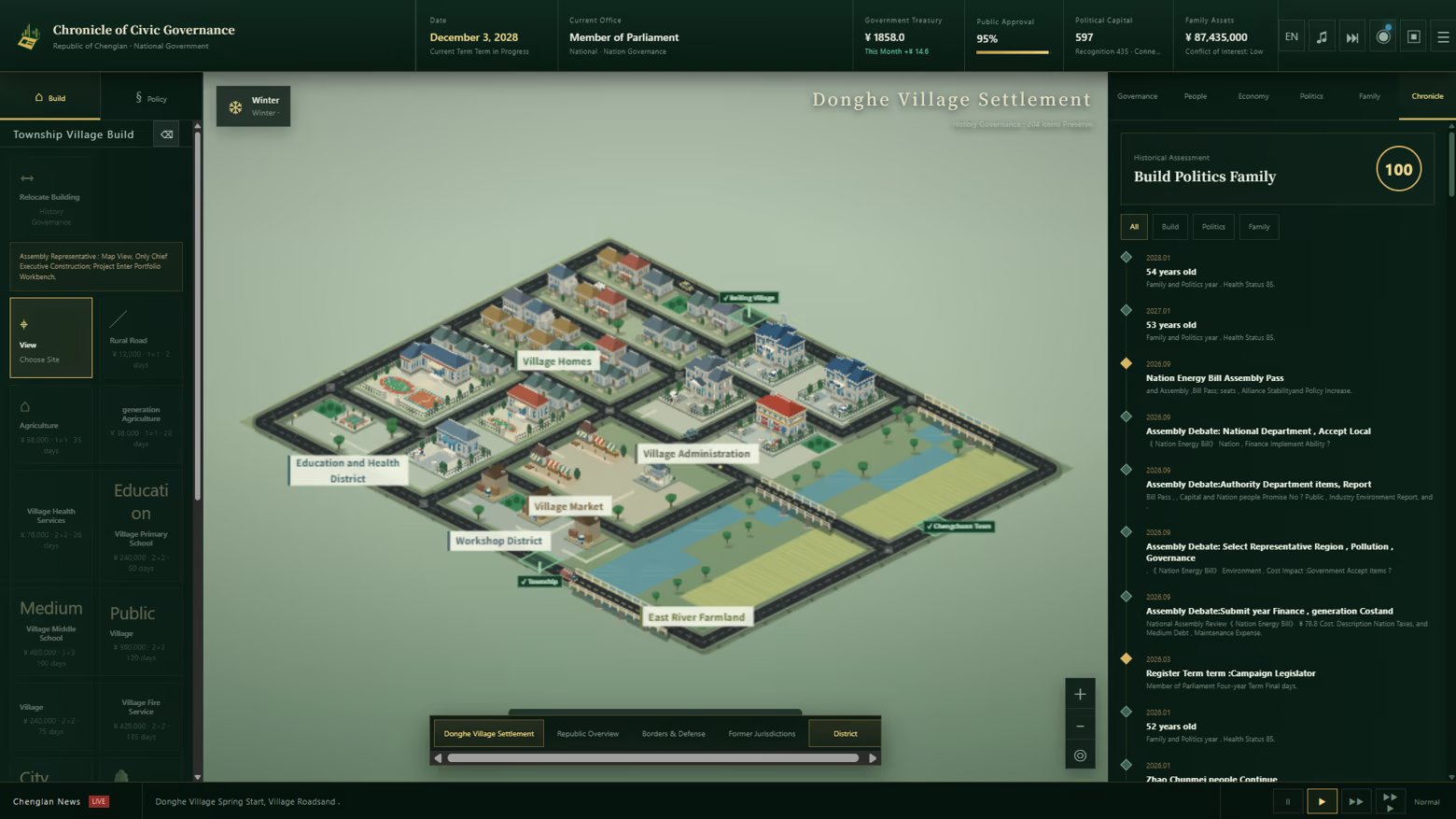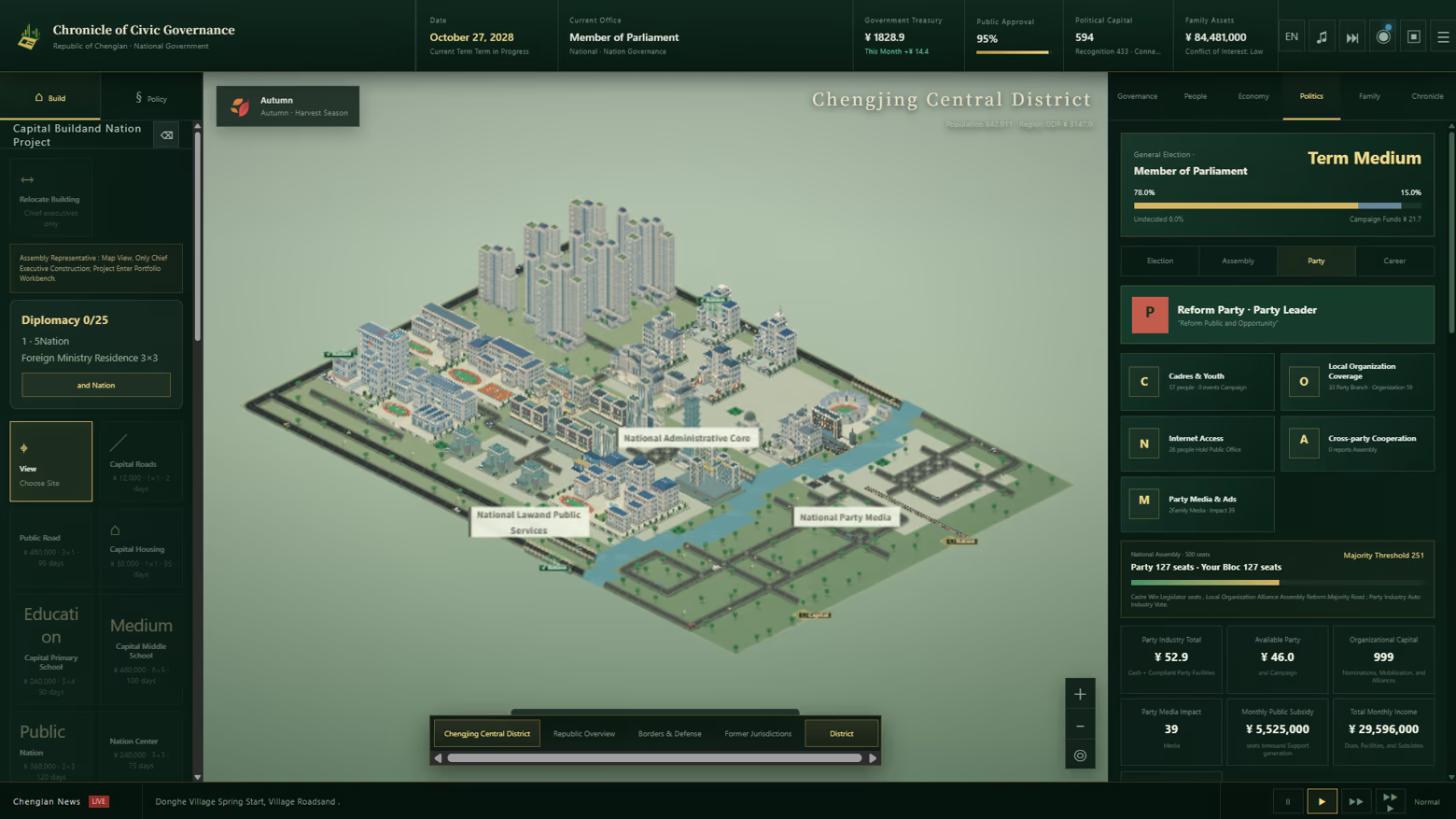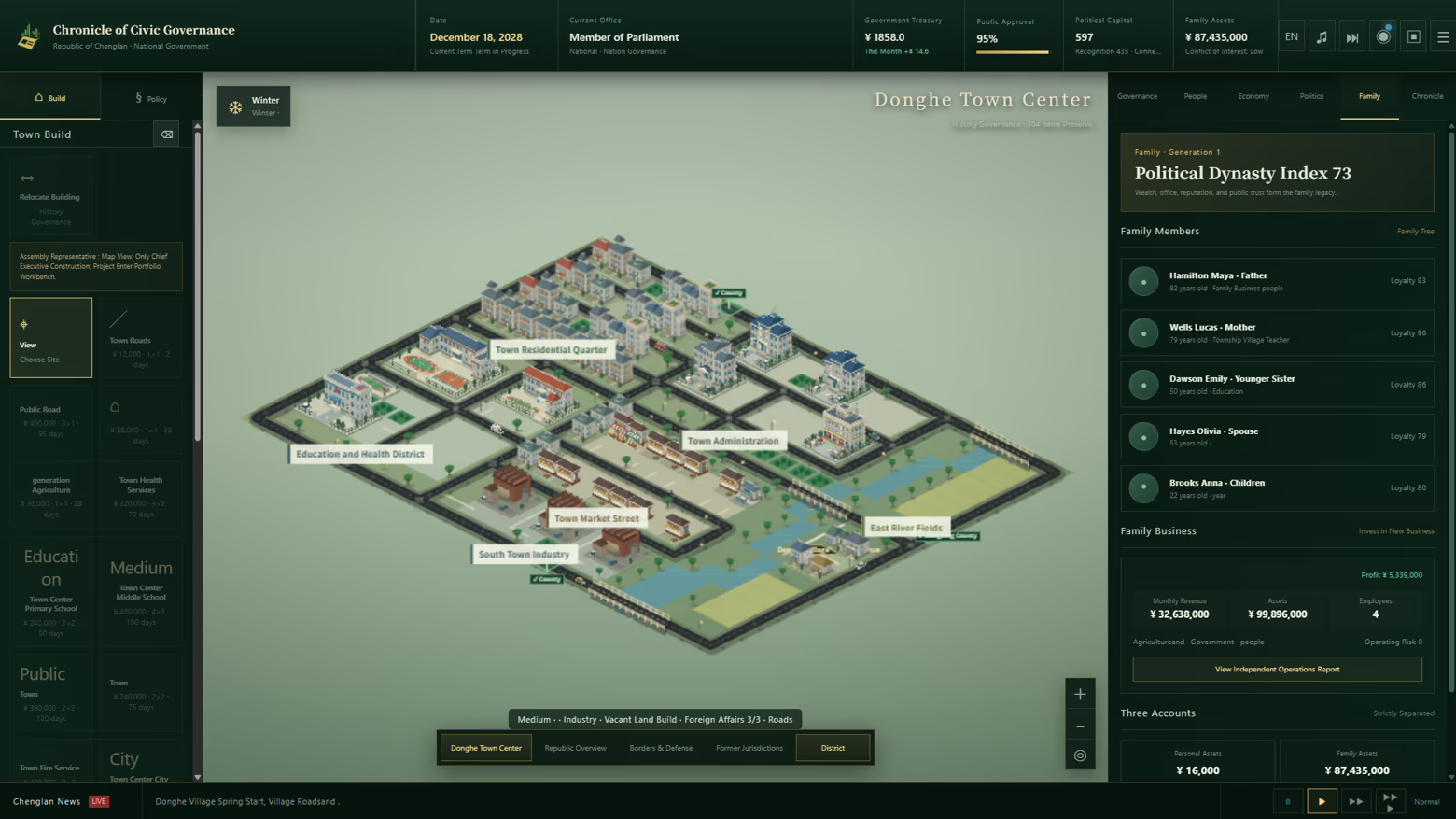


Chronicle of Civic Governance is a single-player simulation of political life, city building, elections, parties, family legacy, diplomacy, and national leadership. Start as a local candidate, win office, shape communities, manage interests, and build a lasting political dynasty.

Sign in to add this item to your wishlist, follow it, or mark it as ignored

Coming Soon To Early Access

The developers of this game intend to release as a work in progress, developing with the feedback of players.

Note: Games in Early Access are not complete and may or may not change further. If you are not excited to play this game in its current state, then you should wait to see if the game progresses further in development. Learn more

What the developers have to say:

Why Early Access?

“Early Access allows us to share the playable foundation of Chronicle of Civic Governance with players while we continue improving its systems. Player feedback will help us refine city building, public affairs, resource management, events, and the overall long-term experience.”

Approximately how long will this game be in Early Access?

“We expect Chronicle of Civic Governance to remain in Early Access for roughly 12 months. Our current target is to move toward the full 1.0 release around October 2027, based on our development progress and player feedback. This is an estimate rather than a fixed promise, and the schedule may change if additional development or refinement is needed.”

How is the full version planned to differ from the Early Access version?

“We plan to expand the available regions, public facilities, events, management systems, character relationships, and long-term development options. We also plan to improve balance, interface clarity, performance, and localization. The final scope may change as development continues.”

What is the current state of the Early Access version?

“The current version provides the core single-player experience, including city building, public affairs, resource planning, elections, organization management, resident needs, and long-term development. Some content, events, interfaces, and systems are still being refined.”

Will the game be priced differently during and after Early Access?

“We plan to launch Early Access at an introductory price that reflects the current amount of content and features. As we add substantial content, expand the game’s systems, and move toward the full 1.0 release, we expect the price to increase gradually. Any price change will be announced in advance. Players who purchase the game during Early Access will continue to own the game and receive the full release.”

How are you planning on involving the Community in your development process?

“We will read player feedback, monitor bug reports, review suggestions, and use community discussions to guide improvements. We plan to share development news through Steam announcements and use future updates to explain major changes.”
Read more
This game is not yet available on Steam

Planned Release Date: Nov 10, 2026

This game plans to unlock in approximately 2 weeks

Interested?
Add to your wishlist and get notified when it becomes available.
 

Report bugs and leave feedback for this game on the discussion boards

See all discussions

About This Game

ABOUT THIS GAME

Every great political career begins with an ordinary road.

It is the spring of 1998 in the fictional Republic of Chenglan. A muddy village road, an irrigation dispute, an understaffed school, and a limited public budget become the beginning of your political life.

In Chronicle of Civic Governance, you do not simply choose policies and wait for numbers to change. You live through an entire political career: meeting voters, campaigning, debating opponents, taking office, building public works, managing budgets, negotiating with legislatures, and deciding what kind of political life you want to create.

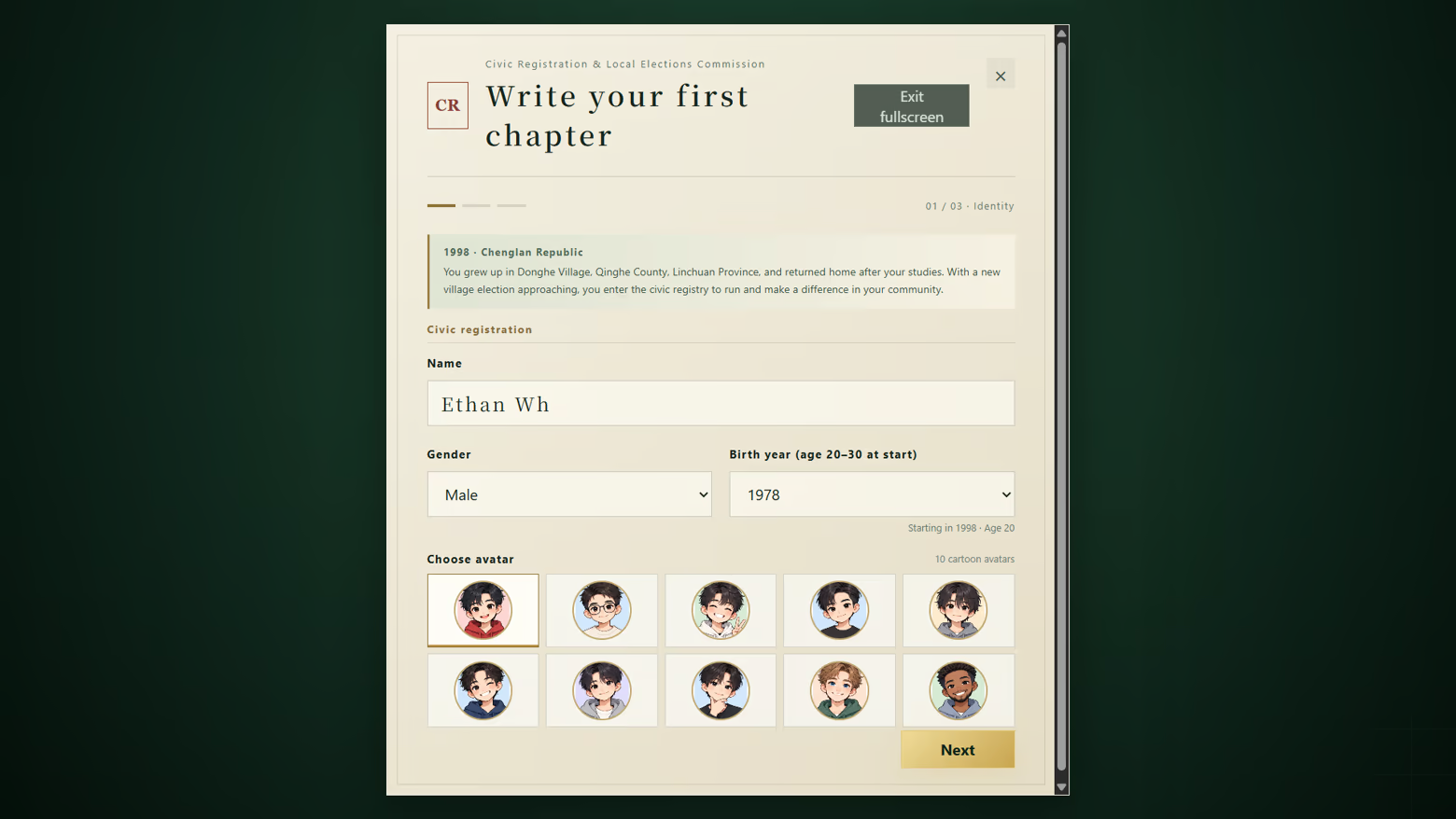
Character Creation

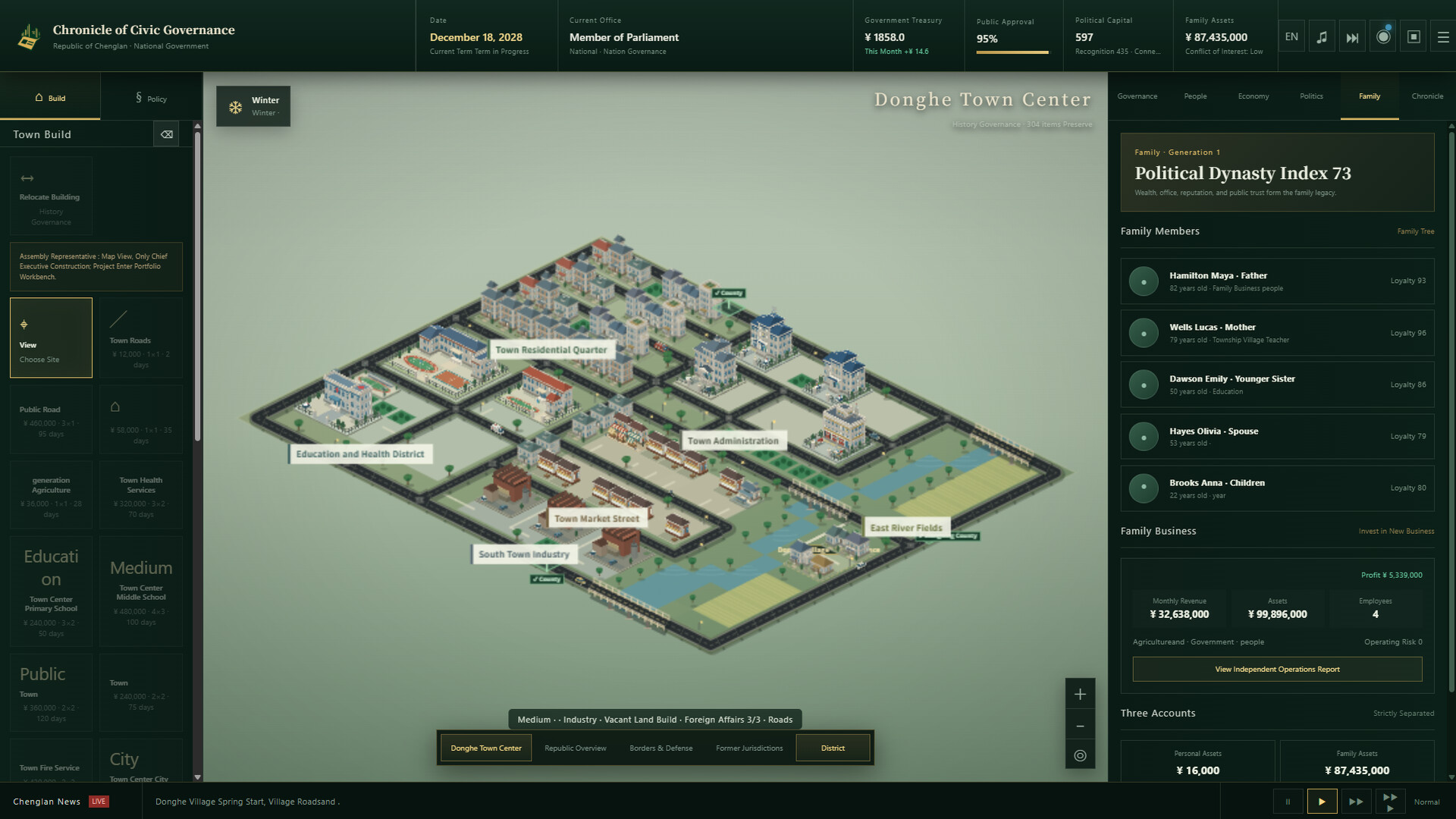
Village Governance & Map

A Career Without a Fixed Ladder

Your career is not a single predetermined promotion route. You can remain in a legislature, seek executive office, accept a departmental appointment, support an ally, challenge a higher-level election, return to local politics, or build a national career.

Candidates, legislators, and executives have different powers. A candidate can campaign but cannot govern. A legislator can question the government, introduce bills, and vote, but cannot directly order construction. Executives control departments and budgets, yet major projects may still require hearings, legislative approval, and public scrutiny.

Elections, Legislatures, and Political Parties

Campaign among different voter groups, organize tours, raise political funds, debate opponents, build recognition, and watch election results arrive. Winning office is only the start of the next political stage.

Inside legislatures, you can introduce bills, answer questions, negotiate support, organize caucuses, and face recorded votes. You may stay independent, join an existing party, or create your own. Develop local organizations, manage party finances, recruit cadres, handle internal factions, build coalitions, and compete for party leadership.

Campaign and Election Management

From a Village to the Central Government

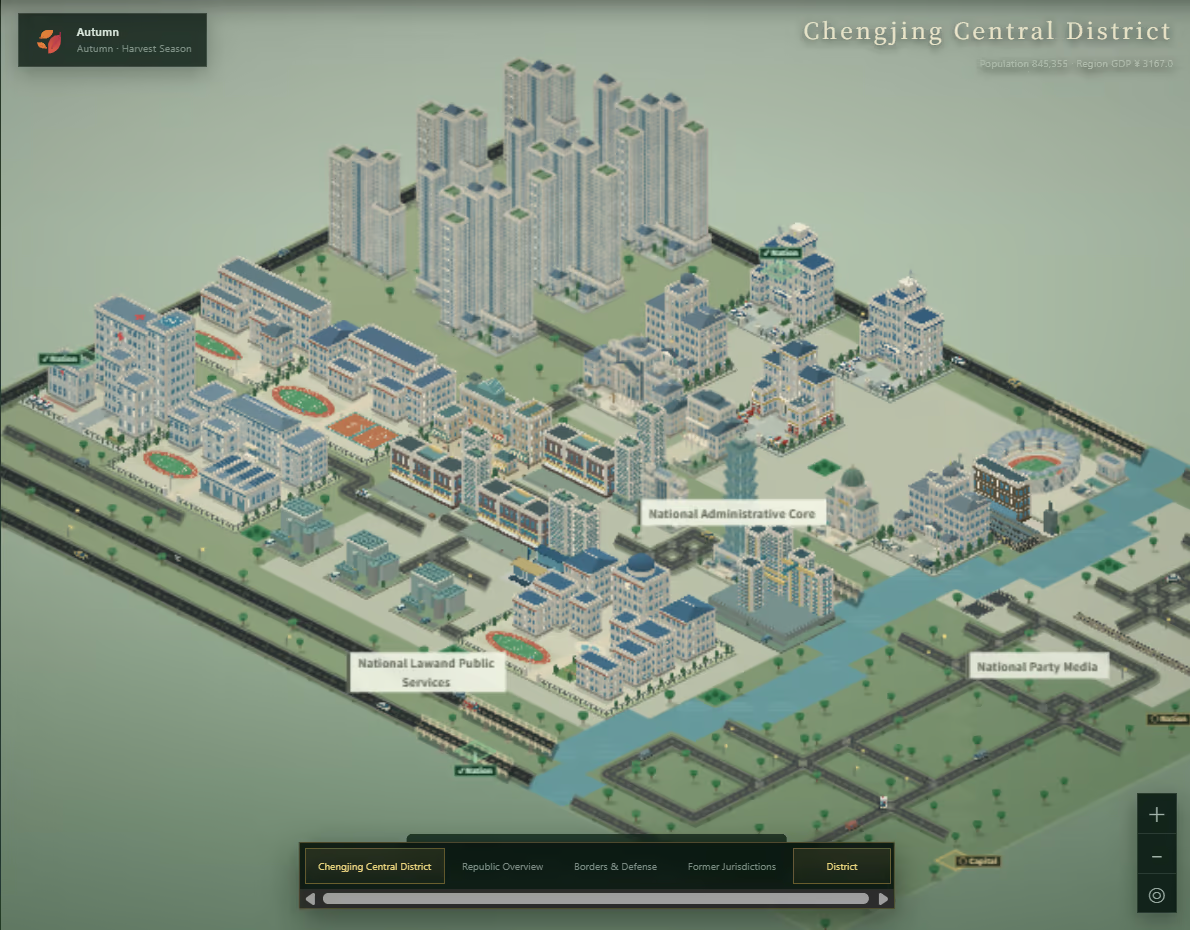
The game contains six connected levels of government: Village → Town → County → City → Province → Central Government. Each step opens a larger playable map, new institutions, new public services, and more complex decisions.

Your world can grow from farm roads, clinics, and primary schools to industrial districts, hospitals, railways, metro systems, universities, airports, regional infrastructure, and national projects. Places you governed earlier remain part of your history instead of disappearing when you advance.

Build and Govern Real Places

Roads, bridges, housing, agriculture, schools, hospitals, police and fire services, commercial districts, industry, rail, metro, universities, airports, and major infrastructure can be built directly on the map.

Construction changes the society around it. Industry may create jobs while increasing pollution. Transit may improve mobility while raising land and housing prices. Public services improve living conditions but create lasting fiscal costs. Every project becomes part of both the place and your political record.

People, Economy, and Public Opinion

Different social groups care about different things. Farmers, young people, workers, business owners, seniors, educators, public employees, and environmental groups can react differently to the same decision.

Track population, GDP, employment, health, education, housing, traffic, inequality, crime, safety, pollution, inflation, government finance, and public approval. Political success is not a single popularity meter: a policy that helps one group may create opposition elsewhere.

Economy and Regional Indicators

Family, Wealth, and Legacy

Your political life continues outside public office. Your family background affects starting wealth, relationships, and social support. Over time you can marry, have children, build family businesses, and create a political family history.

Personal money, campaign funds, and family assets are separated. Private wealth can create opportunities, but it can also create conflicts of interest and public scrutiny. As decades pass, your story can continue through a child or political protégé, carrying the previous generation's cities, projects, allies, controversies, and reputation into a new era.

Family, Assets, and Legacy

National Politics and the Wider World

Reach the central level and the scale changes again. Enter the National Assembly, seek cabinet office, and eventually compete for the premiership.

The fictional world of Azure Planet contains five continents and 125 countries. Follow national power rankings, international relations, neighboring states, trade, sanctions, international organizations, defense, border crises, diplomatic missions, and multilateral summits. At the highest level, succession and leadership transition also become part of the simulation.

Your Decisions Become History

The game records elections, projects, policies, political conflicts, family events, and national decisions. A lost election does not always end a career, and an old road may remain on the map decades after you have moved on.

You are not simply trying to finish a game. You are creating a political history that the world remembers.

System Requirements

    Minimum:
    • Requires a 64-bit processor and operating system
    • OS: Windows 10 64-bit
    • Processor: Intel Core i5 or equivalent AMD processor
    • Memory: 8 GB RAM
    • Graphics: DirectX 11 compatible graphics card
    • DirectX: Version 11
    • Network: Broadband Internet connection
    • Storage: 2 GB available space
    • Sound Card: Windows-compatible sound card
    • VR Support: None
    Recommended:
    • Requires a 64-bit processor and operating system
    • OS: Windows 10/11 64-bit
    • Processor: Intel Core i5 8th generation or equivalent AMD processor
    • Memory: 16 GB RAM
    • Graphics: NVIDIA GTX 1050 or equivalent graphics card
    • DirectX: Version 11
    • Network: Broadband Internet connection
    • Storage: 2 GB available space
    • Sound Card: Windows-compatible sound card
    • VR Support: None
Review Filters