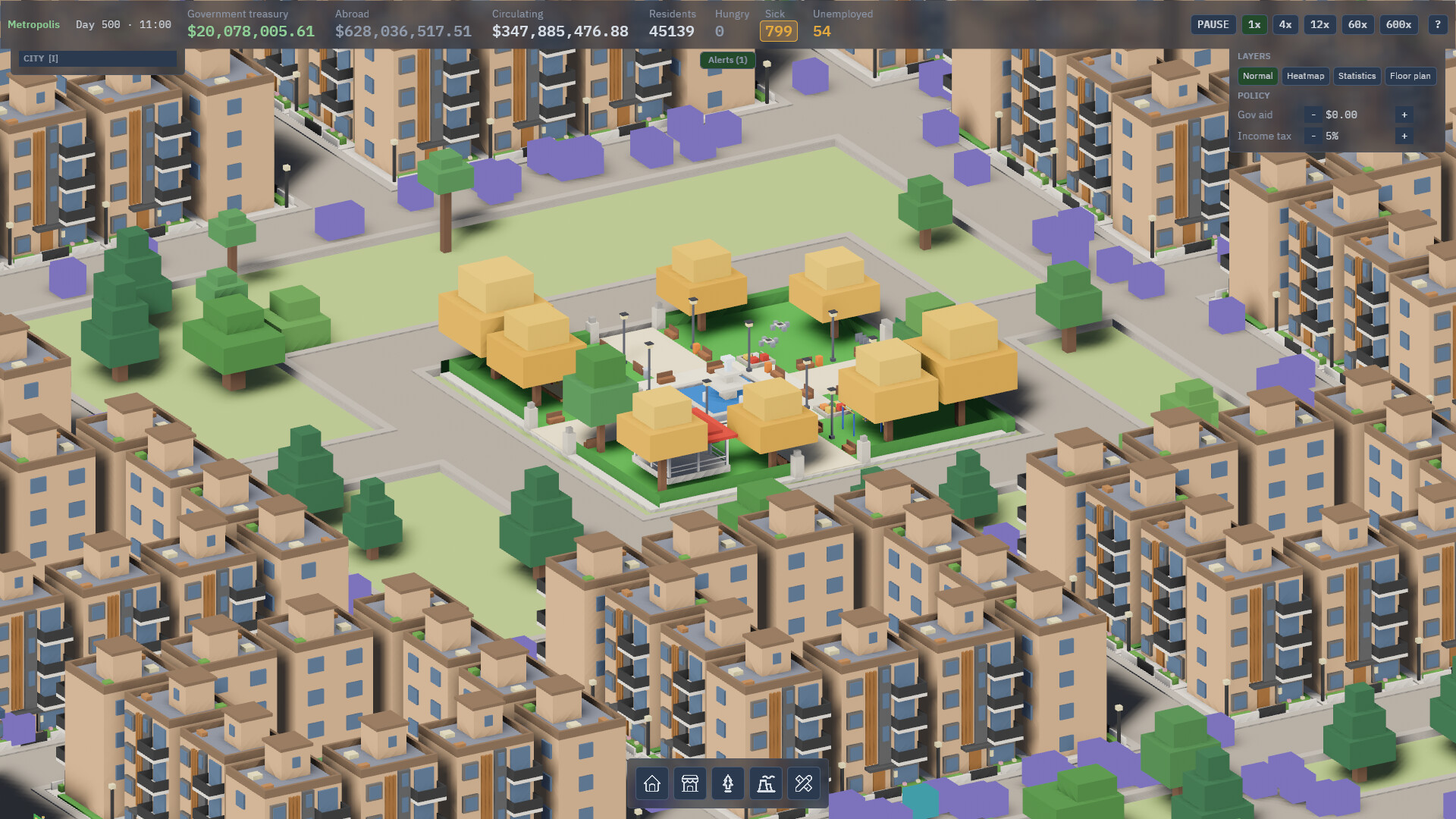


A city where every cent is always in someone's pocket. You don't put up the buildings: you zone the lots, lay the streets and set taxes and welfare. Residents found the businesses, hire, buy and leave. Light up the money map and see which pocket every payment came out of.

Sign in to add this item to your wishlist, follow it, or mark it as ignored

Coming Soon To Early Access

The developers of this game intend to release as a work in progress, developing with the feedback of players.

Note: Games in Early Access are not complete and may or may not change further. If you are not excited to play this game in its current state, then you should wait to see if the game progresses further in development. Learn more

What the developers have to say:

Why Early Access?

“CENTAVO is an economy simulation where every cent is in someone's pocket, and the player's behaviour is part of the experiment. So far the city has been tested with a scripted player that always zones the same way. Real people zone differently, tax differently, and let the city die in ways I didn't foresee. That is what Early Access buys: cities I wouldn't know how to build, and the problems only they reveal. The game is made by one person, and I would rather tune the balance together with the people playing it than alone.”

Approximately how long will this game be in Early Access?

“The estimate is between one year and a year and a half. Leaving Early Access is not tied to a date but to a criterion: the city sustaining itself in the hands of real players, not only the scripted one, and a saved city surviving any update. If that takes longer, the game stays in Early Access longer.”

How is the full version planned to differ from the Early Access version?

“We plan, without promising order or dates:

A real tutorial. Today the progression ladder plays that role: each step unlocks the next brushes, which prevents the fatal early mistakes, but it doesn't yet teach the why behind each thing.

A fuller government panel. Today there are two levers, income tax and government aid. We plan a progressive tax table, social programmes beyond the floor, adjustable service contracts and the arbitration of bids for the large businesses, which today is automatic.

School, police and crime already exist in the engine and arrive at the high steps of the ladder. We plan to adjust when and how they come in based on what the community reports.

Credit. Today the amount of money in the world is fixed. We plan to study loans, which bring back the tension between holding and issuing.

Ambient sound and effects, on top of the soundtrack that already plays. More languages on the page and in the interface as the community asks. Linux and macOS versions once the Windows version is stable.

And the exit commitment: in the full version, a saved city survives any update.”

What is the current state of the Early Access version?

“Playable from start to finish: the city starts empty, climbs the seven steps and can end by exodus, starvation or dry coffers. What the page description says is what exists: zoning and laying streets, residents who found and close businesses, walk, eat, fall ill, marry, inherit and leave, prices that react to stock and queues, every resident's statement with the counterparty of every payment, the heat maps, the statistics screen and the floor plan layer. Interface in Brazilian Portuguese and English. Windows only.

What to expect from Early Access: the balance still changes from version to version, because that is exactly what we are tuning with the people playing. The game saves your city's recipe (the seed and every click) and was designed to survive updates, but during Early Access some rule changes may alter a saved city. When that happens, the game warns you on load: the city is still valid, it just isn't exactly the one you left.”

Will the game be priced differently during and after Early Access?

“We plan to raise the price gradually as the game gains content, up to the full version. Every increase will be announced in advance in the update notes. Whoever joins in Early Access pays less for having joined earlier, and gets the whole game all the way through.”

How are you planning on involving the Community in your development process?

“Through the Steam community hub: discussions, update notes with every version and a monthly state-of-the-game post, with the numbers behind each balance change. When a price, a wage or a rule changes, the note says what was measured and why.

One detail that changes the conversation: a CENTAVO save is a recipe, the seed and every click. Send me your city's file and I reproduce exactly the city you saw, at the point where it broke. Every bug reported with a save is a reproducible bug.

We plan to keep a public beta branch to test large updates before they reach everyone, and a Discord server for those who want to follow closely.”
Read more
This game is not yet available on Steam

Planned Release Date: 2027

Interested?
Add to your wishlist and get notified when it becomes available.
 

Report bugs and leave feedback for this game on the discussion boards

See all discussions

About This Game

Every cent is always in someone's pocket

The city starts empty, and the amount of money in the world is fixed: nobody prints it, nobody erases it. The wage a resident takes home came out of the market's till, which came out of a customer's pocket, which came out of another wage. Every payment has a side that pays and a side that gets paid, and you can open both.

You don't build. You zone and you govern.

  • Lay the streets and zone the lots as Housing, Commerce and Services or Production. The one who buys the lot, pays for the construction and opens the doors is a resident with money and an idea. If the business can't make the numbers work, it closes; you demolish and zone again.
  • Building consumes real materials. Without a hardware store in town, the construction site imports from outside and pays more for it.
  • Two levers of government: income tax and government aid. The public coffers live on taxes and lot sales, and they can run dry.
  • Expropriate buys a resident's house above market price and rehouses the family before the demolition. If there is nowhere for them to go, the family refuses.

People who actually walk

Every resident walks to work, to the market and back home. Nobody teleports, and distance costs time. They get hungry, fall ill and pay the hospital, marry, support their children, grow old and die. A dead resident's house passes to the spouse or a child; a dead owner's business passes to someone who worked there. Those who find neither work nor food leave, and take their money with them. Those who arrive from outside come because there was a job that paid and an empty roof.

Prices nobody programmed

The market buys from the farm and sells to residents, and the price reacts to the shelf and to the queue: an empty shelf gets pricier, idle stock gets cheaper. A town with a single market has queues, and queues turn into hunger. No price is set by decree: the Prices tab shows the history of each one.

Open the city like a ledger

  • Click any resident or building: Wallet, Vitals, Work, Housing, Family and the complete statement, entry by entry. The counterparty of every line is a link: jump to whoever paid or whoever got paid, and follow the chain.
  • Heat maps: Well-being, Income, Land value and Money flow, which lights the map exactly where money is leaving.
  • Statistics for the whole city: Population, Labor, Wealth, Prices, Government, Flows and Social, with series going back to day one.
  • Floor plan layer: the city seen from above, like a blueprint, to read the streets behind the buildings.

From Camp to Metropolis

The city climbs seven steps: Camp, Hamlet, Village, Town, City, Capital and Metropolis. Each step unlocks new kinds of construction to zone and shows the next goal in residents, buildings and money in the city. Note the wording: the goal is how much of the world's money lives in your city, not how much sits in the government's coffers. Full coffers and poor residents don't level up.

And the city can end: by exodus, by starvation, or by coffers that ran dry and never recovered. When it ends, you can restart the same city, with the same seed, and try something else.

Made by one person

CENTAVO is made by a single developer. Everything described on this page is already in the game; what is still going to change is in the Early Access section.

AI Generated Content Disclosure

The developers describe how their game uses AI Generated Content like this:

Interface text and the English translation were drafted with an AI assistant and reviewed by the developer. No art, audio or content is AI generated, and nothing is generated at runtime.

System Requirements

    Minimum:
    • Requires a 64-bit processor and operating system
    • OS: Windows 10 64-bit
    • Processor: Quad-core, 2.5 GHz
    • Memory: 8 GB RAM
    • Graphics: DirectX 12 compatible GPU with 2 GB VRAM
    • DirectX: Version 12
    • Storage: 500 MB available space
    • Additional Notes: The simulation runs on the CPU: more cores let a larger city run smoothly.
    Recommended:
    • Requires a 64-bit processor and operating system
Review Filters