

You manage a youth football team: a high school club in Japan or Korea, or the academy of a professional club in England, Spain or Germany. Each week you choose the training, set the tactics, pick the team and watch the match. Graduates go on to university, the pros and leagues abroad.

Inicie a sessão para adicionar este item à sua lista de desejos, segui-lo ou ignorá-lo

Indisponível em Português (Brasil)

Este produto não está disponível no seu idioma. Confira a lista de idiomas oferecidos antes de comprar.

Este jogo ainda não está disponível no Steam

Em breve

Despertou o seu interesse?
Adicione à lista de desejos e avisaremos quando for lançado.
 

Sobre este jogo

You manage a youth football team and develop your players. Choose where you start: a high school club in Japan or Korea, or the academy of a professional club in England, Spain or Germany.

■ Five countries

In Japan and Korea you manage a high school club. Japan has the prefectural leagues, the summer tournament and the winter championship. Korea has the first-half and second-half weekend leagues and the national tournaments.

In England, Spain and Germany you manage the academy of a professional club. You choose the parent club's division (first to fourth) when you start. The academy's budget comes from the parent club and rises and falls with its results. Strong players sign professional contracts with the first team, and you can sign players from other academies.

Each country has its own calendar, competitions, school years, player names and venues.

■ Training

You choose a training session each week — technique, physical work, tactical understanding, set pieces, a practice match, or rest. What you pick decides which attributes come on. Players who build up fatigue get injured more easily, and players who rest too much stop improving.

■ How players develop

Every player has his own growth curve (early, normal, late) and his own ceiling. In one-to-one coaching you either bring on a whole group of attributes or narrow it to a single one. Players pick up special abilities that show up in matches, and some have an ability of their own — those get a nickname that stays in the club's records after they graduate.

■ Matches

Eleven players move on the pitch by themselves, guided by your tactics and team selection. Free kicks build a wall according to the distance and the angle. You can watch from the broadcast, overhead or dynamic camera, or skip ahead to the result. Goals, assists, shots, tackles, saves and a mark out of ten are recorded for every match, and each player's profile shows his average mark and recent form.

■ Tactics

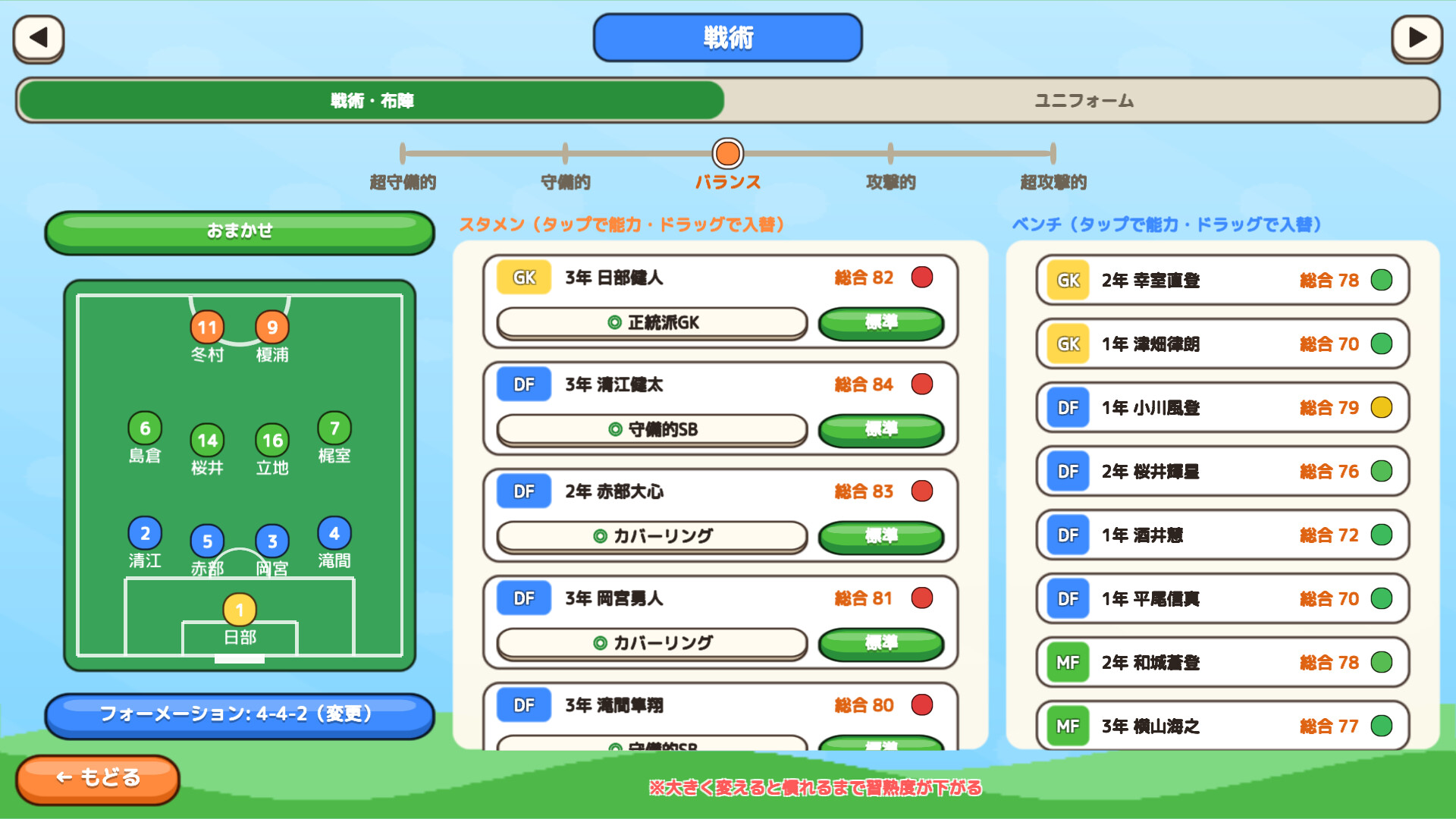
You set the formation, how high the defensive line sits, how hard the team presses, and the tempo in attack. You can also put a man-marker on a particular opponent.

■ Leagues and tournaments

In Japan, the 64 schools in your prefecture play across three divisions, with two regional leagues above them. Teams are promoted and relegated on results. The two leagues above also take the youth sides of professional clubs. The summer tournament and the winter championship are for schools only: win the prefectural qualifiers and you go through to the nationals. Each of the 47 prefectures has its own level.

■ The national team

There are U-17, U-20, U-23 and senior tournaments. You can see the draw, the results of every match including those between other countries, the tables and the brackets. A player who is called up leaves your squad for a few weeks. His caps and goals are recorded at each age group.

■ Academy World Championship

Win the domestic treble in one season and you are invited to the Academy World Championship, where you play the academies of foreign clubs.

■ After they leave

Graduates go on to university, to the three domestic divisions, or to leagues in 24 other countries. The alumni list follows their season-by-season record, transfers, honours, market value, caps and retirement. Some carry on at amateur clubs after university. Old boys who make it as professionals donate to the club and come back to help with training.

■ Running the club

You manage the funds, the squad's morale, the facilities, scouting and prize money, and you decide how the money is spent — facilities, trips, scouting. Events happen according to what the club has achieved, such as donations from old boys and invitations to play other teams.

■ Languages and currency

The game is in English, Japanese, Korean, German, Spanish and French. You can choose whether money is shown in yen, won, pounds, euros or dollars.

■ Saves and records

There are three save slots, so you can run teams in other prefectures or schools at the same time. Saves sync to Steam Cloud. The Hall of Fame keeps your career record as a manager even if you delete a save. There are 38 achievements.

Every school, player, club and tournament in the game is fictional. Any resemblance to real people, organisations or competitions is unintended.

Divulgação de conteúdo gerado por IA

Descrição dos desenvolvedores sobre como o jogo usa conteúdo gerado por IA:

Some of the store artwork, the game icon and some sound effects were created with generative AI tools and then edited by hand before release. The simulation, the program code, the 3D models and the text in the game were made without generative AI. Nothing is generated by AI while you play.

Requisitos de sistema

Windows
macOS
    Mínimos:
    • Requer um processador e sistema operacional de 64 bits
    • SO: Windows 10 64-bit
    • Processador: Dual core 2.0 GHz
    • Memória: 4 GB de RAM
    • Placa de vídeo: DirectX 11 compatible (integrated GPU is fine)
    • DirectX: Versão 11
    • Armazenamento: 1 GB de espaço disponível
    • Outras observações: 1280x720 or higher. Mouse required.
    Recomendados:
    • Requer um processador e sistema operacional de 64 bits
    Mínimos:
    • SO: macOS 11 Big Sur or later
    • Processador: Apple M1 or Intel Core i5
    • Memória: 4 GB de RAM
    • Placa de vídeo: Metal compatible (integrated GPU is fine)
    • Armazenamento: 1 GB de espaço disponível
    Recomendados:
    Filtros de análises