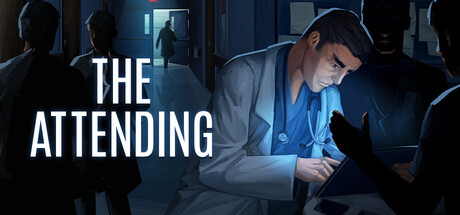

You are the attending on the night shift in an emergency department. Your doctors work the cases and bring you their plans to sign. Read the chart, find the patient who is sicker than the workup says, and decide which of your doctors you trust.

Sign in to add this item to your wishlist, follow it, or mark it as ignored

Download The Attending Demo

This game is not yet available on Steam

Planned Release Date: To be announced

Interested?
Add to your wishlist and get notified when it becomes available.
 

About This Game

The board

The Attending is a management sim about one night shift in an emergency department. You don't build anything. You run the board. You put patients in beds, give cases to your doctors, and sign the plans that send people home or upstairs.

Your doctors

You work with six doctors, and each one has their own speed, habits and blind spots. Some sign fast and sound sure. Some take longer and tell you when they aren't sure. When one of them brings you a discharge, the chart shows what they did and what they skipped. If you sign the wrong one, the debrief shows the minute you signed it.

Stepping in

You can take a case over or order a test yourself. If you were right, that doctor trusts you more. If you were wrong, you lose some of their trust, and you will need it later when the board is full and someone is at the lockers with their coat on.

The rest of the night

Two patients come in drunk after a fall, and one of them is bleeding inside his skull. A family at the desk knows something the triage note missed. A doctor closes the curtain and tells you about a dose they doubled. Your doctors have their own problems tonight too, like a father in a bed upstairs or a son at home with a fever.

  • Each patient's diagnosis is set before the shift starts. The serious cases get worse over time, and you can pause whenever you want.
  • Signing off is the core skill. You read the workup, decide what still needs checking, and live with the result.
  • Some cases come in pairs. A kidney stone and a torn aorta arrive with the same complaint, and only the workup tells them apart.
  • The debrief rebuilds every miss to the minute. It shows when the finding went on the chart and when the discharge was signed.
  • Admitted patients wait in their ER bed until a bed opens upstairs. You can call the bed manager to move one along, and the call costs you minutes.
  • 28 dilemmas, each written for a moment in the shift, like an argument at the desk, a doctor walking out, or a family that wants a transfer to another hospital. Each one costs time, trust or both.
  • Up to three featured patients a night. Some bring a family member, and the debrief tells you how each one ended.
  • 28 kinds of patient, from a toothache to a ruptured ectopic pregnancy.
  • Each night is generated and plays in one sitting.

Character portraits by John Dervishi. Hospital artwork, key art and logo by Angela Reyes-Cole.

AI Generated Content Disclosure

The developers describe how their game uses AI Generated Content like this:

AI tools helped create and edit portions of the game's written content, including case text and dialogue. The instrumental music was generated with Suno and edited for the game. Some short sound effects were synthesized with code developed with AI assistance.

The six character portraits are human-made artwork by John Dervishi. The hospital background, key art and logo are human-made artwork by Angela Reyes-Cole. The game does not generate content with AI while you play.

System Requirements

    Minimum:
    • OS: Windows 10 (64-bit)
    • Processor: Any 64-bit dual core processor
    • Memory: 4 GB RAM
    • Graphics: Graphics hardware and drivers supporting OpenGL 3.3.
    • Storage: 500 MB available space
Review Filters