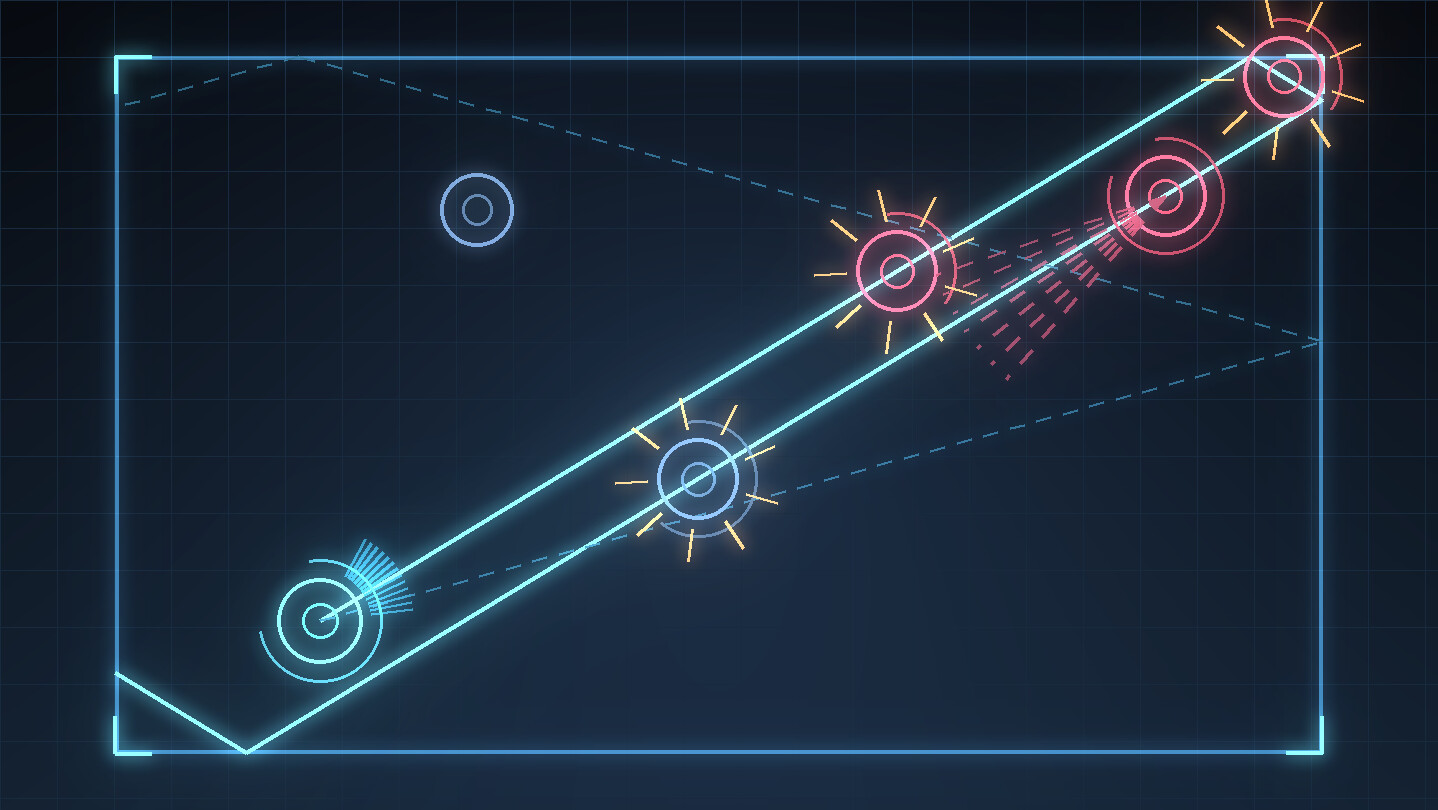


Turn-based tactics on pure elastic billiard physics. One impulse per turn, then everything collides: your pieces, theirs, the furniture. You don't aim at an enemy, you aim at a chain. The sim is fully deterministic, so every turn is a geometry problem — knowable, not lucky.

Sign in to add this item to your wishlist, follow it, or mark it as ignored

This game is not yet available on Steam

Planned Release Date: Oct 16, 2026

This game plans to unlock in approximately 4 weeks

Interested?
Add to your wishlist and get notified when it becomes available.
 

About This Game

]One impulse. Then physics has the floor.

A turn is a single push. After that the table resolves itself — your pieces, the enemy's pieces

and the furniture, all colliding under one elastic solver. You do not target an enemy. You pick

the angle that starts the chain, and the chain does the killing.

Deterministic to the last integer

The simulation is integer fixed-point from top to bottom, with a fixed substep and continuous

collision. No floating point anywhere below the presentation layer. The same shot on the same

board gives the same result on every machine, forever — which is what makes a solution something

you can share, a daily puzzle something everyone plays identically, and "fewest turns" a

leaderboard that means something.

The preview is the game

The aim line is not an approximation of the physics. It is the physics: one call into the same

solver, run ahead of time. There is no second predictor that could ever disagree with what the

pieces actually do. What you see drawn on the table is what will happen.

Aim at the chain

Damage scales with depth in the carom, so the strongest play is always the longest one. Hitting

your own piece is not a mistake — it is how you move momentum somewhere you cannot reach — but

it costs you, so it is a trade rather than a free ride. Mass makes a piece a shover or a

traveller. A bumper is just a wall with restitution above one; a mud bank is one below.

The enemy shows you its shot — and is held to it

At the end of its phase the enemy commits: a piece, a power, an arc, drawn on your table for the

whole of your turn. So you can answer it geometrically. Block the line. Shove the shooter out of

it. Rearrange the board until their shot lands on their own pieces. Kill the shooter and the turn

is simply gone. The exact angle inside that arc stays theirs, which is what keeps them dangerous

instead of a turn behind.

A quantised wheel, not a lottery

720 directions and 8 power steps. Past the third reflection a free analog aim is a coin flip you

cannot reproduce; discrete steps make it a tool you nudge and read — and make a turn a finite

search space the game itself can reason about.

Built on that

  • Handmade campaign encounters, each one rated by a bot that exhausted the search space.

  • Daily board — the same board for everybody, scored on turns taken.

  • Shareable solutions: a short code replays your exact shot on anyone's machine.

  • Attract mode that plays the game for real, not a video.

System Requirements

Windows
SteamOS + Linux
    Minimum:
    • OS: Windows 10 64-bit
    • Processor: Dual-core 2.0 GHz
    • Memory: 4 GB RAM
    • Graphics: Vulkan / OpenGL 3.3 capable, 1 GB
    • Storage: 500 MB available space
    Recommended:
    • OS: Windows 11 64-bit
    • Processor: Quad-core 3.0 GHz
    • Memory: 8 GB RAM
    • Graphics: Dedicated GPU, 2 GB
    • Storage: 500 MB available space
    Minimum:
    • Additional Notes: 1280x720 minimum
    Recommended:
    • Additional Notes: 1920x1080, 60 Hz
Review Filters