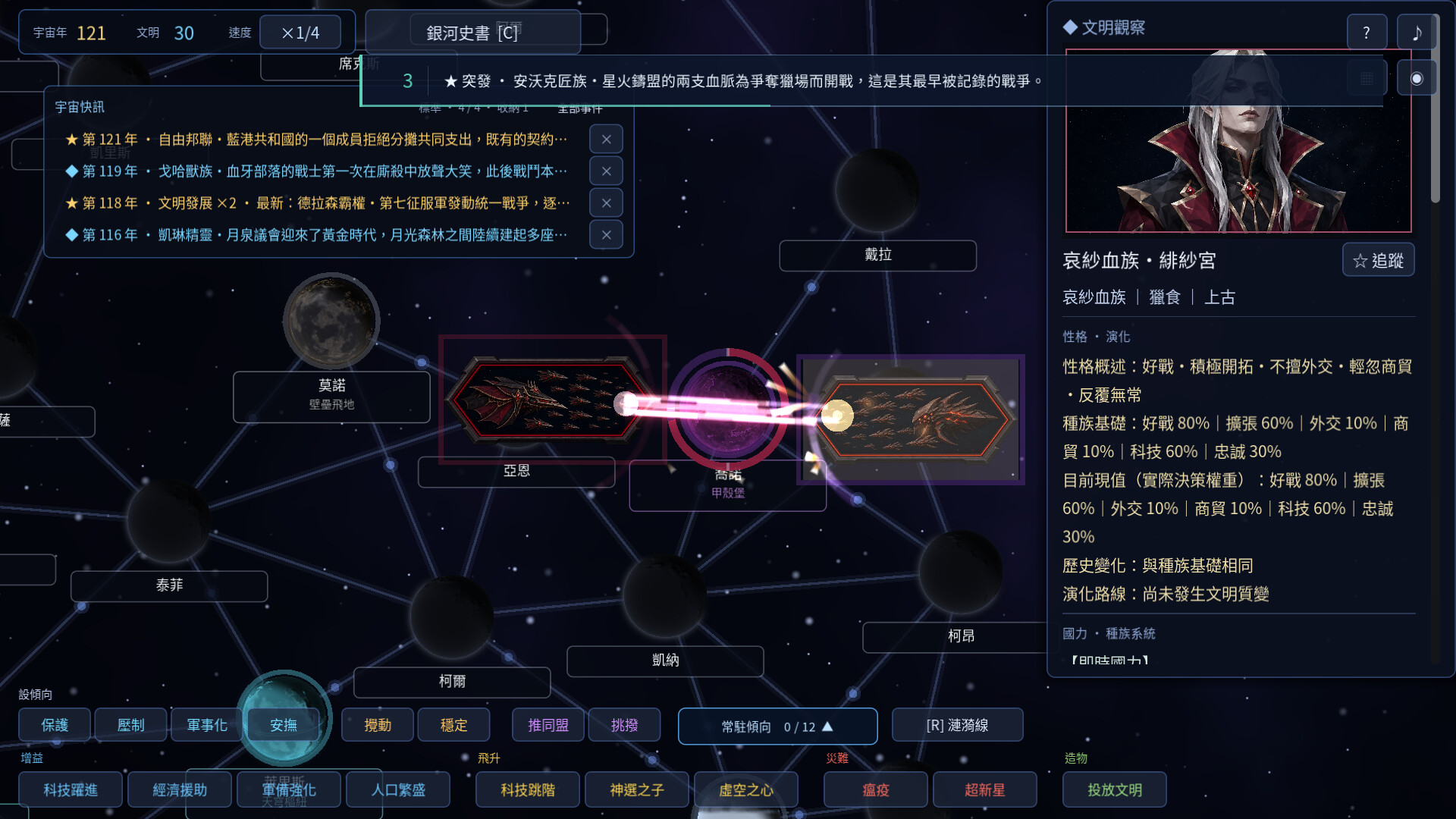


The Stars Are Never Still is a 2D space sandbox. Shape a galaxy and watch 16 unique races colonize, trade, ally, betray and wage war. Observe, or intervene with technology, aid, discord, disasters, new life—even black holes. Chronicle millennia of history. No set goals. No empire lasts forever.

Sign in to add this item to your wishlist, follow it, or mark it as ignored

This game is not yet available on Steam

Planned Release Date: Apr 1, 2027

This game plans to unlock in approximately 6 months

Interested?
Add to your wishlist and get notified when it becomes available.
 

About This Game

Build a Galaxy and Witness Civilizations Rise and Fall

The Stars Are Never Still is a 2D sandbox game about observing civilizations across the cosmos. Instead of playing as a single empire, you take the role of a cosmic observer—creating a galaxy and watching its civilizations develop, expand, form alliances, trade, wage war, and ultimately rise to prosperity, fracture, or disappear.

You can quickly generate an entire galaxy, manually arrange its civilizations and worlds, or use the race editor to customize existing races—including their names and portraits—before introducing them into the universe to see how they reshape history.

16 Unique Races

The galaxy is home to 16 original races, each with its own personality, development priorities, diplomatic behavior, fleet doctrine, ground combat capabilities, and defining traits.

They make their own decisions based on the situation around them: competing for frontier territory, forming alliances, betraying former partners, developing trade, declaring war, conquering worlds, or rising again after losing their homeland.

  • Gnathim Star-Eater Swarm: An interstellar swarm that reproduces by consuming biomass. Its individual fleets are relatively weak, but war and conquered worlds allow it to replenish its forces at remarkable speed.

  • Tesseron Purifiers: Ancient machines devoted to the extermination of organic life. They reject diplomacy and transform conquered worlds into cold mechanical domains.

  • Orrery of Order: Intelligent machines dedicated to maintaining order throughout the galaxy. They excel at protecting weaker civilizations, forming alliances, and restoring worlds devastated by war.

  • Mournveil Bloodkin: Cosmic predators who regard other civilizations as prey. They replenish their strength through raids and retreat from the battlefield by vanishing into crimson mist after a successful hunt.

  • Sorrowkin: Dark elves whose power is sustained through enslavement and tribute. Their subject states can provide enormous military strength, but constant oppression may also provoke rebellion.

  • Gorhak Clans: A warlike people born for battle. They seek powerful opponents, launch repeated raids, and grow stronger through prolonged warfare.

  • Drathan Hegemony: A disciplined human military empire. It excels at conquest, administration, and establishing vassals, although excessive expansion places an increasing burden on the empire.

  • Myrandi Hunters: A warrior civilization that values honor and ritual hunts. They prefer opponents of equal or greater strength and use victory to forge elite fleets.

  • Caelyn Elves: High elves devoted to arcane knowledge and the perfection of civilization. They concentrate their efforts on a small number of highly developed worlds and can uncover powerful knowledge within ancient ruins.

  • Aevum Transcendants: Cybernetic humans who transform themselves through technology. They can sacrifice part of their military strength to undergo ascension, gaining a lasting technological advantage.

  • Gravenkind: Slow-growing but extraordinarily resilient lithoid lifeforms. They rarely start wars, but can transform mature worlds into fortresses that are extremely difficult to conquer.

  • Anvolk Artificers: Spacefaring dwarves skilled in mining, forging, and starship construction. Their dependable industrial power also allows them to help allies restore damaged worlds.

  • Scrappkin: Survivors who make use of wreckage, ruins, and abandoned worlds. They follow the destruction left behind by war and establish new settlements among the remains.

  • Free Worlds Confederation: A human federation strengthened through diplomacy and collective defense. Its members possess limited military power individually, but together their allies can form a formidable combined force.

  • Abyssal Cult: A corrupting cult devoted to unknown powers from the abyss. It spreads its faith across vulnerable frontiers, causing enemy worlds to defect or break away.

  • Hearthfolk: Interstellar merchants whose strength comes from trade routes and prosperity. Their military is relatively weak, but a mature trade network can sustain population growth, economic development, and postwar reconstruction.

Intervene in the Fate of Civilizations

You may choose to simply observe the universe as it unfolds, or use special abilities to intervene.

Advance a civilization’s technology, provide economic aid, strengthen its military, stabilize its territory, sow discord, or provoke conflict. Seed a new civilization on a barren world, unleash plagues and disasters across the stars, or even destroy an entire world and leave a black hole in its place.

Every intervention can alter the future of a civilization, leaving consequences that continue to shape later events and historical records.

Every Game Creates a Different Galactic History

Civilizations independently form friendships and rivalries while competing for territory and resources. A war might begin with a minor border dispute and gradually develop into a conflict lasting hundreds of years. A declining empire may be divided among its enemies—or rise again after generations of ruin.

The game records colonization, diplomacy, warfare, internal conflict, ruin research, racial abilities, and major historical turning points. Open the Galactic Chronicle to follow a particular civilization or event and look back across thousands of years of galactic history.

Keep the Galaxy on Your Desktop

Switch to Desktop Idle Mode and allow the universe to continue developing in a compact display. While working, reading, or doing something else, you can leave the galaxy in a corner of your desktop and occasionally check whether civilizations have risen, gone to war, or disappeared.

When an important event occurs, return to the full star map, examine what happened, and decide whether to intervene.

Game Features

  • Quickly generate a galaxy or manually configure its civilizations and worlds

  • 16 original races with unique behavior, abilities, and combat doctrines

  • Continuously evolving diplomacy, trade, colonization, and warfare

  • Observer abilities that let you intervene in the development of the universe

  • Emergent stories shaped by interconnected causes and consequences

  • A comprehensive Galactic Chronicle recording major events and the rise and fall of civilizations

  • Desktop Idle Mode that allows the galaxy to continue developing on your desktop

  • Adjustable simulation speed, pausing, and the ability to save your progress at any time

You can protect a civilization on the verge of extinction—or plunge the entire galaxy into war.

In this galaxy, no empire lasts forever—the stars are never still.

AI Generated Content Disclosure

The developers describe how their game uses AI Generated Content like this:

Generative AI was used to assist in the creation of some 2D art assets.

System Requirements

    Minimum:
    • OS: Windows 10
    • Processor: Intel Core i3
    • Memory: 4 GB RAM
    • Storage: 200 GB available space
    Recommended:
    • OS: Windows 11
    • Processor: Intel Core i5
    • Memory: 8 GB RAM
    • Storage: 500 GB available space
Review Filters