
An incremental game made of seven physics simulations. Drop balls into a ring until it shatters, steal links on a gravity-free lattice, sweep a reactor with a beam. Upgrades change the physics itself, and every simulation keeps earning while you work on the next one.

Sign in to add this item to your wishlist, follow it, or mark it as ignored

Free Demo

Play Bouncemetry Demo

Check out the full game


About This Demo

What's in the demo

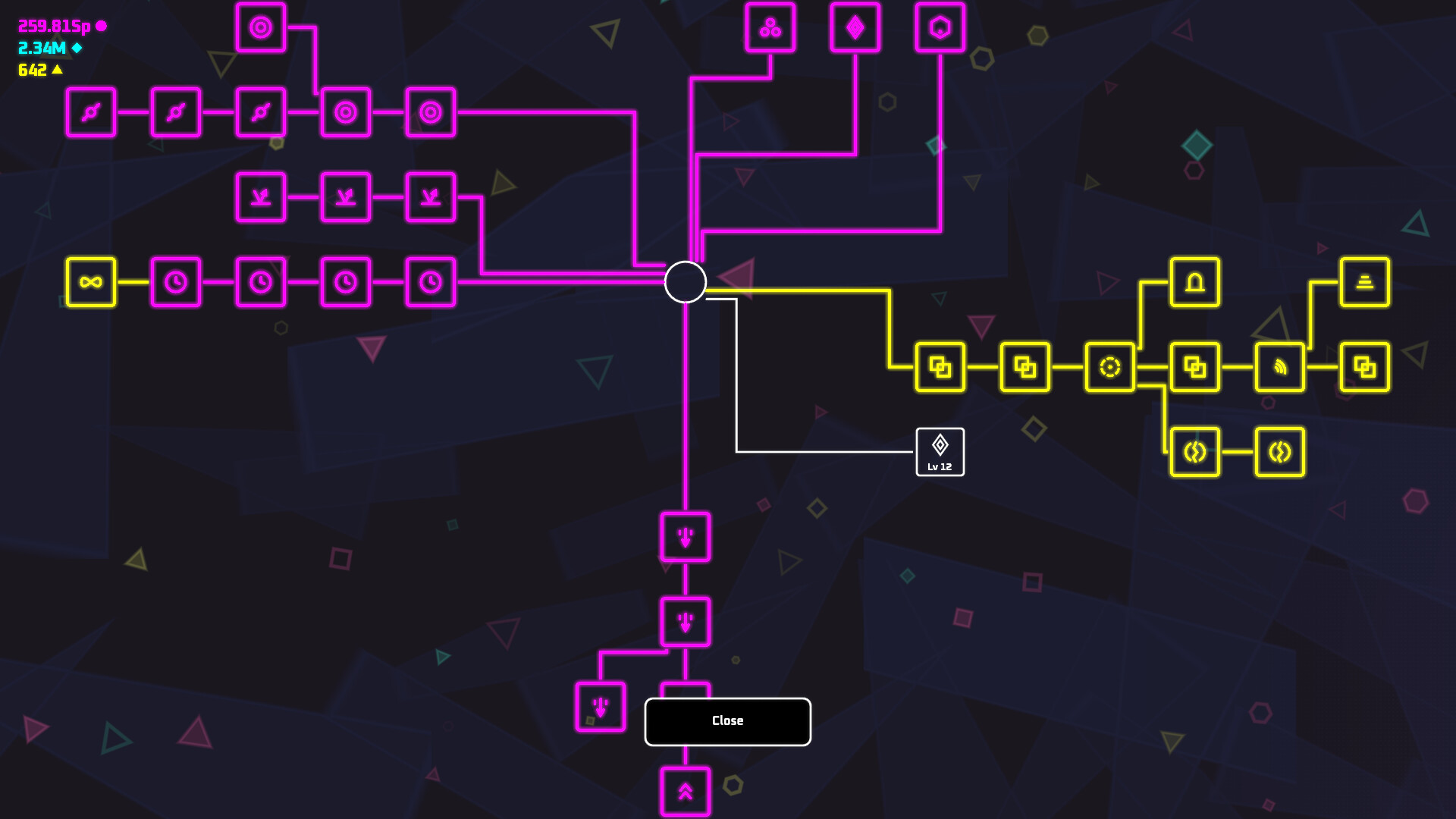
The demo contains the first three simulations, Bouncing Balls, Lattice and Reactor, with their full skill trees. Your progress carries over: the full game offers to continue from your demo save.

Seven simulations, one economy

Bouncemetry is an incremental game about physics. Each simulation is a small machine of balls, walls and shapes, and every hit pays. You spend the income in that simulation's skill tree, where one of the upgrades unlocks the next simulation.

  • Bouncing Balls: drop balls into a ring until the arena is full and shatters.
  • Lattice: cross enemy links on a gravity-free board to take them over.
  • Reactor: a beam sweeps a chamber of drifting matter. Fill the chamber to go critical.
  • Hexahedron: a hollow hexagon grows with every hit until it locks in place, and the next one drops inside it.
  • Enclosure: every wall a body strikes moves inward until the box is sealed.
  • Collapse: shells step inward around a falling core until the stack implodes.
  • Corona: a ball breaks out through rotating rings, one gap at a time.

Upgrades change the physics

Over 240 upgrades in seven skill trees change how the simulations behave: ball size and mass, bounciness, launch speed, the size of the arena, the sweep speed and width of the reactor beam, how many new balls a destroyed one splits into. Later upgrades let you run several arenas of the same simulation side by side.

Everything keeps running

Switch between simulations at any time. The ones you leave keep running at full speed, and each simulation has an automation upgrade, so a finished simulation runs on its own while you work on the next one.

A score played by the bounces

The music is not a recording. It is generated while you play: every bounce plays a note of the current scale, and the key changes as each round builds up and resolves.

Features

  • Seven physics simulations, three of them in the free demo
  • Over 240 upgrades in seven skill trees
  • Generated music: every bounce is a note
  • Played with the mouse
  • Options for screen shake, hit-stop, camera smoothing, ball trails, background motion, bloom and UI scale (75-150 %)
  • 31 languages

System Requirements

Windows
macOS
SteamOS + Linux
    Minimum:
    • Requires a 64-bit processor and operating system
    • OS: 10
    • Processor: Quad core 2Ghz+
    • Memory: 8 GB RAM
    • Graphics: GeForce GTX 750 Ti, Radeon R7 360 or Intel UHD Graphics 730
    • Storage: 1 GB available space
    Recommended:
    • Requires a 64-bit processor and operating system
    Minimum:
    • OS: macOS 12.0 (Monterey)
    • Processor: Intel Core i5 or Apple M1
    • Memory: 8 GB RAM
    • Graphics: Intel UHD 630, Radeon Pro 555, or Apple M1
    • Storage: 1 GB available space
    Recommended:
      Minimum:
      • OS: Ubuntu 20.04 / SteamOS 3 or newer (64-bit, glibc 2.28+)
      • Processor: Quad core 2Ghz+
      • Memory: 8 GB RAM
      • Graphics: GeForce GTX 750 Ti, Radeon R7 360 or Intel UHD Graphics 730
      • Storage: 1 GB available space
      Recommended:
      Review Filters