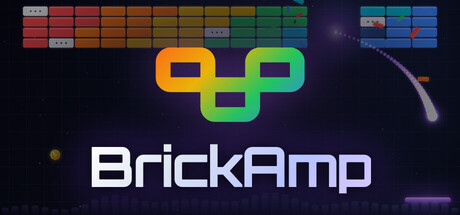

Two brick-breakers in one: AMPED runs fast and loud, ZEN reshapes the same 100 levels onto a slower, calmer board. Charge the Smash meter to blow out whole clusters of bricks in one hit — and play it all to your own music, or whatever's already playing.

Sign in to add this item to your wishlist, follow it, or mark it as ignored

Coming Soon To Early Access

The developers of this game intend to release as a work in progress, developing with the feedback of players.

Note: Games in Early Access are not complete and may or may not change further. If you are not excited to play this game in its current state, then you should wait to see if the game progresses further in development. Learn more

What the developers have to say:

Why Early Access?

“BrickAmp is a solo project, and the game is already fully playable: two modes, 100 levels, the Smash system, your own music and a full theme store. What it needs now is players. Early Access lets me tune difficulty, grading and pacing against how people actually play rather than how I play, and test it on hardware I don't own. It also leaves the door open for real musicians to join the soundtrack while the game is still taking shape.”

Approximately how long will this game be in Early Access?

“[Roughly 6–12 months], depending on what players tell us along the way.”

How is the full version planned to differ from the Early Access version?

“We plan to:
- Work with real artists on new music, with the goal of replacing or joining the AI-composed soundtrack
- Add more levels and mini-album packs to the shelf
- Rebalance difficulty, the grade targets and medal challenges based on player data and feedback
- Explore bringing more of the modes in development to the main menu
- Keep polishing Steam Deck, controller and handheld play
- Add more themes, visualizers and cosmetic unlocks”

What is the current state of the Early Access version?

“The game is complete enough to play from start to finish. It includes AMPED and ZEN modes, 100 levels shelved as mini albums, Endless and Score Attack, 16 power-ups, 35 themes, optional grades and medals, Steam soundtrack playback, system-audio visualization on Windows, macOS and Linux, full gamepad support and Steam Cloud saves.

Expect balance changes: difficulty curves, grade targets and power-up pacing are still being tuned. Some features are newer than others and may have rough edges, particularly on handheld hardware. Saves carry forward between updates.”

Will the game be priced differently during and after Early Access?

“I plan to raise the price modestly as the level and theme collections grow, so players who join during Early Access get it at its lowest. Any increase would come alongside real added content rather than on a schedule.”

How are you planning on involving the Community in your development process?

“Through the Steam discussion forums, regular update notes in Steam News, and bug reports straight to team@brickamp.com. Level feedback, difficulty reports and "this felt unfair" moments are the most useful things players can send. Musicians interested in scoring a shelf of levels can write to the same address.”
Read more
This game is not yet available on Steam

Coming soon

Interested?
Add to your wishlist and get notified when it becomes available.
 

Report bugs and leave feedback for this game on the discussion boards

See all discussions

About This Game

Two ways to break a brick

BrickAmp ships as two brick-breakers sharing one shelf of levels, and you pick from the title screen.

AMPED is the loud one — fast ball, full pace, the field coming apart in front of you. ZEN takes the same levels and reshapes them onto a narrower, shorter board so the ball's round trip takes longer and the run breathes. It has its own four speed tiers, from Normal up to Expert, and it is still perfectly capable of ending you — calmer is not the same as safe.

Around both sit 100 levels, 16 power-ups, 35 unlockable themes, and Endless and Score Attack waiting once the shelf runs out.

Charge the Smash. Take the whole neighbourhood with it.

Hold to charge the Smash meter and the game shows its work. A live preview traces the exact path the ball will fly, marks the brick it lands on, and lights up every brick that impact will take out alongside it — with a running count of the damage and a rating of OK, GOOD, GREAT or PERFECT.

The rating is the payload. A clean release detonates the full cluster around the impact; a sloppy one spends a charge on the target and a couple of neighbours.

The preview is not a suggestion. It is the same trajectory solve the ball actually flies, drawn before you commit.

Then bring your own music

Own soundtracks on Steam? BrickAmp finds them. Every soundtrack DLC in your Steam library, on any drive (the SD card too, on a Deck), plays in-game with real title and artist tags and its cover art on the HUD. There is no import step and no separate music menu to babysit.

The built-in visualizer runs on live FFT data, not a canned animation loop, and the playfield moves with it. Album art, seek bar and transport controls sit in the side rail, so you can skip a track without leaving the level.

Or skip the library entirely. Leave Spotify, Apple Music or a browser tab playing in the background and BrickAmp taps the system audio directly — live spectrum, now-playing title and artist, cover art and all. Windows, macOS and Steam Deck / Linux alike. Whatever you're already listening to, the board moves with it.

100 levels, filed like records

Level select is a record shelf. The levels are grouped into mini albums with their own cover art, each one paired with the slice of soundtrack that matches its mood — so a run through a shelf plays like a side, not a playlist on shuffle.

Grades and medals

Switch on grades and every level ends in a letter, F through S, measured against score targets built for that level's layout. Score Attack always keeps the grade on. Optional medal challenges sit on top of that: clear it without touching a wall, without dying, under par time, on a combo target, on a coin quota, or without picking up a single power-up.

Sixteen power-ups, and a few are traps

Widen, Shrink, Multiball, Laser, Sticky, Slow, Fast, Extra Life, Fireball, Trishot, Mystery, Bomb, Mortar, Magnet, Splitter, Missile. Grabbing everything that falls is a strategy, not a good one.

Spend what you break

Every brick pays out. Coins buy visual themes from the in-game store — 35 of them, from Midnight and Retro to Vaporwave, Brutalist, Liquid Metal, Glass, Sakura Glass, Arctic, Ember, Terminal, Aurora, Copper, Marble, Blueprint, Candy, Wooden, Obsidian, Tetris and LCD. Each one restyles the whole board, and Album Art repaints it from whatever cover is playing.

Drawn, not stamped

Every brick, ball, trail and particle is drawn on the GPU from scratch each frame, which is why it stays sharp at any resolution instead of blurring on a big display. The Steam Deck is detected automatically at launch and the game is tuned for it. Full gamepad support throughout.

About the soundtrack

The music that ships with the game was composed with AI, and that is worth saying plainly rather than burying. It is a solo project, and a scored one beats a silent one. It is also the part I would most like to hand to somebody better: I am actively looking to work with real artists on what comes next. If you make music and the idea of scoring a shelf of levels appeals to you, write to team@brickamp.com — that door is wide open.

And if none of it is to your taste, that is what the music section is for. Bring your own.

Features

  • Two modes on one shelf of levels: AMPED at full pace, ZEN reshaped slower and quieter with four speed tiers
  • The Smash meter: a previewed trajectory that detonates on impact and takes the surrounding bricks with it
  • 100 levels, shelved as mini albums with their own cover art and their own slice of the score
  • Endless and Score Attack for when the shelf runs out
  • 16 power-ups, several of which are working against you
  • 35 visual themes, bought with coins you break out of the bricks
  • Optional F-through-S grading against per-level score targets, plus medal challenges per level
  • Plays the soundtracks you own on Steam, with title, artist and cover art on the HUD
  • Live spectrum visualizer driven by real FFT, with album art, seek and transport controls in the rail
  • System-audio capture on Windows, macOS and Linux: visualize Spotify, Apple Music or a browser tab
  • Everything in play drawn on the GPU each frame, sharp at any resolution, tuned for Steam Deck
  • Original soundtrack composed with AI, with real artists wanted for what comes next

AI Generated Content Disclosure

The developers describe how their game uses AI Generated Content like this:

The current soundtrack and its album-cover artwork were generated with AI music and image tools and selected by the developer. I am looking to commission original music from human artists; if you make music and would like to hear your tracks in BrickAmp, get in touch at team@brickamp.com. Some level layouts and visual effects were drafted with AI-assisted coding tools and hand-reviewed. All of this content is pre-generated and ships with the game. Nothing is generated live during play, and the game does not connect to any AI service.

System Requirements

Windows
macOS
SteamOS + Linux
    Minimum:
    • OS: Windows 10 64-bit
    • Processor: Dual-core 64-bit processor, 2.0 GHz (Intel Core i3-4130 / AMD FX-4300 or better)
    • Memory: 4096 MB RAM
    • Graphics: Vulkan 1.0 compatible GPU with 1 GB VRAM — NVIDIA GeForce GTX 660, AMD Radeon HD 7850, or Intel HD Graphics 520
    • Storage: 1024 MB available space
    • Sound Card: Any Windows-compatible sound device
    • Additional Notes: Gamepad recommended. Optional System Audio visualizer captures desktop audio via WASAPI loopback.
    Recommended:
    • OS: Windows 11 64-bit
    • Processor: Quad-core 64-bit processor, 3.0 GHz or better
    • Memory: 8192 MB RAM
    • Graphics: NVIDIA GeForce GTX 1060, AMD Radeon RX 570, or better
    • Storage: 2048 MB available space
    • Sound Card: Any Windows-compatible sound device
    • Additional Notes: A gamepad and a populated Steam Music library give the best experience.
    Minimum:
    • Requires an Apple processor
    • OS: macOS 11.0 Big Sur
    • Processor: Apple Silicon and Intel (universal binary — runs natively on both)
    • Memory: 4096 MB RAM
    • Graphics: Metal-capable GPU — any Apple Silicon, or Intel Iris Plus / AMD Radeon Pro 500 series
    • Storage: 1024 MB available space
    • Sound Card: Built-in
    • Additional Notes: System Audio capture (visualizing Spotify or Apple Music) requires macOS 14.2 or later. The game itself runs on macOS 11.
    Recommended:
    • Requires an Apple processor
    • OS: macOS 14.2 Sonoma or later
    • Processor: Apple M1 or newer
    • Memory: 8192 MB RAM
    • Graphics: Apple M1 integrated graphics or better
    • Storage: 2048 MB available space
    • Sound Card: Built-in
    • Additional Notes: macOS 14.2+ enables the System Audio visualizer.
    Minimum:
    • OS: SteamOS 3.0, Ubuntu 20.04 LTS, or newer (glibc 2.31+)
    • Processor: Dual-core 64-bit processor, 2.0 GHz
    • Memory: 4096 MB RAM
    • Graphics: Vulkan 1.0 capable — NVIDIA GeForce GTX 660, AMD Radeon HD 7850 (RADV), or Intel HD Graphics 520
    • Storage: 1024 MB available space
    • Sound Card: PulseAudio or PipeWire
    • Additional Notes: Steam Deck supported and detected automatically. System Audio capture requires PulseAudio or PipeWire; the game runs normally without it.
    Recommended:
    • OS: SteamOS 3.0 or Ubuntu 22.04 LTS
    • Processor: Quad-core 64-bit processor, 3.0 GHz (Steam Deck APU or better)
    • Memory: 8192 MB RAM
    • Graphics: NVIDIA GeForce GTX 1060, AMD Radeon RX 570, or Steam Deck RDNA 2 integrated graphics
    • Storage: 2048 MB available space
    • Sound Card: PipeWire
    • Additional Notes: Tuned to hold 60fps on Steam Deck hardware.
Review Filters