
An 1821 sailing sim where the chart starts blank. Take a noon sight, sound the bottom, log the wind — and your own reckoning error becomes your current data. Plan passages against what you actually measured. Ships are lost. The chart is what you keep.

Sign in to add this item to your wishlist, follow it, or mark it as ignored

This game is not yet available on Steam

Planned Release Date: To be announced

Interested?
Add to your wishlist and get notified when it becomes available.
 

About This Game

Your chart begins as an empty sheet of paper.

Not fogged. Not greyed out. Empty. There is no wind arrow on it, no current, no

coastline, no sounding — because nobody has been there and written one down. Everything

that ever appears on that chart, you put there yourself, one measurement at a time.

Four instruments and a great deal of patience

You have what a ship in 1821 actually carried, and nothing else.

  • Compass and log — a course and a speed, hour after hour, which is a position

  • only for as long as the sea agrees with you.

  • Sextant — the sun at its highest gives you a latitude. It gives you nothing at

  • all about your longitude, and it gives you nothing on a cloudy day.

  • Thermometer — sea temperature, hourly. It is how you find the edge of a current

  • before you can see it.

  • Lead line — the bottom, if the bottom is within 150 metres. Where it answers,

  • You are closer to land than you thought.

Your mistakes are the data

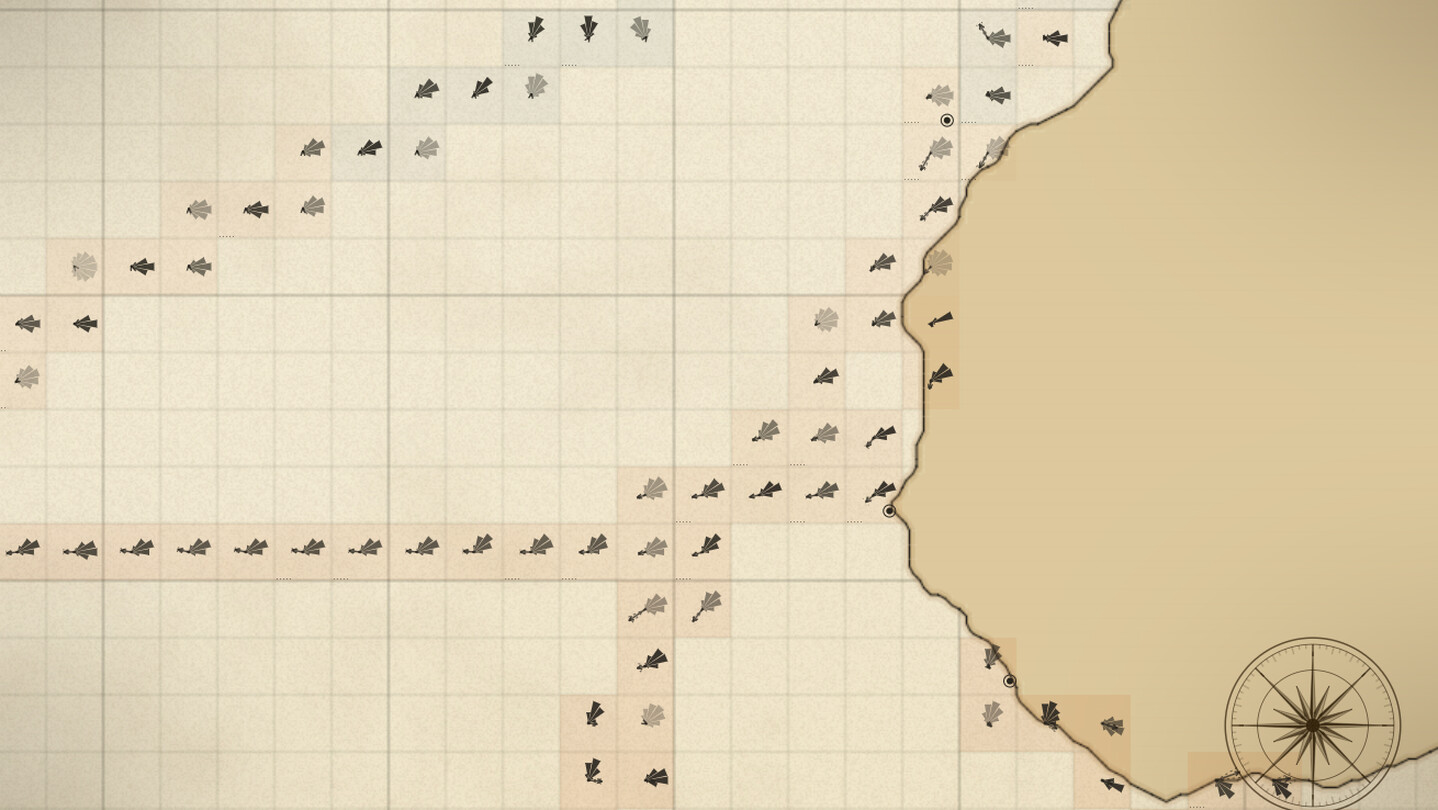
This is the mechanic the whole game is built from. You reckon your position from course

and speed. Then you take a sight, and the sight disagrees with your reckoning. That

disagreement is not a failure state — it is the current, measured. The difference between

where you thought you were and where you are gets written back along the track you

sailed, cell by cell, and becomes an arrow on your chart.

Navigate carelessly and the arrows land in the wrong squares. The chart will go on lying

to you about that stretch of ocean for as long as you let it.

A plan is worth exactly what your chart is worth

Lay marks across the water and the game tells you the date you reach each one, the days

of water you will have left when you get there, and — in plain numbers — how much of that

forecast rests on cells you have actually measured. On a blank sheet the certainty reads

[b]0%[/b], and the panel says so outright: the rest is extrapolation, not prediction.

That number is the reason to survey. Not points. Not currency. The planner simply stops

lying to you.

Water is the second deadline

Twenty-four sailors, a hundred days of provisions, fifty days of water. Water runs out

first, and it is bought with time alone — days idle in harbour, or hours spent putting a

boat ashore in a bay that may or may not have a stream in it. Whether a stretch of coast

gives water is a fact about that coast, fixed from the moment the world was made, and

finding it out is the same loop as finding a wind: go, look, write it down.

Ice closes the north in its season. Cyclones close the south in theirs. You do not learn

this from a tooltip. You learn it by arriving.

The ship is expendable. The chart is not.

Run out of water at sea and the ship is lost. You may take a new one out of your home

port with [b]the same chart[/b] — every rose, every sounding, every watering place you

ever wrote down. That is the whole proposition of the game in one line: the voyage ends,

the knowledge stays.

What this is not

  • No combat. Nothing shoots at you.

  • No economy. No gold, no cargo prices, no shops, no upgrade tree. Provisions are

  • Counted in days, not coins, and buy nothing but time.

  • No quest log. Nobody hands you a checklist. Where you sail is your own idea.

  • No sail trim. You set a heading and stand the watch. The interesting decision

  • is where, not how tight the sheets are.

The world

The Atlantic as it is — real coastline, sixteen real harbours from Falmouth to Cape Town,

real wind belts, real calm latitudes — and a generated ocean that plays by the same rules

when you want water nobody has ever charted. Every world is a seed: the same seed gives

the same ocean, so a passage that beat you can be sailed again.

System Requirements

    Minimum:
    • Requires a 64-bit processor and operating system
    • OS: Windows10/11
    • Memory: 8 GB RAM
    • Graphics: 1650
    Recommended:
    • Requires a 64-bit processor and operating system
    • OS: Windows10/11
    • Memory: 8 GB RAM
    • Graphics: 1650
Review Filters