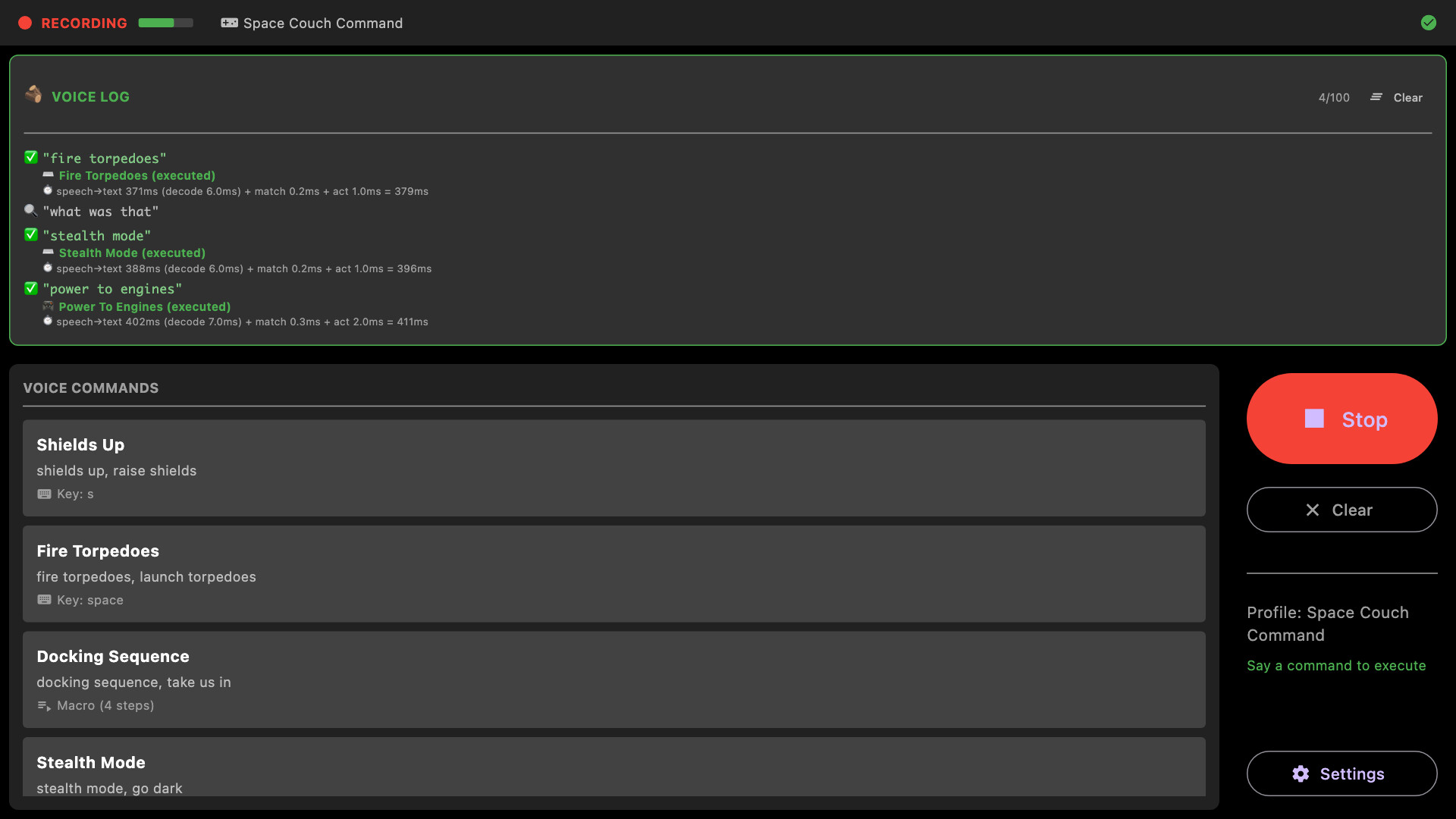


Speak a phrase, your game reacts. VoiceCmd turns spoken commands into the keystrokes, holds and macros your games already understand — recognised entirely on your own machine, with no internet connection, no account, and nothing sent anywhere.
Veröffentlichung:
Bald verfügbar
Entwickler:
Tags

Melden Sie sich an, um dieses Produkt zu Ihrer Wunschliste hinzuzufügen, zu abonnieren oder als „Ignoriert“ zu markieren.

Dieses Spiel ist noch nicht auf Steam verfügbar

Bald verfügbar

Interesse? Fügen Sie das Spiel Ihrer Wunschliste hinzu und erhalten Sie eine Benachrichtigung, wenn es verfügbar ist.
 

Über diese Software

Your voice is another controller

VoiceCmd listens for phrases you choose and turns them into input your games already understand: key presses, held keys, mouse actions, typed text and multi-step macros. There is no plugin to install and no game integration to wait for. If it responds to a keyboard, it responds to VoiceCmd.

Nothing leaves your machine

Speech recognition runs on your own hardware. No cloud service, no account, no sign-in, no telemetry. Pull the network cable out and it behaves exactly the same.

Built for the way people actually talk

  • Fuzzy matching forgives a rushed or half-swallowed word.
  • Sound-alikes are handled, so "reload four me" fires the same command as "reload for me".
  • Push-to-talk when you want control, or a toggle hotkey when you want your hands free.
  • An optional wake word, so ordinary conversation does not set things off.

A profile for every game

Keep a separate command set per game and switch between them in a click. Individual commands can be switched off while you tune them, so a half-finished idea never fires mid-match.

What one command can do

  • Press, hold or release any key or combination
  • Click, move or scroll the mouse
  • Type a line of text
  • Chain steps into a macro with timed pauses
  • Play a sound, or speak a confirmation back to you
  • Launch an application or open a page

Windows, macOS and Linux

One purchase covers all three. On Linux, VoiceCmd can drive input through uinput as well as X11, which lets it reach native Wayland windows that many tools cannot.

Systemanforderungen

Windows
macOS
SteamOS + Linux
    Mindestanforderungen:
    • Setzt 64-Bit-Prozessor und -Betriebssystem voraus
    • Betriebssystem: Windows 10 (64-bit) or later
    • Prozessor: 64-bit x86 processor; quad-core recommended
    • Arbeitsspeicher: 4 GB RAM
    • Speicherplatz: 500 MB verfügbarer Speicherplatz
    • Zusätzliche Anmerkungen: A microphone is required. Speech recognition runs locally on the CPU — no internet connection is used at any point. VoiceCmd sends input to other applications, which some anti-cheat software may restrict.
    Empfohlen:
    • Setzt 64-Bit-Prozessor und -Betriebssystem voraus
    Mindestanforderungen:
    • Betriebssystem: macOS 10.15 Catalina or later
    • Prozessor: Apple Silicon or 64-bit Intel
    • Arbeitsspeicher: 4 GB RAM
    • Speicherplatz: 500 MB verfügbarer Speicherplatz
    • Zusätzliche Anmerkungen: A microphone is required. Speech recognition runs locally on the CPU — no internet connection is used at any point. macOS will ask for Microphone and Accessibility permission; Accessibility is what allows VoiceCmd to send keystrokes to other applications.
    Empfohlen:
      Mindestanforderungen:
      • Betriebssystem: Ubuntu 22.04 or later, or any distribution with glibc 2.34+
      • Prozessor: 64-bit x86 processor; quad-core recommended
      • Arbeitsspeicher: 4 GB RAM
      • Speicherplatz: 500 MB verfügbarer Speicherplatz
      • Zusätzliche Anmerkungen: A microphone is required. Speech recognition runs locally on the CPU — no internet connection is used at any point. Works on X11 and, via XWayland, on Wayland desktops. To send input to native Wayland windows, VoiceCmd uses /dev/uinput, which needs a one-time udev rule.
      Empfohlen:
      Filter überprüfen