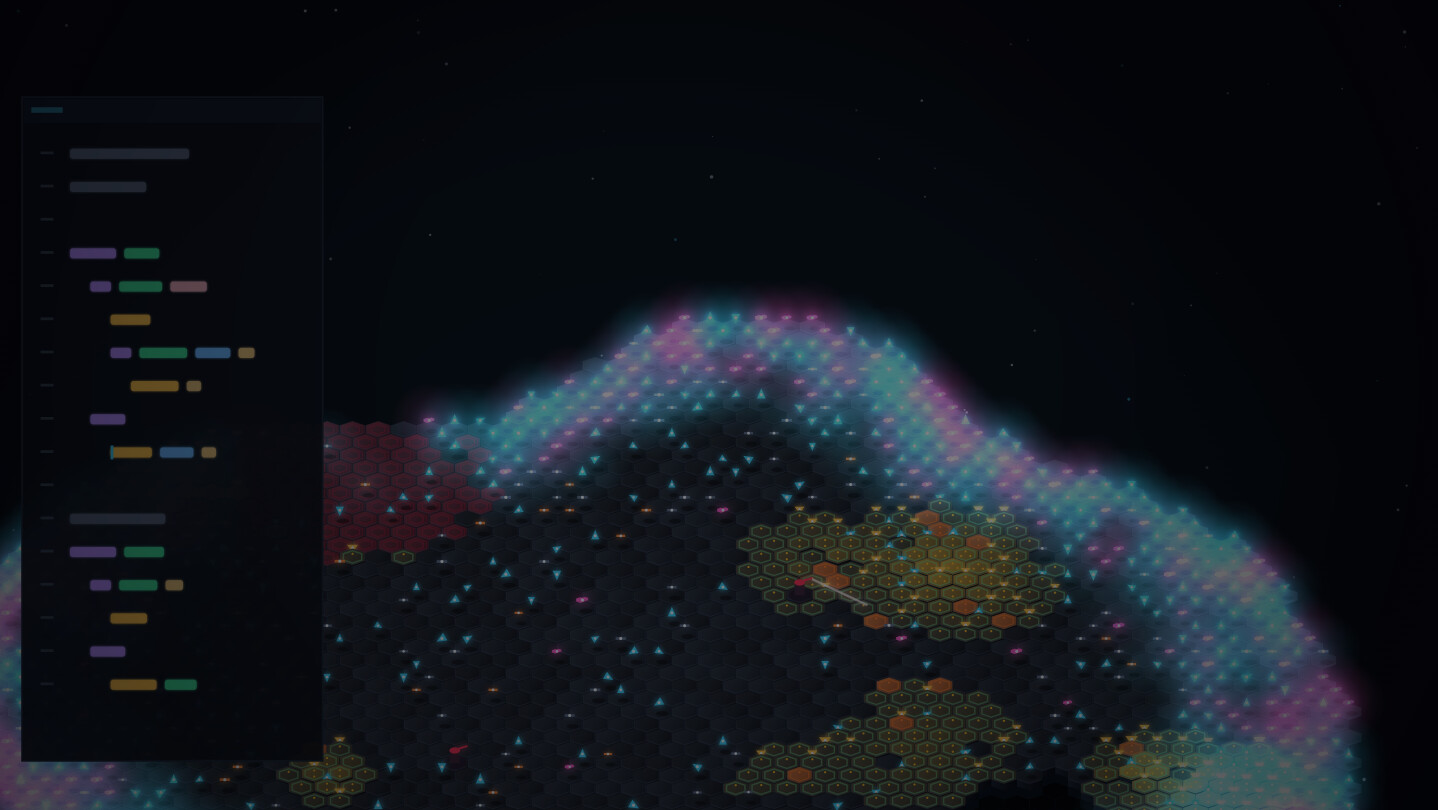


Write real code in a Python-like language to control one machine that copies itself. Then watch a thousand copies of your program eat a world. A single-player programming incremental game about self-replicating machines.

Daftar masuk untuk menambah item ini ke senarai hajat anda, ikuti atau tandakannya sebagai diabaikan

Akan Datang ke Akses Awal

Pembangun permainan ini berhasrat untuk melancarkannya sebagai projek yang sedang berlangsung, dengan perkembangan dipengaruhi oleh maklum balas pemain.

Nota: Permainan dalam Akses Awal belum lengkap dan mungkin akan mengalami perubahan. Jika anda tidak berminat untuk bermain permainan ini dalam versi semasa, anda seharusnya menunggu untuk melihat jika permainan ini akan terus dibangunkan. Ketahui lebih lanjut

Kata-kata daripada pembangun:

Kenapa Akses Awal?

“The difficulty of this game is emergent. A level is hard because a hundred machines running your code collide with each other in ways I cannot predict from my desk - contention on a single ore vein, a corridor the swarm blocks with its own bodies, an instruction budget that runs out three ticks before the thing you needed. I have tuned fifty levels against my own solutions. I need to watch other people's solutions break in ways mine never did, and retune against those.”

Berapa lama permainan ini dijangka akan berada dalam Akses Awal?

“Twelve to eighteen months.”

Apakah perbezaan yang dirancang antara versi penuh dan versi Akses Awal?

“Three things, in priority order. We plan to move your programs onto real files on disk, so you can edit them in your own editor and the game picks up the change. We plan to open public leaderboards for every scenario on five separate metrics, where a submitted program is verified by the server re-running it rather than trusted. And we plan to add more scenarios, built around the parts of the language that arrive last.”

Bagaimanakah keadaan semasa versi Akses Awal?

“Playable and finished as far as it goes. Eleven guided lessons, thirty-nine scenarios across four difficulty tiers, and an open sandbox with about thirty world dials. Seventeen machine calls - fifteen unlocked across the first ten lessons, and send()/recv() at lesson eleven. Twenty-three achievements. Every level ships with a reference solution that the test suite re-simulates on every build, so nothing in the box is unsolvable. Roughly fifteen to thirty hours to see all of it, considerably more if you start optimising.”

Adakah harga permainan ini berbeza semasa dan selepas Akses Awal?

“We plan to gradually raise the price as we ship new content and features.”

Bagaimana anda merancang untuk melibatkan Komuniti dalam proses pembangunan anda?

“Steam Discussions and a Discord, both read by the person who wrote the game. The two things I want most are programs that broke in a way I did not design for, and the exact moment a level stopped being fun. Level tuning lives in a plain config file, so a well-argued "this one is unfair" can be in the next build the same week.”
Baca lagi
Bahasa Bahasa Melayu tidak disokong

Produk ini tidak menyokong bahasa tempatan anda. Sila semak senarai bahasa yang disokong di bawah sebelum membuat pembelian

Permainan ini belum tersedia di Steam lagi

Tarikh Keluaran Dirancang: September 2026

Berminat?
Tambah ke senarai hajat anda dan terima pemberitahuan apabila permainan sudah tersedia.
 

Laporkan pepijat dan tinggalkan maklum balas untuk permainan ini di papan perbincangan

Lihat semua perbincangan

Tentang Permainan Ini

Write real code in a Python-like language to control one machine that copies itself. Then watch a thousand copies of your program eat a world. A single-player programming incremental game about self-replicating machines.

You are handed one machine on a dead rock and a text editor. The machine can move, dig, sense the ground under it and read the colony's energy. Around lesson four it learns to do the one thing that changes everything: build a copy of itself. The copy runs your code. From the top. Exactly as written.

ONE MACHINE BUILDS ONE MACHINE


That is the entire game. Nothing else scales. There are no stat upgrades, no multipliers, no currency to spend on being stronger. Every unit of progress is a new function in your vocabulary - seventeen of them, from move() through sense() and spawn(). Fifteen arrive across the first ten lessons. The last two, send() and recv() for machine-to-machine messaging, open at lesson eleven. Your code is the only thing that scales.

CODE THAT WORKS FOR FOUR MACHINES FAILS AT FOUR HUNDRED


Not because of an artificial difficulty gate. Because a hundred machines converge on the same ore vein and starve. Because the swarm's own bodies block the only corridor. Because one event wakes every machine on the same tick. Because each machine gets a fixed instruction budget per tick, and naive code burns it and stalls where you can watch it happen.

Growth is the reward and the pressure at the same time. The machine count is the difficulty curve, so the late game never plays itself.

FIFTY LEVELS, AND THE HARD ONES TAKE THINGS AWAY


Eleven guided lessons introduce one idea each and never hand you a blank buffer. Thirty-nine scenarios across four tiers escalate from "one machine, five lines" to a radius-sixty world where the best program we know of puts four hundred machines on the map inside a hundred ticks. The pro tier is built by subtraction: no sensors, no price readout, no position, no identity. Ten levels switch an instrument off and tell you in-fiction why your sensor array is slag.

Then there is a sandbox with about thirty dials - world radius, ore density and hardness, radiation, volatile ore, turrets, holes, machine lifespan, upkeep, the instruction budget, and the API calls you can individually disable - and no goals at all.

THE ERRORS ARE THE TUTORIAL


The errors you will actually hit have a plain-English translation that points at the line and names the concept: "After a line ending in :, the next line must be indented 4 spaces - that's how the machine knows it belongs inside." The full API reference is one keystroke away, searchable, with a worked example on every call, and it tells you which calls are locked and which the level has taken away from you before you deploy. A Field Guide names every symbol on screen.

WHAT IT DOESN'T HAVE


No microtransactions. No PvP, no matchmaking, no ranked queue. No random numbers the game keeps to itself - the simulation is deterministic to the tick, so the same seed and the same program always produce the same run, right down to the machine that dies.

[hr][/hr]

Programming is done in a small language similar to Python. The first lessons introduce every concept you need, one at a time, and you edit working code rather than filling an empty file.

It will not hold your hand once the concepts are in. Figuring out how to actually solve a level is the game, and that can be genuinely hard if you have never programmed before.

And if you already write code for a living: the first ten lessons will take you under an hour, and then the interesting problems start, because they are the ones you have already met at work.

Keperluan Sistem

    Minimum:
    • Memerlukan pemproses 64-bit dan sistem pengendalian
    • OS: Windows 10 64-bit, version 1803 or later
    • Pemproses: Any x64 processor, 2.0 GHz dual-core
    • Memori: 4 GB RAM
    • Grafik: Integrated graphics with hardware acceleration enabled
    • Storan: 300 MB ruang tersedia
    • Nota Tambahan: Requires the Microsoft Edge WebView2 Runtime, which is preinstalled on Windows 11 and installed automatically on Windows 10 if absent. 1366 x 768 minimum display resolution.
    Dicadangkan:
    • Memerlukan pemproses 64-bit dan sistem pengendalian
    • OS: Windows 11 64-bit
    • Pemproses: Any modern x64 processor, 3.0 GHz quad-core
    • Memori: 8 GB RAM
    • Grafik: Any discrete or modern integrated GPU
    • Storan: 500 MB ruang tersedia
    • Nota Tambahan: 1920 x 1080 or higher. Large sandbox worlds benefit from the extra headroom.
Penapis Ulasan