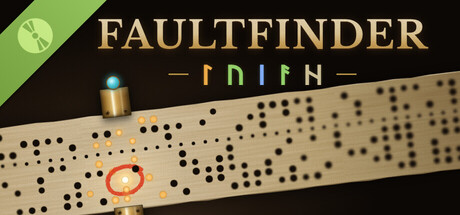

Seven incidents. One machine. The engineer who kept it running is dead. Step through her rune-tape, set breakpoints and rewind its execution, then name the line that killed her and the fault it carried. The free demo of a deduction game where the crime scene is a program.

Sign in to add this item to your wishlist, follow it, or mark it as ignored

Free Demo

Play Faultfinder Demo

Check out the full game


About This Demo

Seven incidents. One machine. One engineer, and she is not coming back.

The pressure ward on the underside of the Drifted City ran correctly for eleven years. Last night it killed M. VOSK, the engineer who maintained it.

This demo is her filed casework. Seven incidents, audited one at a time, ending with the one that killed her.

What is in the demo

  • Seven incidents, 35 to 70 minutes, on one machine: the pressure ward

  • Fourteen instructions of rune-tape, taught by using them

  • Six classes of fault, each hiding in a different way

  • The full debugger: step, conditional breakpoints, register watches, complete rewind, and input injection

  • Her marginalia, which thin as the cases go on

You never write a line of code. You read one.

Each incident opens as three panes. Her annotated listing on the left, the machine's live state in the middle, and on the right what the city actually observed. A pressure reading that held at zero for nine seconds. A valve that seated closed while the gauge read open.

Your tools are a debugger's, not a programmer's:

  • Step one instruction and watch exactly one thing change.

  • Break on a line, or on a condition: stop when PRESSURE drops below four.

  • Watch a register and read its whole history as a strip beside the tape.

  • Rewind. The entire trace is recorded. The scrub bar runs both ways.

  • Inject a different reading from the outside world and re-run it. Some faults only wake for one input in a thousand.

Then you commit. Name one line. Name one fault from a fixed vocabulary. Then name the moment the harm was done. Get all three right and the report writes itself, one clause at a time.

Every incident here has exactly one answer, and it was proven before you saw it

These seven cases were not designed and playtested into fairness. They were machine-verified before they shipped: a correct program, one seeded fault, and then exhaustive simulation across the whole input space to prove the faulty program fails, that reverting that one instruction fixes it, and that no other single change can.

If a case had a second defensible answer, the pipeline rejected it and it is not in this demo.

What is not in the demo

The pressure ward is one machine. There are others, and they are not here. Two further classes of fault are held back, including the one where two tapes race each other. The demo ends where her last report does.

Wishlist Faultfinder to hear when the rest of the ward opens.

AI Generated Content Disclosure

The developers describe how their game uses AI Generated Content like this:

Store page capsule artwork and page background were created with AI image generation tools. All game design, writing, art direction, code and case construction are the developer's own.

System Requirements

    Minimum:
    • Requires a 64-bit processor and operating system
    • OS: Windows 10
    • Processor: Any dual-core processor (2 Ghz+)
    • Memory: 4 GB RAM
    • Graphics: Any GPU with OpenGL 3.3 support
    • Storage: 500 MB available space
    Recommended:
    • Requires a 64-bit processor and operating system
    • OS: Windows 10/11
    • Processor: Any quad-core processor
    • Memory: 4 GB RAM
    • Graphics: Any GPU with Vulkan or D3D12 support
    • Storage: 500 MB available space
Review Filters