
Command modular fleets in a top-down tactics game where every shot is aimed by hand. Build warships socket by socket, flick projectiles across drifting battlefields, and carry damage, veterans, and hard choices through a 60-mission campaign.

Sign in to add this item to your wishlist, follow it, or mark it as ignored

Coming Soon To Early Access

The developers of this game intend to release as a work in progress, developing with the feedback of players.

Note: Games in Early Access are not complete and may or may not change further. If you are not excited to play this game in its current state, then you should wait to see if the game progresses further in development. Learn more

What the developers have to say:

Why Early Access?

“I'm a solo developer, just a guy at his desk who wanted to make a game for his friend. Building it has also been an enormous learning process for me. I'm not a software developer or game developer by trade, and this experience has given me tremendous respect for the people who do this every day. It is hard work, especially mentally.

The main reason I chose Early Access is simple: in my mind, this is not yet a finished product. Armada Ascendant is playable from beginning to end, but its story and interconnected shipbuilding, fleet-composition and positional-damage systems would benefit enormously from a broader range of players and playstyles. In other words, all of you. Early Access allows me to discover designs, tactics, edge cases and balance problems that I could never find alone.

Your feedback can help me forge this rough ore of a game into a shining battlefleet. I want it to become something I can be proud of, that I hope my friends will be proud of, and that the community can be proud to have supported.

More specifically, Early Access will help refine the core game systems, weapon and system balance, enemy behavior, campaign pacing, long-term fleet progression, user experience, interface clarity and accessibility. It will also give me an opportunity to test different story ideas and learn what players care about most. Does a scene communicate what I intended? Does a storyline need more nuance or restraint? Which characters, factions and themes resonate with players?

The campaign is finished end to end: sixty missions across eight operations, from a two-ship border patrol to a fleet-scale assault on the Vaelen Crown Citadel. What it has not had is a wide range of players. Sixty missions of balance, pacing and difficulty have been tuned by just me and a great deal of automated testing with myself as an observer to catch issues, and that is exactly the kind of work that improves fastest once other people get their hands on it. I would also like to create a parallel campaign that tells the conflict or a continuation of it from the opposing faction's perspective. I don't intend to use Early Access as a substitute for having a playable game. It is already very much playable, and, I hope for all of you, enjoyable. Instead, Early Access gives me the chance to sharpen what is there and to grow the game beyond its current borders.

Early Access is a way to gather broader feedback and refine a complete, playable foundation, and I don't intend to use it as a substitute for a plan to continue development. Which I plan to do regardless. I also plan to keep improving the game's visual and audio presentation, including replacing prominent prototype assets over the course of development.

I look forward to continuing this project and improving what I think is a solid foundation alongside players who understand its potential and who want to help shape what Armada Ascendant ultimately becomes.”

Approximately how long will this game be in Early Access?

“My current estimate for being in Early Access is approximately 18 to 24 months. The core game is already playable from beginning to end, and the Early Access period will be used to refine its balance and usability, tuning missions, pacing, and difficulty against what players actually do, explore a parallel campaign from the opposing faction's perspective, and improve the game's visual and audio presentation.

As a solo developer, the exact timeline may change based on player feedback, technical challenges and the amount of iteration the game requires. I would rather adjust the schedule openly than rush the game toward an arbitrary date. If that estimate changes significantly, I will communicate the reasons and update the development roadmap accordingly.”

How is the full version planned to differ from the Early Access version?

“The full version is planned to be a broader, better-balanced and more polished evolution of the current game. I do not plan to replace the flick-shooting combat or modular fleet-building systems that define Armada Ascendant. Instead, I plan to build more depth, variety and clarity around that foundation.

The current version already includes the complete sixty-mission campaign across eight operations, ending in a fleet-scale assault on a heavily defended Super-Fortress and its support batteries. The work I plan for the full version is depth rather than length: continued tuning of pacing for ship classes, fleet budgets, technology families and persistent fleet damage, and of the difficulty curve across all three tiers. I would rather make sixty missions play well than make eighty missions exist. Though if the opportunity to expand the story is there, I would love to do so.

As such I would also like to explore a second campaign from the Vaelen perspective. This story would follow a Vaelen fleet that was stationed on another frontier and remained outside the opening stages of the war. When it returns, the player would see the Castalia Concord as the invading force and would be tasked with organizing the defense of Vaelen-controlled space. The exact length of this campaign will depend on what the expanded main campaign and player feedback show works best. It could become another full campaign or a shorter companion story of approximately 20 missions.

Combat development is planned to focus primarily on making the existing systems deeper rather than continually adding more equipment. I plan to continue refining weapon and system balance, positional damage, shields, armor, repairs, carriers, support ships and environmental hazards. New equipment would only be considered when it creates a meaningful tactical role that is not already represented. The opposing campaign may also introduce altered Vaelen equipment or faction-specific versions of existing systems where they support the story and fleet identity.

Enemy behavior is another area I plan to develop further. Doctrines already shape both fleet composition and battlefield behavior, including range discipline, kiting, focus-fire priorities and screen formations. The goal during Early Access is to widen those distinctions further and help each doctrine present its own recognizable tactical problem. I also plan to improve how enemy fleets use objective pressure, support systems, control stations and environmental conditions.

Campaign and fleet progression are planned to receive additional refinement as well. This includes clearer presentation of new ships and technologies, improved reward screens, better communication of repairs and persistent damage, and more meaningful veterancy decisions. I also plan to continue refining mission variety so that different objectives, environmental conditions and fleet compositions encourage players to reconsider how they build and deploy their forces.

The full version is intended to have a more cohesive professional presentation. Planned presentation work includes replacing prominent prototype artwork across ships, fitted systems, bases, stations, environmental objects, battle effects, interface elements and promotional materials. I also plan to improve the soundtrack and build a more consistent sound library for the game's weapons, ships, impacts, shields and interface.

The current game already includes scripted teaching missions, contextual coaching, tooltips, interface scaling, fullscreen and resolution controls, rebindable controls, shape-coded status information, adjustable effect density and reduced-flash options. Early Access will provide an opportunity to refine these features through feedback from players with different displays, control preferences and accessibility needs. Controller and Steam Deck support may also be explored if they can be implemented without compromising the precision of the game's controls.

Steam Cloud saves are implemented. During Early Access, I plan to continue improving save migration between updates, performance in large battles, local diagnostic tools and general Steam integration.

The current game includes local two-player Skirmish. Features such as online multiplayer, online cooperative play, mod support and a public mission editor may remain possibilities for after 1.0, but they are not intended to take priority over completing and polishing the core single-player experience. Voice acting and procedurally generated campaigns are not currently part of the planned scope.

The exact scope may change as I learn what players enjoy, what needs the most attention and what is practical for a solo developer to accomplish. Ultimately, I plan for the full version to offer a better-tuned campaign, stronger enemy behavior, deeper fleet progression, more polished presentation, clearer interfaces, better accessibility and a more thoroughly tested combat sandbox.

The goal is not to turn Armada Ascendant into a different game. The goal is to make the game that already exists feel complete, cohesive and worthy of the players who will help shape it.”

What is the current state of the Early Access version?

“Armada Ascendant is fully playable today, not a demo or a vertical slice. The current Windows build includes a 60-mission single-player campaign that can be played from beginning to end, configurable Skirmish battles against the computer at five fleet scales, and local two-player hotseat Skirmish.

The campaign runs from a two-ship border patrol to fleet actions involving dozens of ships. It is organized into eight operations with written briefings, each ending in a capstone battle against a named enemy, and it mixes five objective types: Deathmatch, Control Points with capturable stations, Base Assault against armed fortresses, Holdout defenses against timed reinforcement waves, and Breakthrough extractions where getting your fleet out is the win condition. Two set-piece assaults combine them: a fortified border compound, and a finale that requires both breaking a Super-Fortress and taking the batteries that shield it.

Most missions also carry optional objectives, and many carry a harder mastery condition on top of them. There are 64 optionals and 28 masteries across the campaign, each stated in the briefing and scored in the After-Action Report, so a mission you have already won usually has a reason to be fought again.

Campaign progress is persistent. The early operations let you recover from a bad battle, but once the counteroffensive begins your fleet carries real damage between missions, repairs cost Credits and bench a ship for one deployment, and destroyed ships are permanently lost. Surviving crews earn five promotions as they advance from Green to Ace. When a run of losses leaves you unable to field a fleet, the game offers a loaned relief package rather than letting the campaign dead-end.

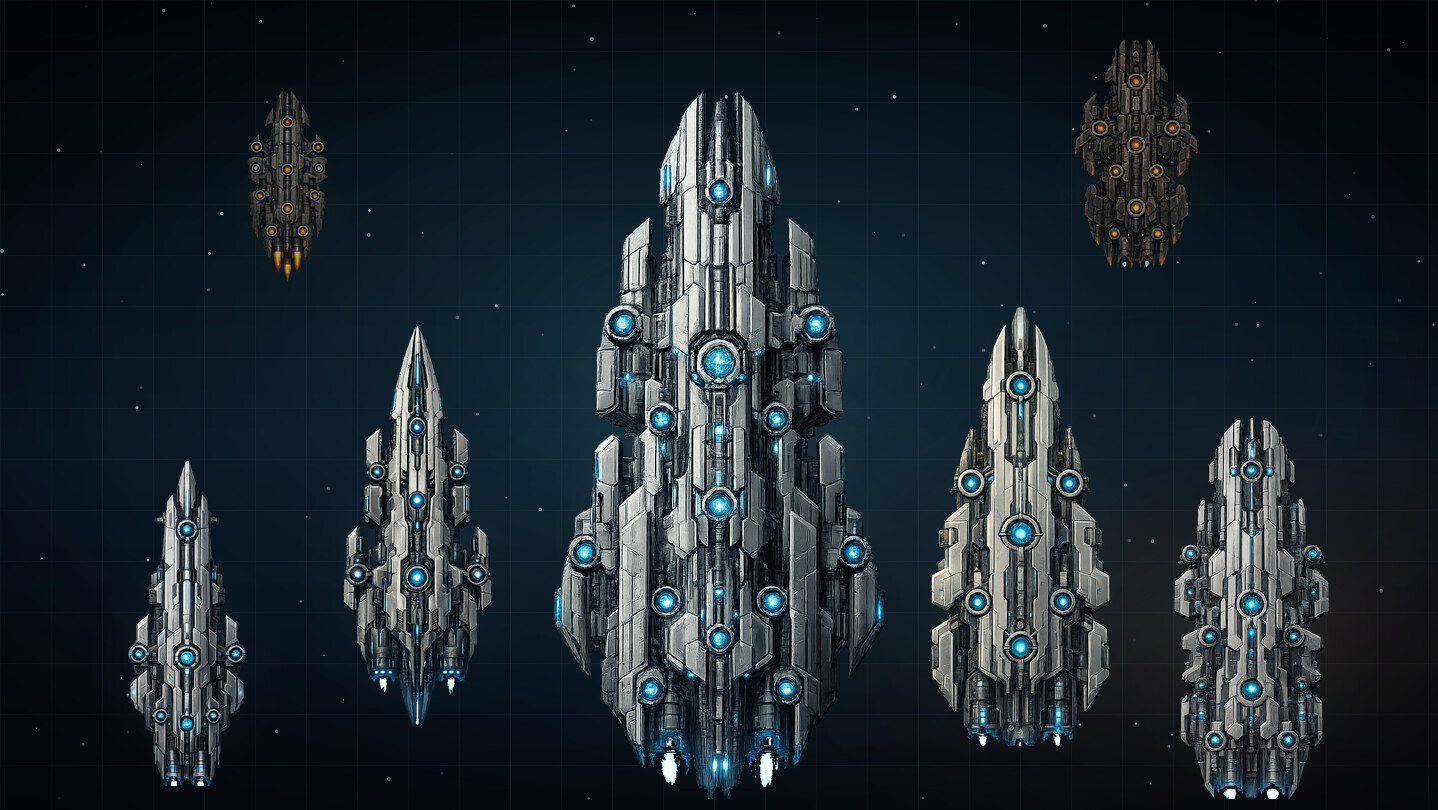
Ship construction covers seven combat classes from Corvette to Titan, plus Utility Carrier and Fleet Carrier variants. Every ship is fitted socket by socket with weapons, auxiliary systems, individual drive slots, armor and a choice of citadel. Weapons have their own firing arcs and can be re-aimed within the limits of their mounts. Most systems also have upgrade or alternate versions to unlock, including torpedoes, mine layers, EMP weapons, drone wings, point defense, cloaking fields and repair systems. Later in the campaign a Refit Program opens alternate faces for whole families of systems, each bought individually rather than granted.

Combat is the deepest part of the current game. Damage is positional and resolved through internal hull compartments, so where a shot lands matters. Shields, armor, point defense, electronic countermeasures and terrain all affect incoming fire. Battles take place on fields containing asteroids, nebula clouds, wreckage, meteor showers and gravity wells.

Enemy fleets are generated to fit the available battle budget across three difficulty levels. Four doctrines affect both fleet composition and battlefield behavior, including range discipline, kiting, focus-fire priorities and screening formations.

The build also includes multiple campaign saves with Steam Cloud support, an After-Action Report with battle statistics, a Wayfarer Codex that fills in as you meet new ships, factions and places, display and audio settings, interface scaling, rebindable controls, tooltips, shape-coded status information, adjustable effect density and reduced-flash settings.

Several parts of the game remain unfinished, and I would rather say so plainly. Balance has been tuned through automated testing and my own play, but it has not been tested against the range of strategies a larger group of players will find. The enemy AI is functional and doctrine-aware, and I expect to keep sharpening it against the strategies players actually bring. Much of the current artwork is prototype work and the soundtrack uses licensed music. Improving both is part of the planned presentation work. The largest fleet engagements are also the most demanding performance cases.

Updates can occasionally require save migration. When compatibility cannot be preserved, I will explain the issue in the update notes, and I keep the previous build available on a rollback branch where practical.”

Will the game be priced differently during and after Early Access?

“Yes. I plan to offer Armada Ascendant at a lower price during Early Access and may increase the base price as substantial new content and features are added. The final decision will reflect the scope and state of the game at that time.

Any planned price increase will be communicated in advance. Players who purchase the game during Early Access will retain access to the full version without needing to pay the difference.”

How are you planning on involving the Community in your development process?

“Steam Discussions will be the main channel, and it will stay the primary record even after I add a Discord, so that useful reports remain searchable instead of scrolling away in chat.

What I can commit to is how feedback gets handled. Update announcements will list known issues alongside the fixes. When something changes because a player raised it, I will say which change and why. When I decide against a popular request, I will say that as well, rather than leaving it unanswered until people reasonably conclude it was ignored.

Two things in the build exist to make reports concrete rather than anecdotal. The game keeps a record of your recent battles for its own after-action reporting, held on your computer. It is never transmitted, and the telemetry system has no upload path. If you switch on log export in the Settings menu, the game saves a copy to a file you can attach to a post, so that a balance argument can rest on figures rather than impressions. Export stays off until you turn it on.

I also intend to run an opt-in beta branch, so that patches can be tried by players who enjoy that kind of testing before they reach everyone else.

What I would value most is disagreement. Tell me a mission felt unfair, that a weapon is obviously the wrong pick, or that the interface made a simple action harder than it needed to be. Those reports move the game further than agreement does.

I will not be able to act on everything. Saying so now seems better than letting silence answer for me later which never seems to end well.”
Read more
This game is not yet available on Steam

Planned Release Date: March 2027

Interested?
Add to your wishlist and get notified when it becomes available.
 
See all discussions

Report bugs and leave feedback for this game on the discussion boards

About This Game

Build the fleet. Take the shot.


Armada Ascendant is a top-down fleet-tactics game built around direct, physical gunnery. Pull back from a ship, judge the power and angle, then release. Rounds leave the weapon dead-straight and only begin to drift after their accurate range, making close fire a test of aim and long fire a calculated risk.

Every ship is your design


Choose a hull, fit its real sockets, mount engines, install a Citadel, set weapon facings, and decide which defensive and support systems deserve the limited space. The same fitted design appears in battle: broadside guns fire from their actual mounts, engines can be disabled, and every section of the hull supports a specific internal system, or nothing but raw structure.

How you deal damage changes the battle


Shields absorb the opening exchange but only return when a ship gives up its entire activation to recharge them. Armor is ablative. Hull and Citadel damage can destroy a ship outright. Weapons, engines, and auxiliary systems have their own health, and wrecking one damages the hull that supports it. Repair ships can bring systems back online, but they cannot erase every loss.

Command a persistent campaign fleet


Take on the title and responsibility of a Wayfarer and lead the Castalia Concord through a 60-mission campaign across eight operations. Earn Credits, commission new hulls, promote veteran crews, unlock new ship classes and systems, and carry unrepaired damage into the next engagement. Early losses are recoverable. Once the counteroffensive begins, they are not: destroyed ships stay destroyed, and your fleet grows from a handful of light ships into a full armada while the cost of keeping it operational grows with it making your battle decisions matter all the more.

Fight across changing battlefields


Asteroids, wreckage, nebulae, gravity wells, mines, fortified bases, and armed control stations reshape the firing lanes. Battles alternate activations instead of resolving whole fleets at once, so positioning a screen, protecting a damaged capital, or spending a turn on repairs can matter as much as taking the shot itself.

Current Early Access features


  • 60-mission single-player campaign across eight operations, each ending in a capstone battle
  • Persistent fleet progression, with permanent losses once the real pressure begins
  • Configurable Skirmish battles against the computer or a second local hotseat player
  • Seven line-ship classes from Corvette through Titan, plus two carrier classes
  • Four visual hull lines across the Concord and its adversaries, two of them unlockable
  • Socket-based construction with individually aimed weapon mounts and fitted drive slots
  • Kinetic, scatter, rail, missile, flak, energy, mine, EMP, drone, interceptor, repair, shield, cloak, ECM, and point-defense systems
  • Layered Shield, projected Over-shields, Armor, Hull, Citadel, and System damage
  • Deathmatch, Control Points, Base Assault, Holdout, and Breakthrough objectives
  • 64 optional objectives and 28 mastery conditions across the campaign
  • A Refit Program of alternate system faces, and a Wayfarer Codex that fills in as you fight
  • Five fleet scales supporting battles of up to 50 ships per side
  • Multiple campaign save slots with Steam Cloud sync
  • Three difficulty settings, enemy doctrines, configurable audio, display, accessibility, and keybinding options

AI Generated Content Disclosure

The developers describe how their game uses AI Generated Content like this:

The ship and part artwork was generated with AI, then hand-edited and traced by me into the sprites and collision shapes the game actually uses.
Nothing generative runs while you play. There is no AI service wired into the build, and the game never calls one.
The music is licensed from real artists, and the sound effects come out of a script I wrote. Neither is AI.
I want to replace the AI art with work from real artists before Early Access ends. I am not going to promise a date for that, but it is what I am working toward.

System Requirements

    Minimum:
    • Requires a 64-bit processor and operating system
    • OS: Windows 10 64-bit
    • Processor: Dual-core 2.5 GHz (Intel Core i3-4000 series or AMD equivalent)
    • Memory: 4 GB RAM
    • Graphics: Integrated graphics with DirectX 11 support (Intel HD Graphics 4000 or better)
    • DirectX: Version 11
    • Storage: 1 GB available space
    • Sound Card: Any Windows-compatible sound device
    • Additional Notes: Mouse required.
    Recommended:
    • Requires a 64-bit processor and operating system
    • OS: Windows 11 64-bit
    • Processor: Quad-core (Intel Core i5 or AMD Ryzen 5)
    • Memory: 8 GB RAM
    • Graphics: Dedicated graphics card with DirectX 12 support
    • DirectX: Version 12
    • Storage: 1 GB available space
    • Sound Card: Any Windows-compatible sound device
    • Additional Notes: 1920x1080 or higher recommended for the largest fleet battles.
Review Filters