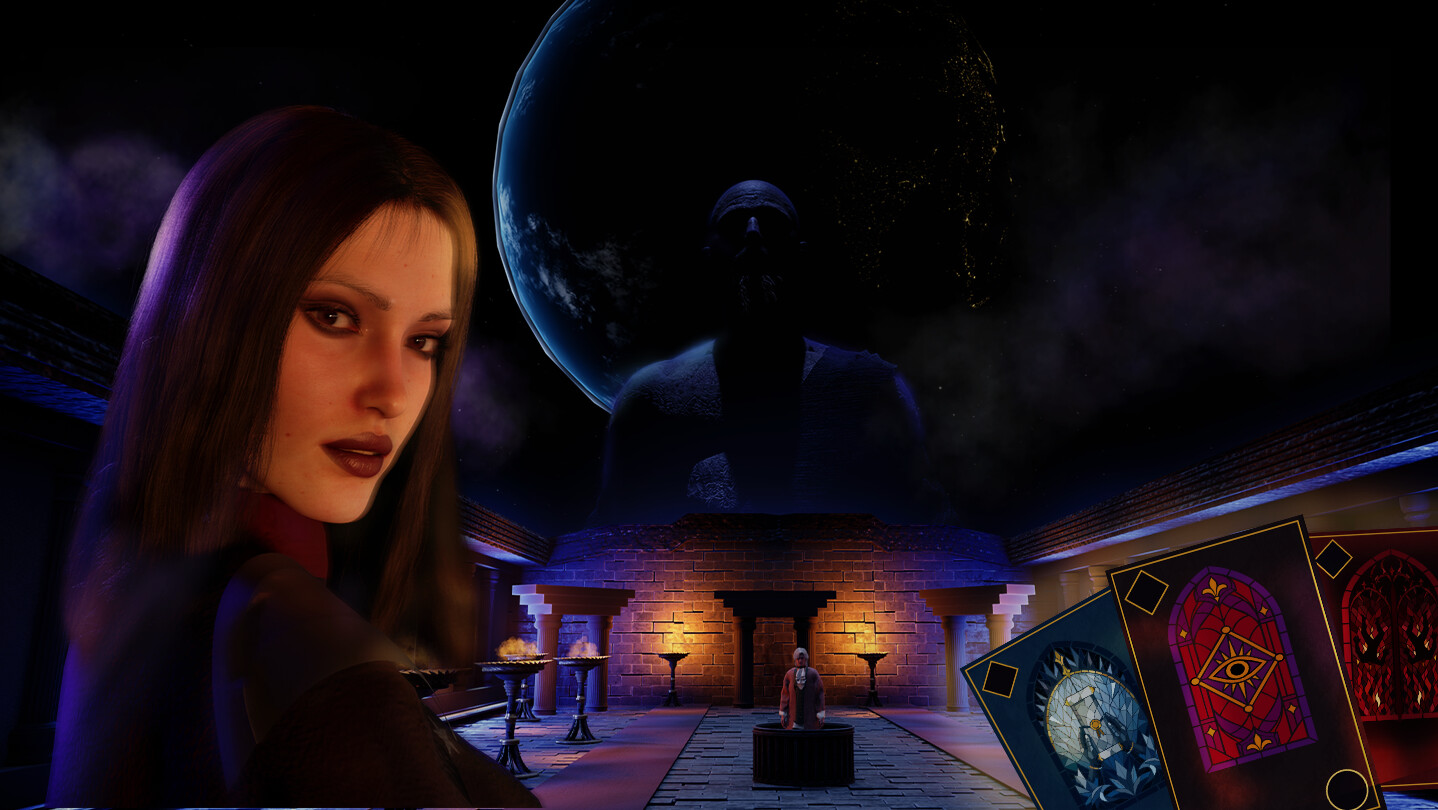


Put history on trial in a cosmic courtroom. Manipulate Sanity, Guilt, and Arrogance to psychologically dismantle legendary figures, uncover the truth, and deliver your verdict in this roguelike deckbuilder.

Sign in to add this item to your wishlist, follow it, or mark it as ignored

Coming Soon To Early Access

The developers of this game intend to release as a work in progress, developing with the feedback of players.

Note: Games in Early Access are not complete and may or may not change further. If you are not excited to play this game in its current state, then you should wait to see if the game progresses further in development. Learn more

What the developers have to say:

Why Early Access?

“Eye of the Giant is a story-driven roguelike deckbuilder, and stories are
the hardest thing to test alone. The trials, the cards, the way each
defendant's arrogance breaks — all of it needs real players reacting to it
before I can call it finished.

I'm a solo developer. Early Access lets me put the courtroom in front of
people while the verdict is still being written, and shape the remaining
trials around what actually lands. If a card feels weak, if a confession
feels unearned, I want to hear it now — not after 1.0.”

Approximately how long will this game be in Early Access?

“I'm planning for roughly 6 to 9 months in Early Access, though this may
change depending on the scope of feedback and how much the trials evolve
along the way.”

How is the full version planned to differ from the Early Access version?

“The full version is planned to tell the complete story. Early Access covers
the opening trials — the later defendants and the final judgment are still
in development, and some characters won't appear until 1.0.

Beyond the story, I'm planning to expand the card pool, deepen the
relationship system with the two jurors, add more branching outcomes and
additional endings depending on how you rule. Balance, pacing and polish
will keep evolving based on player feedback.”

What is the current state of the Early Access version?

“The Early Access build is fully playable from start to finish within its
current scope. The core loop is complete: you take the seat of the judge,
build a deck, and break down each defendant's arrogance until they confess.

What's in: the opening trials, the core card system, the four psychological
stats, and the jury relationship system.

What's not in yet: the later defendants, the final judgment, and a large
portion of the card pool. Some story arcs end where development currently
ends.”

Will the game be priced differently during and after Early Access?

“The price is planned to increase modestly when the game leaves Early Access,
reflecting the additional content. Players who buy during Early Access will
receive all future updates at no extra cost.”

How are you planning on involving the Community in your development process?

“I'm a solo developer, so feedback reaches me directly. I plan to be active
in the Steam Community Hub and discussion boards, reading every thread and
responding where I can.

The trials in this game are built around player choice, and I want the
remaining ones shaped by how people actually play. If a card feels weak, if
a confession feels unearned, or if a defendant's arc doesn't land — that's
exactly what I want to hear. Bug reports, balance notes and story feedback
all shape what comes next.”
Read more
This game is not yet available on Steam

Planned Release Date: Nov 4, 2026

This game plans to unlock in approximately 2 months

Interested?
Add to your wishlist and get notified when it becomes available.
 
See all discussions

Report bugs and leave feedback for this game on the discussion boards

About This Game

PUT HISTORY ON TRIAL

Eye of the Giant is a roguelike deckbuilder about interrogation, judgment, and psychological warfare.

You sit as Judge in a courtroom outside of time. Your defendants are not monsters or fictional villains. They are the figures who shaped history: Isaac Newton. Genghis Khan. Odin.

They cannot be killed.

They can only be broken down, card by card, until they confess.

Or until you decide they should be forgiven.

The verdict is yours.

THEY DON'T HAVE HEALTH BARS. THEY HAVE PRIDE.

Every defendant enters the courtroom with four psychological states instead of HP:

SANITY — Their grip on reality. Push it too far and paranoia takes over their deck. Break it completely, and the defendant loses their mind before they can confess. A madman cannot tell you the truth.

CONVICTION — Their belief that they were right. The stronger their conviction, the harder they fight back.

ARROGANCE — Their defenses. Threats, bluffs, accusations, and pressure can all be turned aside by a defendant who still believes they stand above judgment.

GUILT — The only path to confession. Break the other three, and the truth can finally surface.

Every defendant has a breaking point.

Your job is to find it.

EVERY CARD IS AN ACCUSATION

You don't simply drag cards onto an enemy.

Each card is placed into the Decision Point at the center of the bench. From there, it burns away as it leaves your hand, becoming an accusation, manipulation, threat, or revelation that crosses the courtroom.

The defendant responds according to their current state.

A barrier.

A justification.

A counterattack.

A confession.

Or something you did not expect.

Use the Rotten Apple against Newton and he may begin to explain himself. He may tell you about the crippled child. He may convince himself that he had no choice.

His excuse can strengthen his Arrogance while reducing his Guilt.

The right accusation is not always the one that deals the most damage.

Sometimes, it is the one that makes a defendant believe they are right.

TWO JURORS. ONLY ONE STAYS.

You are not alone in the courtroom.

Lilith and Elysa move around the bench as you work. They whisper. They argue. They influence your decisions.

One pulls you toward mercy.

The other toward cruelty.

Both sound reasonable.

Both are certain they are right.

Their influence changes more than dialogue. Their affinity affects the cards available to you, the choices presented during trials, and the direction your judgment takes.

But there is a limit.

You cannot keep them both.

Choose one, and the other will remember.

EVERY VERDICT REWRITES THE WORLD

Your trials do not end at the courtroom door.

Every verdict changes the world below.

After each session, the bailiff Sadık brings you the Daily Paradox — a newspaper from an Earth quietly rewritten by your decisions.

Some headlines will look familiar.

Some will describe events that never happened.

Some will contradict everything you thought you knew.

And some will be about you.

Acquit or condemn.

Forgive or punish.

There is no guaranteed good ending and no guaranteed bad one.

There is only your judgment — and the world that follows it.

THE GIANT IS NOT YOUR JUDGE. HE IS YOUR JAILER.

You are not a body.

You cannot die.

When your judgment fails, a voice speaks from above the bench:

“Insufficient. Judgment resets.”

The trial begins again.

Your deck scatters.

Your memory remains.

Something has been watching from above the courtroom.

The Giant has been bound to this place for longer than anyone can remember. He has watched the greatest minds in history stand before the bench, one after another.

He has been waiting for someone.

Someone capable of passing judgment.

Someone who might finally understand why this courtroom exists.

You woke at the bench without a name or a past.

Sadık says the previous Judge did not last long.

He says it like he has said it before.

The files keep coming.

Newton.

Genghis Khan.

Odin.

And countless others.

Nobody tells you why you were chosen.

IN EARLY ACCESS

  • The opening trials, from the Whisperer's first tale to the Judgment of Sir Isaac Newton

  • The complete four-stat psychological combat system

  • The Decision Point card system and starting card pool

  • The jury affinity system featuring Lilith and Elysa

  • Multiple verdict outcomes for each trial

  • The Daily Paradox, revealing how your judgments reshape the world

AI Generated Content Disclosure

The developers describe how their game uses AI Generated Content like this:

Some visual assets were partially created with the help of generative AI. It was used as a reference for a few alpha brushes, clothing patterns, and some card designs. No output was used as-is — everything was heavily modified and finished by hand. All other content in the game was created entirely by the developer.

System Requirements

    Minimum:
    • OS: Windows 10 64-bit
    • Processor: Intel Core i5-6600K / AMD Ryzen 5 1600
    • Memory: 8 GB RAM
    • Graphics: NVIDIA GeForce GTX 1050 Ti 4GB / AMD Radeon RX 570 4GB
    • DirectX: Version 12
    • Storage: 12 GB available space
    • Sound Card: DirectX compatible sound card
    • Additional Notes: SSD recommended. Low settings, Lumen disabled.
    Recommended:
    • OS: Windows 10/11 64-bit
    • Processor: Intel Core i5-10400 or AMD Ryzen 5 3600
    • Memory: 16 GB RAM
    • Graphics: NVIDIA GeForce GTX 1660 SUPER (6 GB) or AMD Radeon RX 5600 XT (6 GB)
    • DirectX: Version 12
    • Storage: 15 GB available space
    • Sound Card: DirectX compatible sound card
    • Additional Notes: SSD required for best performance.
Review Filters