
Behind every great victory is someone who got the roles right. Forge five adventurers, arm them, plot out their talents, build the party — then send them into twelve dungeons and find out whether you saw it coming.

Sign in to add this item to your wishlist, follow it, or mark it as ignored

This game is not yet available on Steam

Planned Release Date: Q3 2026

Interested?
Add to your wishlist and get notified when it becomes available.
 

About This Game

You do the preparing. The fight takes care of itself.


One camp, five adventurers, twelve dungeons.

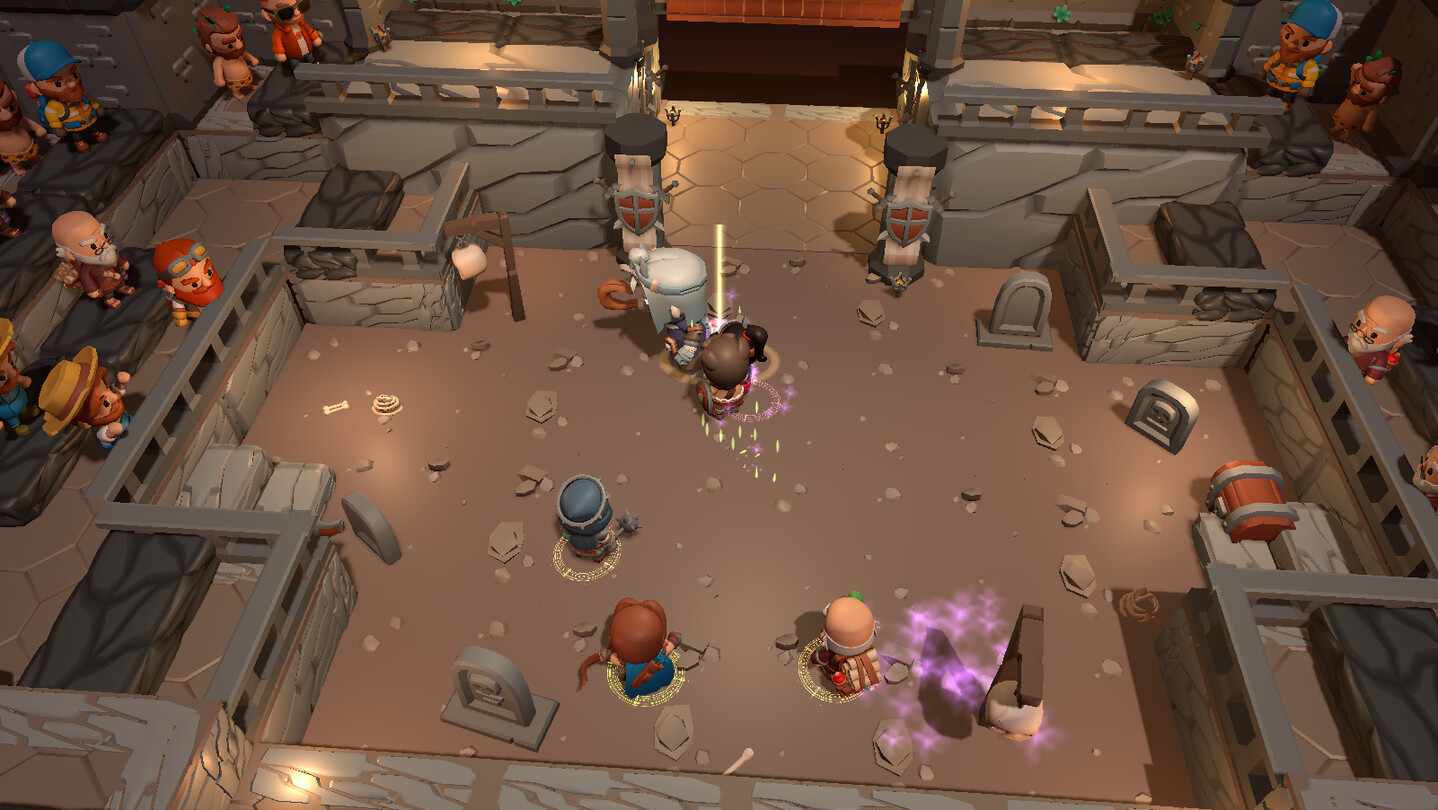
You control nothing once a fight starts. You choose who goes down, with which gear, with which talents. Then you watch, and you find out whether your preparation held. Every defeat is a sentence about what you should have planned for.

Ten classes, twenty paths


Warrior, Ranger, Priest, Paladin, Ninja, Cleric, Orc, Druid, Mage, Duelist. Each one swears to one of their two paths, and swearing one closes the other: a Paladin will hold the wall or heal, never both.

The trees are not lists of bonuses. They are graphs where a node opens only once you have mastered its parent — thirty points at the cap, sixty nodes per tree. You will never have all of it.

Three ways to send your people out


  • The Arena — duel, two against two, or three against three. Nothing at stake: this is where you test a build in two minutes.
  • The Gauntlet — five rounds back to back, health carrying over from one fight to the next. The fourth round is won during the second.
  • The Dungeon — a full descent, several packs, and a boss at the end who has rules of his own and tells you what they are before you go in.

Twelve dungeons, and an escalation that goes off the rails


You start with a crypt full of skeletons. It is reassuring, and it is meant to be. Then there is a gardening robot in a wood, a mining station with no air, an inn whose slate carries names you recognise.

Nobody will ever explain to you why these places sit on the same itinerary. What you bring back from them, on the other hand, shows: every dungeon cleared for the first time leaves one more crate on the table in the yard. Eleven dungeons leave one. The twelfth is the Pit, and the Pit does not get cleared.

A company, not a hero


A dungeon asks for a number of places, and it does not negotiate: going down with four where five are needed is a descent lost before the first blow. So you build around real roles — who holds the threat, who heals, who hits — and you raise up to five adventurers in the same camp, all served by the same chest.

And the camp changes. Not in a quest log: an anvil, a portcullis, a table that were not there yesterday. It is the game's only progress report, and it does not lie.

What the game promises you


  • From level 1 to 30, it walks with you. The thread names the next dungeon, opens the menu piece by piece and tells you what to bring. No wall, no grind.
  • After that, it lets go of you. Nightmare mode replays the whole game at the cap, with nothing left to hold your hand. That is where the build counts.

What the game does not do


No multiplayer, no leaderboard, no social tab, nothing more to buy. It is a single-player game, written and built by one person, and all of it is there the moment you install it.

Anonymous play statistics


The game sends a handful of anonymous play statistics (play time, dungeons attempted, level reached) to see where players stop. Never a name, never an address — one random id per install. It can be switched off in Settings → Anonymous statistics.

AI Generated Content Disclosure

The developers describe how their game uses AI Generated Content like this:

The Rumble Pit is made by one person, and generative AI tools were part of how it was built.

Music: the tracks you hear in the menus and in the twelve dungeons were generated with a local AI music model, from a written brief for each place, then cut, looped and mixed by hand.

2D art: the interface icons, the class and specialisation emblems, the dungeon thumbnails, the illustrated boss backdrops and the logo were produced with image generation tools, then cropped, cleaned up and colour-matched by hand.

Text and code: much of the in-game text — talent names and descriptions, loot labels, boss briefings, the translation tables — and part of the source code were drafted with an AI assistant, then edited, tested and rewritten by hand.

Not AI-generated: the 3D models and animations (licensed art packs), and the sound effects (CC0 libraries).

Nothing is generated while you play. The game connects to no AI service and produces no new content at runtime — everything ships as a fixed file, checked before release.

System Requirements

    Minimum:
    • OS: Windows 10 64-bits
    • Processor: Dual-core 2.5 GHz
    • Memory: 4 GB RAM
    • Graphics: OpenGL 3.3 / Direct3D 11 compatible, 1 GB
    • DirectX: Version 11
    • Storage: 1 GB available space
    Recommended:
    • OS: Windows 11 64-bit
    • Processor: Quad-core 3.0 GHz
    • Memory: 8 GB RAM
    • Graphics: Dedicated GPU, 2 GB
    • DirectX: Version 11
Review Filters