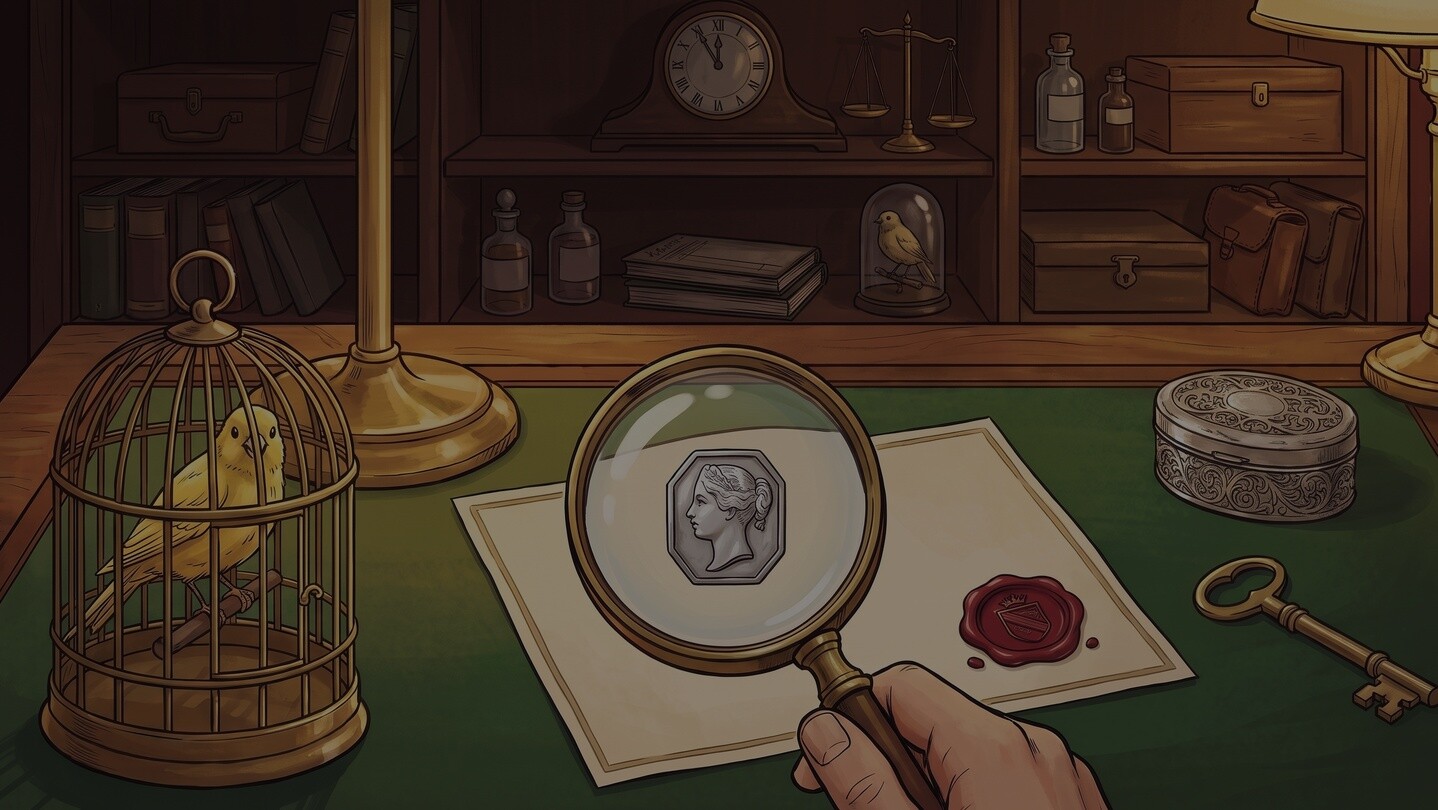


Vienna, 1901. A bureau that authenticates antiques: without your certificate the piece is worth nothing. Silver, paintings, watches, papers — each carries a truth and a lie about its history. A predecessor’s debt makes bribes tempting. And you won’t get this right every time — mistakes cost.

Sign in to add this item to your wishlist, follow it, or mark it as ignored

This game is not yet available on Steam

Planned Release Date: November 2026

Interested?
Add to your wishlist and get notified when it becomes available.
 

About This Game

“Just say it’s genuine. Forty crowns, after the seal.”


Vienna, 1901. You have inherited your uncle’s bureau — the place people bring old things to when they need to know whether they are real. With it come his loupe, his books, his seal, and his debt: 150 crowns in seven days. An honest verdict pays three crowns. The man across the desk is offering forty.

The bureau will not help you


There is no hint button. Nothing glows. Nobody tells you that you are close. You are shown the object and everything on it, and after that you are on your own — and it is your name at the bottom.

That is what makes it hard. Not that something is hidden from you — the mark is right there under the loupe. It is that the thing looks real, reads real, and isn’t, and the only person answerable for the difference is you.

Everything you write must be something you saw with your own eyes: the mark under the loupe, the streak the metal left on the stone, the line in the book. If you didn’t see it, you can’t write it.

Then comes the seal: hot wax on the paper, and the press down on top of it. The wax hardens in a second and nothing can be rewritten. Three seals over a lie and the bureau closes for good.

Seven days is not a long week. Most people never see the seventh day: the bureau shuts before the week runs out. Honestly, you probably won’t finish this game. Prove us wrong.

Seven days, each one harder than the last


On the first day the lie is easy to see: copper coming through where the silver has worn away.

After that it hides. Put the thing on the scales against a weight you trust and the beam tips the wrong way. Lower it into water and the water rises higher than it should: something heavier is sitting under the gilding. Tilt the lamp and the shadow drops into a dent where somebody ground a hallmark off. Breathe on cold metal and the mist clears in a neat square — a patch was soldered in there. Hold a template against the edge and there is a gap, because that curve was made in another century.

And it is not only silver. Papers and documents follow, a canvas restretched onto somebody else’s frame, furniture with a false bottom, a collector’s curiosities — a fossil that arrived from London a year too early to have arrived at all.

By the seventh day you can test a thing six different ways — and whoever is making these forgeries is learning at exactly the same speed you are.

Nothing here is a menu


The bribe is on the desk before you start, and it sits in front of you while you work. Take it, or put it in the stove.

The dealer you can prove is a thief is standing in your office, and the gendarmes are two streets away. Turn him in, or say nothing and keep a client.

Tell a widow the truth and she leaves with nothing, and you have earned your three crowns.

You never pick a line of dialogue from a list. You simply do it — and the bureau’s book remembers what you did.

Four endings. Only one of them is earned


Nothing decides your ending except the papers you signed. Three of them you merely survive into. The fourth has to be won, and it comes down to a single document nobody meant to hand you for examination: your own.

The office is keeping things from you as well


The dust on that shelf is broken in an arc — the box was moved recently. One book’s spine is worn far more than its neighbours. The card index is locked with a code, and the clock in this room stopped at 15:06. Seven hiding places across seven days: you spot one during the day and open it in the evening, once the clients have gone.

Vienna, 1901


Theodor Haas kept this bureau at Wollzeile 17 for thirty years. A city of dealers, moneylenders and workshops, where every piece of silver carries somebody’s mark. A workshop can close in 1869 and its mark still turn up on silver made in 1874. Somebody is putting those marks there.

Nobody killed your uncle. They broke him with paperwork — and they still hold the paper.

AI Generated Content Disclosure

The developers describe how their game uses AI Generated Content like this:

Only background artwork, and transformation scenes

System Requirements

Windows
macOS
    Minimum:
    • Requires a 64-bit processor and operating system
    • OS: Windows 10 64-bit
    • Processor: 2 core from 2Ghz
    • Memory: 4 GB RAM
    • Graphics: support OpenGL 3.3 або Vulkan
    • Storage: 1 GB available space
    • Sound Card: any suported
    Recommended:
    • Requires a 64-bit processor and operating system
    Minimum:
    • OS: MacOS
    • Processor: Intel Core M
    • Memory: 2 GB RAM
    • Graphics: Any Supported
    • Storage: 2 GB available space
    Recommended:
    • OS: MacOS
    • Processor: Apple M1
    • Memory: 2 GB RAM
    • Graphics: Any Supported
    • Storage: 2 MB available space
Review Filters