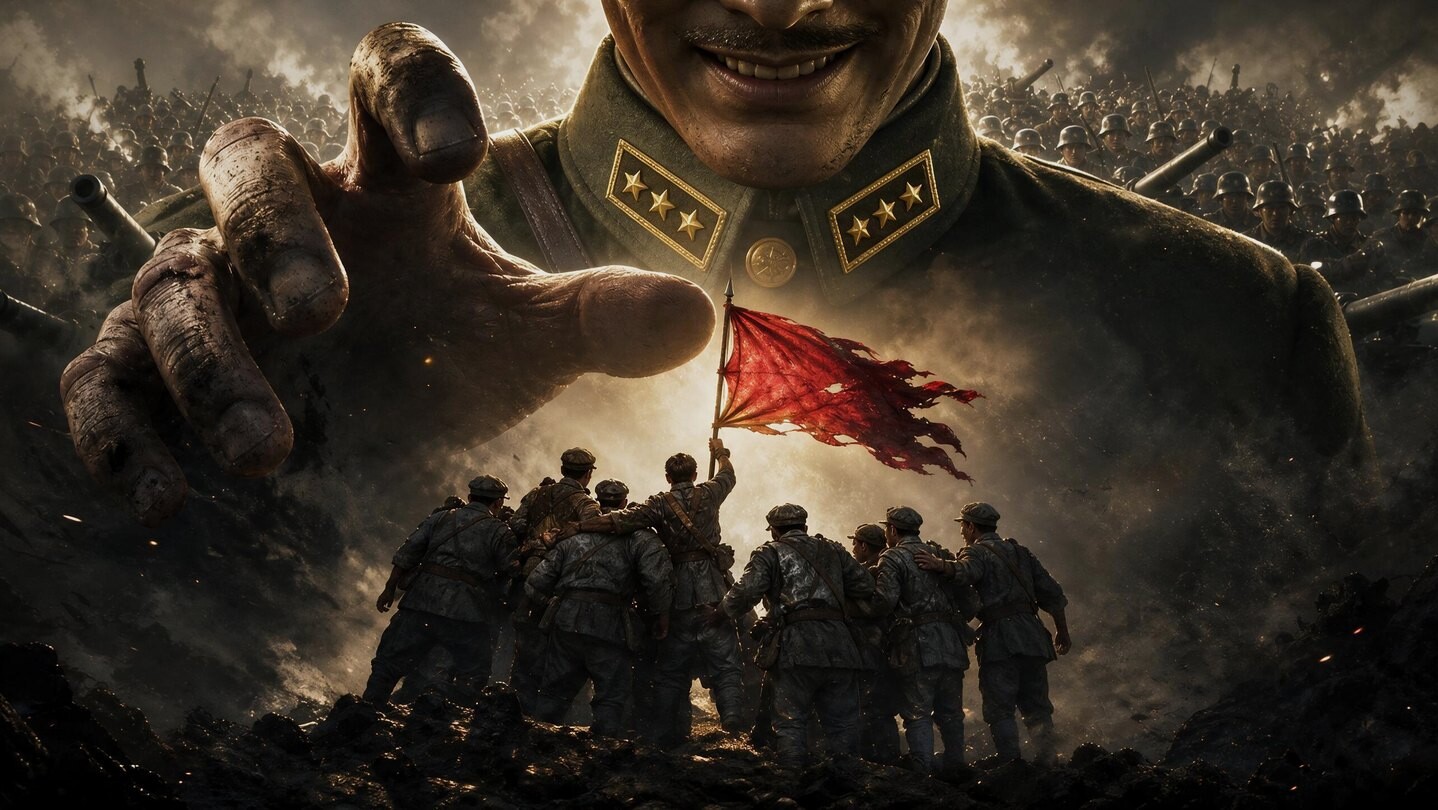


A turn-based hex wargame on the 1935 Four Crossings campaign. Command 30,000 Red Army troops through 100 daily turns: scout, decrypt enemy telegrams, cross rivers under fog, deceive pursuers with fake radio orders, break out via one of three routes.

Sign in to add this item to your wishlist, follow it, or mark it as ignored

This game is not yet available on Steam

Planned Release Date: September 2026

Interested?
Add to your wishlist and get notified when it becomes available.
 

About This Game

Four Crossings of the Chishui River Simulator is a turn-based, hex-grid wargame on the Red Army's 1935 campaign of the same name. Acting as the Central Revolutionary Military Commission, you command the army groups of the Central Red Army in daily turns, from the withdrawal at Tucheng on January 26, 1935 to May 5 — breaking out under incomplete intelligence, with the Yangtze river defenses to the north, Hunan divisions blocking the east, and the Central Army's relentless pursuit at your back. This is not a scripted level to walk through. It is an open campaign simulation.

■ An Open Breakout — Three Mutually Exclusive Routes

Choose one of three escape routes: north across the Yangtze, east into Hunan to join the Red 2nd and 6th Army Groups, or west through Yunnan toward the Jinsha River. Succeed on any one of them and you win. Nothing is rigged against you.

The northern and eastern routes are genuinely winnable under the rules — their difficulty comes entirely from forces that actually existed: Sichuan Army river-defense brigades holding the Yangtze in strength, the Chuanjiang police flotilla patrolling its waters, and four Hunan divisions dug in across eastern Guizhou. Scout and decrypt before committing your main force, and you can weigh the price of every route in advance.

Emergent objectives appear as the campaign unfolds: concentrate the army at Zhaxi for reorganization, hold the Maotai crossing, or threaten Guiyang to pull the Yunnan Army out of position — each pays off in tangible mechanical benefits.

■ The Intelligence Contest and Electronic Deception

The fog of war hides the enemy, never the terrain. Enemy positions are unknown by default.

Intercept and decrypt KMT telegrams — most quoted from archival originals, a few reconstructed from historical records — triggered by time windows, unit positions, and enemy states. Chiang Kai-shek's orders, Long Yun's hesitations, Pan Wenhua's river-defense arrangements are all there in the traffic: read the telegrams, and you will know what the enemy intends to do next.

Intelligence on each escape route is disclosed in stages. The Commission's original plan was to cross the Yangtze — whether to change course after decrypting the river-defense telegrams is your call.

Deception tools: radio disguise sends a decoy detachment with a transmitter to draw enemy direction-finding; any unit can deliberately draw fire to shield the column; forged KMT radio orders rewrite enemy march destinations — turn the enemy's command system into your own weapon.

■ Command and Logistics in a War of Movement

A dozen-plus commands: march, forced march, bridging, bridge demolition, detach, reorganize, recruit, reconnoiter, conceal, attack, defend — plus the radio-deception set.

Split and merge: send detachments along mountain trails to scout and infiltrate while the main force moves by road — the two scales differ in action points and terrain capability.

Supply is a hard constraint. Every unit consumes fixed rations each day; every hex holds a finite larder, stripped bare once used; mountains offer almost nothing to forage; towns supply in tiers; captured stocks help. The army cannot sit still — it must live on the move.

Combat resolves through seven modifiers — strength, attack versus defense, terrain, morale, faction, scale, and supply. Winning against the odds is a matter of terrain and timing.

■ Serious Historical Research

A hex battlefield of 82×73 — nearly six thousand hexes — with terrain built from AMS military-map grids and SRTM satellite elevation data. The Yangtze, the Chishui and the Wu rivers, Loushan Pass, Zunyi, Maotai, Tucheng and other crossings and towns are anchored by their real coordinates.

Weather for all 100 days comes from documentary research — 52 days from primary sources such as the diaries of Tong Xiaopeng and Chen Bojun. Rain and snow bog down marches, fog shrinks vision, storms ground enemy aircraft, and bridging in the rain takes longer. The rules are symmetric: the Red Army could dare move on stormy nights precisely because enemy planes could not fly either.

Forces follow historical figures. The Red Army takes the field with roughly 24,000 combat troops (the 30,000-plus headcount includes non-combat headquarters personnel); the 200,000-odd fielded and garrison enemy are physical units on the map, while the "400,000" counts the entire strategic encirclement net.

Each enemy faction behaves as it did in history: Sichuan units hold their own soil and push no deeper into Guizhou; Guizhou troops garrison key points and fight poorly; the Central Army pursues relentlessly; the Yunnan Army holds the Yunnan–Guizhou border and moves only when the Red Army actually enters Yunnan; the four Hunan divisions appear under their real designations.

The enemy has intelligence assets too: aerial reconnaissance and radio direction-finding keep searching for you. Concealment, disguise, and weather are your counters.

■ Debrief and Replay

A black-box replay system records every turn — orders issued, combat resolution numbers, enemy movements, telegrams, and events — in the save file. After the campaign, replay it turn by turn and audit every decision.

Four difficulty levels: Novice, Standard, Hard, and Historical Hardcore. Historical Hardcore restores the enemy — above all the KMT Central Army — to its true historical order of battle, with far more units on the map. Structural difficulty, not stat inflation.

Switch freely between the 2D staff map and 3D terrain views.

AI Generated Content Disclosure

The developers describe how their game uses AI Generated Content like this:

As an individual developer, during development of this game, AI tools were heavily used. I disclose this honestly and transparently.

1. In-Game Assets
Illustrations & Art: Unit portraits and the opening cinematic illustrations were generated using AI image models, then manually curated, retouched, and unified in style. All assets were human-reviewed under strict art direction to ensure historical tone and consistency.
Opening Cinematic: Subtle motion effects on the illustrations were produced with an AI image-to-video model and assembled by using the Remotion pipeline.
Background Music: The soundtrack was generated by an AI music model in multiple takes, then human-selected, mixed, and mastered.
Telegram Voice-overs: The historical telegram voice-overs in-game were synthesized by an AI TTS system. Each character's reference voice was human-approved through listening tests before use.
2. Development Assistance
Code: Game code was written and debugged with the aid of AI coding assistants. All code was human-reviewed and validated through automated testing.
Localization: The game supports Simplified Chinese, Traditional Chinese, and English. The English text was AI-drafted and human-proofread.
3. What Is NOT AI-Generated
Historical Text: The telegrams in-game are taken from historical archives, 34 are verbatim transcriptions of the original documents, and 12 were written based on the sources. They were not AI-generated.
Terrain & Map: The battlefield map was procedurally rendered from real elevation data (SRTM), not generated by AI.
Game Balance & Statistics: Troop strength, Unit Introduction, and values were researched and set manually from historical sources, cross-checked for accuracy and play balance.

System Requirements

    Minimum:
    • Requires a 64-bit processor and operating system
    • OS: Windows 10 64-bit及以上
    • Processor: 双核 2.0 GHz(Intel Core 2 Duo / AMD 同代)
    • Memory: 6 GB RAM
    • Graphics: 支持 OpenGL 3.3(Intel HD 4000 / GT 630 / Radeon HD 5000+)
    • DirectX: Version 10
    • Storage: 2 GB available space
    Recommended:
    • Requires a 64-bit processor and operating system
    • OS: Windows 10 64-bit及以上
    • Processor: 四核 3.0 GHz(Intel Core i5-4xxx 或更新)
    • Memory: 8 GB RAM
    • Graphics: Intel UHD 620 / GTX 750 Ti / RX 550+
    • DirectX: Version 11
    • Storage: 3 GB available space
Review Filters