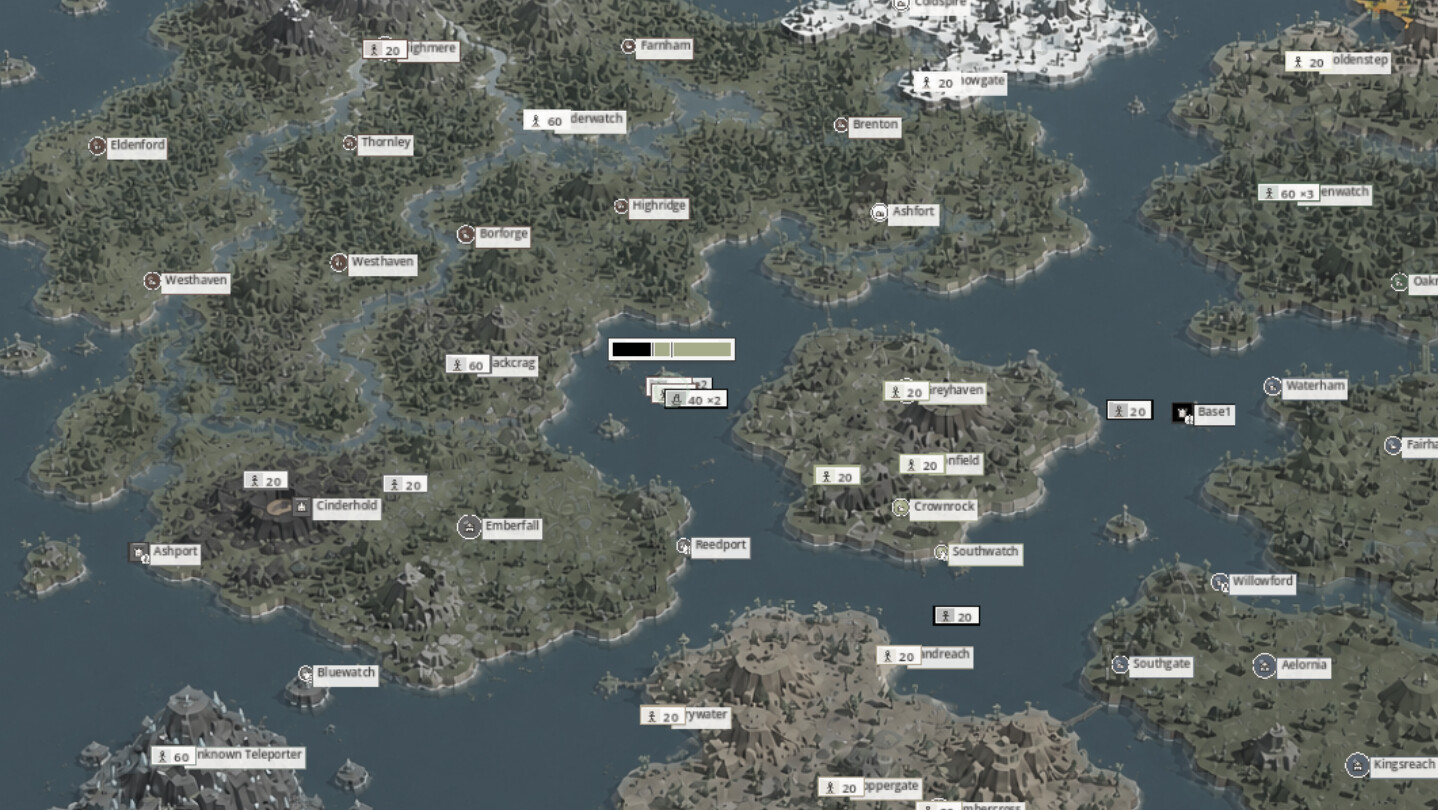


Import map images and create a grand strategic sandbox. Build nations and cities, develop technology, reform laws, handle diplomacy and turmoil, command armies, and bear the political consequences of conquest.

Sign in to add this item to your wishlist, follow it, or mark it as ignored

Coming Soon To Early Access

The developers of this game intend to release as a work in progress, developing with the feedback of players.

Note: Games in Early Access are not complete and may or may not change further. If you are not excited to play this game in its current state, then you should wait to see if the game progresses further in development. Learn more

What the developers have to say:

Why Early Access?

“Early Access will allow us to gather player feedback while continuing to develop Mapborn.”

Approximately how long will this game be in Early Access?

“We expect Mapborn to remain in Early Access for approximately 12–18 months. This timeframe may change depending on development progress and player feedback.”

How is the full version planned to differ from the Early Access version?

“The Early Access version already includes the core systems that make up Mapborn's vast strategic sandbox, including city specialization and political pressure, technology and legal reforms, diplomacy, army composition and experience, supplies, war, conquest, and assimilation. During Early Access, we plan to continue expanding available content and scenario-building options, while improving balance, AI, interface, performance, and interactions between existing systems. Specific scope and priorities may be adjusted based on development progress and player feedback.”

What is the current state of the Early Access version?

“The Early Access version includes the core playable grand strategy sandbox experience. Players can create playable worlds from custom maps, create and customize civilizations, and interact with the game's core strategic systems including expansion, technology, laws, armies, and warfare. Some systems are still being refined, and players may encounter bugs, balance issues, or incomplete features during Early Access.”

Will the game be priced differently during and after Early Access?

“We plan to gradually raise the price as we ship new content and features.”

How are you planning on involving the Community in your development process?

“We plan to use Steam Discussions as our primary channel for community feedback. Players can share suggestions, report bugs, and discuss the game there. We will review feedback throughout Early Access and use it to help improve Mapborn.”
Read more
This game is not yet available on Steam

Planned Release Date: September 2026

Interested?
Add to your wishlist and get notified when it becomes available.
 
See all discussions

Report bugs and leave feedback for this game on the discussion boards

About This Game

Mapborn is a real-time grand strategy sandbox game centered around cities, politics, diplomacy, and war.

Import your own map image or start with a preset scenario. Create nations and civilizations based on the map, define their technologies, laws, and military units, then choose one and shape its history from scratch. Conquered cities must be governed and integrated. Armies must be kept well-supplied. Political pressure can escalate into unrest or even revolution. Overexpansion may also cause other nations to see you as a common threat.

Create your own grand strategic world

Import map images and use them as the visual foundation for your strategic world. Imported images are for reference only; cities, factions, and oceans must be created manually in the editor.

Place cities, create nations, design civilizations, and configure initial armies, diplomacy, technology, laws, and victory conditions.

Build historical scenarios, fictional continents, or completely original worlds, then experience them firsthand or share your custom content via the Steam Workshop.

Mapborn is not limited to a single setting or tech tree. Its scenario and civilization tools are designed to allow different worlds to operate under different strategic rules.

Rule Through Cities

Cities are the basic political and economic units in Mapborn.

Cities generate income, provide manpower, and participate in local defense. Conscripting more people into the regular army also means less tax revenue, weaker local defenses, and a more strained supply of manpower.

Cities can develop into specialized centers for different areas, such as trade, administration, research, military training, defense, population management, or supply.

Conquest does not immediately transform a city into a loyal core. Occupied territory requires management and integration over time, and different governance policies will trade off economic output, administrative recovery, integration speed, and political stability.

Cities will raise their own political demands

If these demands are ignored for a long time, political pressure will accumulate and may gradually escalate from protests to unrest, rebellion, or even revolution. In extreme cases, cities may attempt to restore their original regimes, and the armies recruited from these cities may choose to follow them.

Taking territory is one thing.

Defending territory is another.

Warring Around Armies and Supplies

Form legions, whose members consist of units playing different battlefield roles, including frontline troops, fire support troops, reconnaissance troops, logistics troops, armored troops, siege troops, air defense troops, and amphibious troops.

Legions accumulate experience through long-term combat, gradually growing from recruits to veterans, elites, and even legendary units, and can adopt different combat postures.

However, military strength is not determined solely by combat statistics.

Army depends on supply sources, supply routes, controlled territory, and logistical capabilities. Overly long supply lines, overburdened supply networks, and hostile territory can gradually turn a well-equipped army into an exhausted and poorly supplied force.

Army forces maneuver on the map, while navy and air force perform automated tasks such as blockade, escort, interception, and battlefield support.

Diplomacy Has a Memory

Improve relations, forge alliances and defense agreements, guarantee the independence of other countries, provide economic aid, impose embargoes, designate adversaries, or establish a system of vassals.

Nations remember not only current relationships, but also long-term cooperation, refusal to honor commitments, and diplomatic betrayals.

Diplomatic capacity limits the number of diplomatic commitments a nation can maintain simultaneously, while trust and goodwill are gradually built through long-term cooperation.

Alliances Are Not Automatic War Machines

When war breaks out, eligible partner nations will receive invitations to participate and must decide for themselves whether joining is worthwhile. Refusing to fulfill obligations can damage trust, violate treaties, and leave a long-term diplomatic memory of "untrustworthy allies."

Conquest Has Consequences

Expansion changes how the world perceives you.

Global notoriety represents the world's overall perception of your expansionist behavior, while regional "aggressive expansion" (AE) records each nation's reaction to your specific territorial expansion.

Occupying a remote rural city may be insignificant to some nations. But occupying a major city of a neighboring power—or seizing territory from its allies—can provoke a much stronger reaction.

A common adversary can bring former strangers together. Continued aggression can turn neighbors into enemies. A notorious power can even become the target of a temporary punitive war.

Therefore, peace negotiations are not simply about taking as much territory as possible—you must also consider whether you can bear the ensuing diplomatic consequences.

AI Generated Content Disclosure

The developers describe how their game uses AI Generated Content like this:

Some in-game icons were created with the assistance of generative AI during development.

System Requirements

    Minimum:
    • Requires a 64-bit processor and operating system
    • OS: Windows 10
    • Processor: Intel Core i5-8400
    • Memory: 8 GB RAM
    • Graphics: NVIDIA GeForce GTX 1050 Ti
    • DirectX: Version 12
    • Storage: 1 GB available space
    Recommended:
    • Requires a 64-bit processor and operating system
Review Filters