

After the air raid, everyone in Anping evacuated inland. You didn't. A fourteen-floor apartment with no power, someone who couldn't be bothered to leave, and a fridge of food gone bad. Cards decide where the time goes: search, move, eat, sleep. No counterattack, no last stand. Just one more day.

Sign in to add this item to your wishlist, follow it, or mark it as ignored

Coming Soon To Early Access

The developers of this game intend to release as a work in progress, developing with the feedback of players.

Note: Games in Early Access are not complete and may or may not change further. If you are not excited to play this game in its current state, then you should wait to see if the game progresses further in development. Learn more

What the developers have to say:

Why Early Access?

“At its core this game is a set of numbers: how much time each action costs, how fast the eight statuses fall, how scarce supplies ought to be, how bad the days of a typhoon should get.

I can't tune those alone. I know which cupboard every can is in, and how many times a drawer has to be searched before it gives something up — which means I can't test what happens to someone who doesn't know. Those are exactly the people I need.

Early Access lets the game grow with players present, rather than growing on my own computer.”

Approximately how long will this game be in Early Access?

“The current plan is six to eight months.

The actual timeline will follow how development goes. If it needs longer, I'll say so in an update post and explain why — it won't just quietly slip.”

How is the full version planned to differ from the Early Access version?

“For the full version I plan to:

・finish building out the main systems
・design the interface properly, replacing the engine-default styling that is in place now
・extend the setting from that one apartment block to the whole of Anping

Content and balance will keep changing throughout Early Access. The above is the direction I'm working in, not a guarantee — where it actually lands will depend on how development goes and on what players tell me.”

What is the current state of the Early Access version?

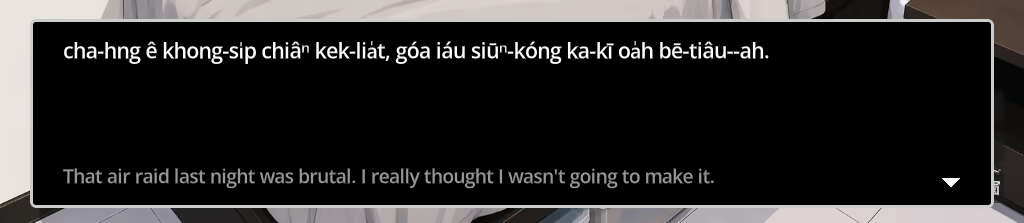
“The core systems are all running: time, the four seasons and weather, status resolution, supplies and inventory, the story scripting, quests, the codex, and the side-by-side Taiwanese Pe̍h-ōe-jī display.

Overall, my own estimate is about halfway. What's missing is volume — the number of scenes, items and story steps. The interface is also still entirely engine-default styling and hasn't been designed yet; the proper interface design will happen during Early Access.”

Will the game be priced differently during and after Early Access?

“Yes. The price during Early Access is lower than the full version — roughly 85% of it.

There will only ever be those two prices, with the single change happening when the game leaves Early Access.”

How are you planning on involving the Community in your development process?

“This is the first game I've released, and I haven't used the Steam discussion boards before — I'll be learning as I go. I may not reply quickly, but I will be reading.

Development progress will go out as update announcements, and I write dev logs on Threads as "灰森 Grayson.TW".

One thing I could particularly use help with: the English, Japanese, German and Taiwanese Pe̍h-ōe-jī in this game are all AI-translated, with no native-speaker editing pass. If you see something wrong, please just tell me.

I'm still looking into Discord; if I set one up, I'll announce it.”
Read more
This game is not yet available on Steam

Coming soon

Interested?
Add to your wishlist and get notified when it becomes available.
 
See all discussions

Report bugs and leave feedback for this game on the discussion boards

About This Game

The war reaches Anping, in the city of Tainan.

An emergency broadcast comes through on your phone. Everyone is to evacuate inland. You can't be bothered to go out, and you don't much like crowds, so you decide to stay in.

Next morning you open your eyes and you're still alive. Outside the window everything is chaos. The power is out, and whatever was in the fridge has probably turned.

That's where the game starts.

There's no counterattack, no base to defend, no fighting your way out. What you have to do is far more ordinary: stay alive one more day, in an apartment with no electricity, on whatever you can turn up by going through drawers.

This isn't a game about a hero. It's a game about the person who didn't leave — why they didn't, whether they still could, and how to get through the next few hours.

There are only ever a few cards on screen

Search, move, sleep, nap, check backpack, supplies here, codex — action cards of that kind. All you do is decide what the next stretch of time gets spent on.

  • Search — go through the room. There are cans in the kitchen cupboard, but you'll need to find the can opener first. Until then a can is just a sealed tin.

  • Move — walking from the bedroom to the bathroom takes a few minutes. Taking the stairs down from the fourteenth floor is another matter entirely. The lift doesn't work; there's no power.

  • Eat, drink, sleep — a salty can will leave you thirstier. Sleeping saves your game, and puts you through a whole night at your most vulnerable.

Every action card spends in-game time, and how much it spends is decided by the thing itself — opening one drawer and descending fourteen flights of stairs are not the same errand.

Time is the only genuinely scarce thing here. Your body will not wait for you.

What you're up against isn't a who — it's eight numbers going down

Health, fullness, thirst, energy, body temperature, injury, mood, hygiene. Each falls at its own pace, and none of them is a case of "higher is better": eating until you're stuffed is as much a problem as passing out from hunger. Every one of them has a comfortable range.

The weather won't cooperate either. Full four-season simulation: the gap between day and night temperatures, rain that settles in for days, a typhoon that arrives without warning. Nobody gets to predict tomorrow. Whatever you wake up to is the weather you get.

When it's cold, a down jacket is worth far more than a can of pineapple.

Taiwanese

Taiwanese is a language a great many people in Taiwan speak every day. Speaking it takes no thought; writing it down or reading it is where most people get stuck. There was a generation that was fined and made to wear a sign for speaking Taiwanese at school, and what survived that was the speaking, and only the speaking.

This game's dialogue is written in Taiwanese Pe̍h-ōe-jī (POJ), a romanised orthography. Choose Taiwanese and you can pick a second language to run alongside it: POJ on top, the one you can read underneath. If you speak it but can't read it, you can match the sounds up as you play. If you don't speak it at all, you still know what you're reading.

Supported languages: 繁體中文, English, 日本語, Deutsch, and Taiwanese (Pe̍h-ōe-jī).

You decide who you are in the opening minutes

At the moment you wash your face and look in the bathroom mirror — young / adult / older, male / female, six combinations. Different bodies start in different places.

You get stronger after that, but only in the bluntest way: you train what you do. Carry more and you get stronger. Walk further and your stamina improves. Strength decides how much you can carry and whether you can shift that hand cart; stamina decides how tired the same task leaves you.

No experience points. No skill tree. Only the things you have actually spent the last few days doing.

What you can carry, and what you can't

Supplies have weight, and you have two hands, one backpack, and perhaps a hand cart. What to take and what to leave behind is a trade-off you are forced into at every turn.

An expired packet of curry is both a liquid food and an expired item. Whether you eat it is your call.

That raincoat won't make you warm. What it guarantees is that you won't get soaked through — and being soaked makes your body temperature fall much faster.

There is nobody to ask

There are no NPCs in this game. From beginning to end, the only voice you hear is the protagonist talking to himself.

Scattered through the rooms are codex fragments. Picking one up unlocks a codex entry — how this war got to where it is. The announcements, the notices, the days that were once entirely unremarkable.

None of it affects whether you survive. You can go a whole playthrough without picking up a single one and still get through every day.

But you will not meet another living person in this game, and the fragments are the only way you'll come to know any of them. Whether the protagonist stops to finish reading is itself part of who he is.

About the name

Anping is a district of Tainan, and the place where this story happens.

Read its two characters the other way round and you get 平安 — safe, unharmed, having come through it. A place name that also happens to be a wish.

An-pêng, set alongside the title, is how those two characters sound in Taiwanese, written in Pe̍h-ōe-jī. It isn't Mandarin romanisation; in Mandarin the same place is Anping.

About the artwork

The scenes start as photographs taken on location — the lanes of Anping, the stairwells, apartment courtyards. Each one is then worked over: removing things that shouldn't be in the frame, commercial branding, anything touching on someone's privacy, before being stylised into animation by AI.

Every single one took a long time.

Where development stands

This is a project in development, currently made by one person.

The core systems are running — time, weather, status resolution, supplies, story and quests are all in place. Early Access will take the game out of the flat: 20 new outdoor scenes and 5 new indoor ones, so you can actually get out of that building.

One more thing worth saying plainly: the interface is currently all engine-default styling. Buttons, windows and lists have not been designed yet. The proper interface design will be done during Early Access.

Early Access is planned for late 2026.

“What was in the fridge has already gone off. A while longer won’t hurt.”

AI Generated Content Disclosure

The developers describe how their game uses AI Generated Content like this:

This game uses generative AI for the following:

Images: the source material for both the scene artwork and the item icons (backpack, hand cart and so on) is photographs taken by the developer — the scenes in the lanes, stairwells and apartment courtyards of Anping, Tainan; the items shot as physical objects. Each photograph is processed first — removing things that should not appear in frame, commercial branding, and anything touching on privacy — and then stylised into animation by AI.

Music: planned to be AI-generated (not yet implemented).

Localisation: Traditional Chinese is the language the game is written in. Every other language — English, Japanese, German, and Taiwanese Pe̍h-ōe-jī — is AI-translated, with no native-speaker editing pass. If you find a mistake, please do tell me.

Store page and marketing images also include AI-generated elements.

Mature Content Description

The developers describe the content like this:

This game is set during an ongoing war.

Moving through outdoor areas can bring you into contact with hostile people. Choosing to fight and winning results in that person's death, and a body remains on the ground; there is no blood, no wounds and no depiction of physical injury. Avoiding the encounter is always an option.

Cigarettes and alcohol can be found and are the player's choice to take or use. Medicine scavenged from a pharmacy is unlabelled and is used to restore health.

The protagonist's monologue occasionally contains strong language.

System Requirements

    Minimum:
    • Requires a 64-bit processor and operating system
    • OS: Windows 10 64-bit
    • Processor: Dual-core 2.0 GHz (Intel Core i3-3220 / AMD A6-5400K)
    • Memory: 4096 MB RAM
    • Graphics: OpenGL 3.3 compatible GPU with 1 GB VRAM
    • DirectX: Version 11
    • Storage: 2048 MB available space
    • Sound Card: DirectX compatible sound device
    • Additional Notes: Single-player. Windowed and fullscreen, multiple resolutions supported.
    Recommended:
    • Requires a 64-bit processor and operating system
    • OS: Windows 10 / 11 64-bit
    • Processor: Quad-core 2.5 GHz (Intel Core i5-6500 / AMD Ryzen 3 1200)
    • Memory: 8192 MB RAM
    • Graphics: OpenGL 3.3 compatible GPU with 2 GB VRAM
    • DirectX: Version 11
    • Storage: 2048 MB available space
    • Sound Card: DirectX compatible sound device
    • VR Support:
    • Additional Notes: 1920×1080 or higher recommended.
There are no reviews for this product

You can write your own review for this product to share your experience with the community. Use the area above the purchase buttons on this page to write your review.

Review Filters