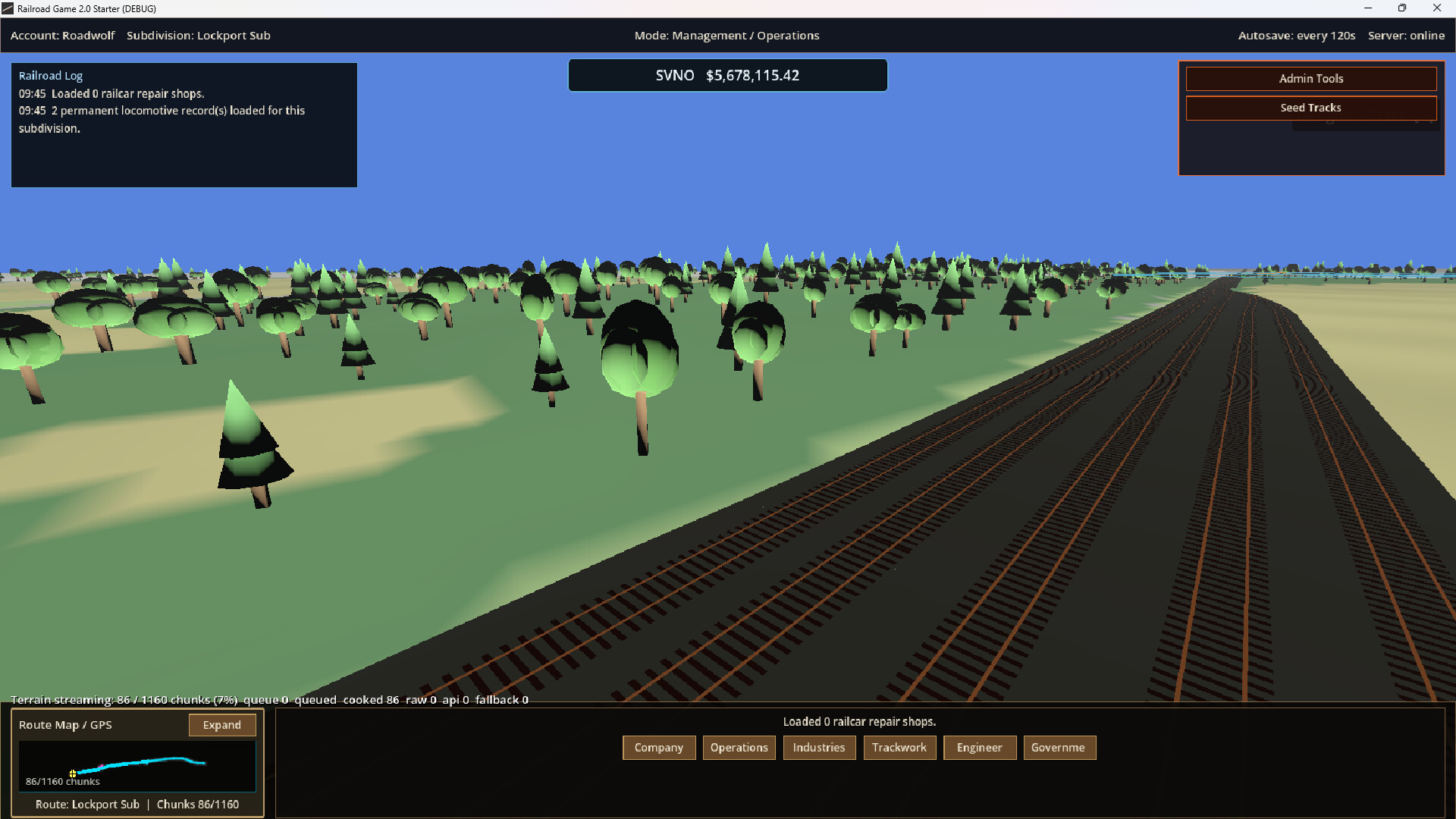


Operate locomotives, assemble trains, switch industries, and move freight through a persistent player-driven railroad network. Every shipment feeds a living industrial economy where railcars, routes, resources, and railroad operations continue to matter long after your train reaches its destination.

Sign in to add this item to your wishlist, follow it, or mark it as ignored

Coming Soon To Early Access

The developers of this game intend to release as a work in progress, developing with the feedback of players.

Note: Games in Early Access are not complete and may or may not change further. If you are not excited to play this game in its current state, then you should wait to see if the game progresses further in development. Learn more

What the developers have to say:

Why Early Access?

“Rail Ops: Subdivisions is being developed by a single developer as a long-term project built from a personal interest in railroads, railroad operations, communications, logistics, and the systems that keep a working freight network moving.

It is an evolution to a website based, text, database, and map based project I worked on several years ago which simulated railcar movements across a similar rail network.

My background and strengths are primarily in understanding how these systems work and in recreating the operational details behind them. Rail Ops is therefore being built from the railroad outward: train operations, track construction, individual railcar management, industrial production, freight routing, yards, equipment ownership, interchange traffic, and a persistent railroad network all interact with one another.

Graphics, presentation, interface design, optimization, and some aspects of traditional game development are areas that will continue to evolve alongside those underlying systems.

Because so many parts of Rail Ops are interconnected, changes to one system can affect many others. Early Access provides an opportunity to develop and refine the game alongside players who are actually operating railroads, building territories, moving freight, and finding situations that would be difficult for a single developer to anticipate through testing alone.

Player feedback will help identify problems, improve usability and performance, refine railroad operations and economic systems, and influence development priorities as the game grows.

Rail Ops: Subdivisions is a labor of interest and enthusiasm for railroad operations, and I am committed to continuing development toward a complete release rather than treating Early Access as the finished product.”

Approximately how long will this game be in Early Access?

“I currently expect Rail Ops: Subdivisions to remain in Early Access for approximately two years.

This is an estimate rather than a fixed release date. Development may take longer as existing systems are refined, additional railroad territory and equipment are introduced, and player feedback leads to new ideas or changes that improve the game.

As a single-developer project, development priorities may also change as individual systems require more work than originally anticipated.

I would rather allow enough time to properly develop, test, and integrate the railroad, economy, equipment, multiplayer, automation, and network systems than rush the game toward a full release simply to meet an earlier estimate.”

How is the full version planned to differ from the Early Access version?

“The full version is planned to expand and refine the systems introduced during Early Access rather than replace them with a fundamentally different game.

Development toward the full release is expected to include:

• Dedicated server for handling database and back end processes. (Currently it is shared).

• A larger and more refined selection of locomotives, and railcars.

• Industries, and commodities, which create Continental networks, and massive production chain webs.

• More refined scenery details. Maybe including roads, and manually cleaned up bodies of water and valleys.

• A fully modeled network of the North American rail network, allowing players to play on whatever rail line they choose.

• Continued improvements to locomotive physics, braking, train handling, coupling, switching, and multi-unit locomotive operation.

• More complete yard operations, classification tools, automated yard assignments, dispatching, and railroad management features.

• Expansion of the industrial economy, including production chains, inventories, suppliers, customers, freight demand, waybills, and equipment requirements.

• More complete locomotive and railcar purchasing, ownership, leasing, maintenance, condition, and fleet-management systems.

• Expansion and refinement of the subdivision network, interchange system, freight routing, and persistent movement of loaded and empty railcars between territories.

• Possible co-op play - ability to invite friends to help on your subdivision.

• Continued development of shared and multiplayer railroad operations where players can contribute to a larger interconnected freight network.

• Additional signaling, weather, terrain, scenery, structures, sounds, interface improvements, and graphical refinement.

• Improved performance, background simulation, routing, autopilot, and automation systems.

• Additional tools for creating, managing, and developing player railroad territories.

• Statistics, Leaderboards, Shared economy, and Stock market options.

• Possibility of purchasing industries in game.

Features and priorities may change during development as systems are tested and player feedback identifies better approaches.”

What is the current state of the Early Access version?

“Rail Ops: Subdivisions is currently an actively developed alpha with its core railroad and freight simulation systems functioning, but many systems are still being expanded and refined.

Players can currently build and operate railroad territory on generated terrain, construct track and switches, operate locomotives, assemble consists, couple and uncouple individually tracked railcars, move freight, and serve industries.

The current game includes an industrial economy in which facilities maintain material inventories, consume inputs, produce outputs, and generate freight demand. Loads are assigned to compatible railcars and move using waybills through the railroad network.

Locomotives and railcars are individually represented and can be incorporated into player operations. Manual train operation and supported automated movements are available, along with developing multi-locomotive, routing, switching, yard, and fleet-management systems.

Railroad operations can continue beyond the train currently being controlled, and several background systems support the persistent freight economy.

The game is still in alpha. Players should expect bugs, unfinished graphics and models, interface changes, incomplete features, balancing changes, performance improvements, and significant revisions to automation, routing, yards, railroad management, and network functionality throughout Early Access.

The features described in the About This Game section provide additional detail about the current direction of the simulation.”

Will the game be priced differently during and after Early Access?

“We expect the price of Rail Ops: Subdivisions to increase as significant new content, systems, and features are added during Early Access, with the full release expected to be priced higher than the initial Early Access version.

Any pricing changes will reflect the increased scope and maturity of the game as development progresses. Feedback will also be taken into account as well.”

How are you planning on involving the Community in your development process?

“Community feedback will be an important part of Early Access development.

Players will be encouraged to report bugs, describe problems with railroad operations and usability, suggest improvements, and discuss balancing and feature priorities through the Steam Community discussions.

Feedback will be particularly useful for systems such as train handling, switching, yards, routing, freight generation, industrial production, equipment economics, subdivision development, and the balance between manual railroad operation and automation.

Because Rail Ops: Subdivisions contains interconnected railroad and economic systems, actual player behavior can reveal problems and opportunities that are difficult to reproduce during development alone. Feedback and gameplay experience will therefore help determine which systems receive additional refinement and which features should receive priority.

Development updates will be communicated through Steam so players can follow major changes and provide feedback as the game progresses toward full release.”
Read more
This game is not yet available on Steam

Coming soon

Interested?
Add to your wishlist and get notified when it becomes available.
 

Report bugs and leave feedback for this game on the discussion boards

See all discussions

About This Game

Rail Ops: Subdivisions is a persistent online railroad operations game where every locomotive, railcar, industry, and shipment belongs to a larger working freight network.

Start by selecting a subdivision to manage. Build track across realistically generated terrain on one of the currently defined railroad subdivisions in North America.

The long-term goal for Rail Ops: Subdivisions is to build out a connected representation of the North American railroad network, allowing players to eventually operate in railroad towns and industrial regions across the continent. The playable network will continue to grow as additional subdivisions, interchange points, industries, and freight connections are defined and added.

Players will also be able to help expand the network. Through the Rail Ops web portal, players can propose and define new subdivisions, routes, junctions, interchange points, and industrial locations. Player-created additions will go through an approval process before becoming part of the shared network, helping keep routes reasonably aligned with real-world railroad geography while still allowing adjustments that improve gameplay.

As the network expands, more regions will become available for railroad construction and operation, gradually connecting local subdivisions into a much larger freight system.

Once you find a route of your liking, you can establish your Headquarters to claim it.  You then acquire your first locomotive, connect to local industry. Assemble trains, collect freight cars, serve local industries, move traffic between subdivisions, and deliver cargo through an interconnected railroad system shaped by its players.

This is not simply a game about driving trains from one marker to another. It is about understanding why the train exists, where its freight came from, where it needs to go, and what happens after it arrives.

An active internet connection is required to play Rail Ops: Subdivisions. As freight handling and deliveries connect to the global network.

Operate Real Freight Movements

Take control of individual locomotives or build multi-unit consists for heavier assignments. Couple and uncouple cars, work yards, follow switches and signals, plan routes, and manage the weight, length, condition, and braking characteristics of your train.

Use manual controls when you want to work from the cab, or assign supported movements to autopilot while you oversee other railroad operations.

Freight does not appear from nowhere. Industries request specific materials, suppliers produce them, and railcars must be matched to the cargo they are designed to carry.

A chemical plant may need chlorine or petroleum products. A mill may receive grain and ship flour or animal feed. A steel facility may consume ore, scrap, chemicals, and fuel before producing goods needed somewhere else on the network.

Every load has a reason to move.

Serve a Detailed Industrial Economy

Industries maintain inventories, consume materials, manufacture products, and generate transportation demand.

Your work may include:

  • Delivering raw materials before an industry runs out

  • Supplying factories with multiple production inputs

  • Returning empty cars to suitable loading points

  • Selecting railcars based on weight, volume, cargo form, and handling requirements

  • Moving finished products toward warehouses, customers, ports, or interchange connections

  • Responding to urgent shortages and high-priority shipments

Fail to provide reliable rail service and an industry may be forced to use expensive truck transportation. Keep the freight moving and your territory becomes an increasingly important part of the wider economy.

Manage More Than One Train

The railroad continues beyond the locomotive you are currently watching.

Dispatch multiple trains, assign locomotives to yard work, build and classify consists, stage railcars for industries, and coordinate movements across your territory. A local freight can be switching customers while a road train carries outbound traffic toward an interchange.

As your operation expands, your role grows from engineer to yardmaster, dispatcher, freight planner, and railroad manager.

A Persistent Shared Network

Rail Ops: Subdivisions is built around a world where players operate different subdivisions of an interconnected railroad network.

Freight can originate in one territory, pass through several others, and reach its destination through the work of multiple players. Loaded and empty railcars remain part of the system, industries continue producing and consuming goods, and decisions made in one region can create opportunities elsewhere.

Your subdivision is one piece of a much larger railroad puzzle.

Shape Your Railroad Career

Acquire locomotives and railcars, maintain your equipment, expand your operating territory, develop relationships with industries, and choose the kind of railroad operation you want to build.

Run a disciplined mainline freight operation. Specialize in complex industrial switching. Manage a busy classification yard. Maintain a fleet of locomotives. Become a critical bridge between neighboring subdivisions.

There is no single path through the railroad.

Current and Planned Features

Rail Ops: Subdivisions already includes many of its core railroad, freight, and economic systems, with additional features and refinement planned throughout Early Access.

Current Features

  • Detailed locomotive and train handling

  • Individual railcars with weight, capacity, condition, loads, and destinations

  • Cargo weight, volume, packaging, and handling requirements

  • Railcar purchasing, ownership, leasing, and fleet management

  • Player-operated subdivisions and interchange traffic

  • Dynamic freight movements, waybills, and industry demand

  • Industries with inventories, production inputs, and outputs

  • Track construction, switches, yards, and railroad territory development

  • Yard classification and developing automated yard operations

  • Manual train operation and assisted or automated movements

  • Persistent freight and railroad activity beyond the train currently being operated

  • A growing network of industries, commodities, railcars, locomotives, and railroad territories

Planned and Expanding Features

Development during Early Access is planned to include:

  • Cooperative play, including the ability to host friends on a locally operated railroad save

  • More detailed train-control, signaling, dispatching, and railroad communications infrastructure

  • Maintenance-of-way and maintenance train operations

  • Additional locomotives, railcars, equipment types, and specialized rolling stock

  • Expanded locomotive and railcar maintenance, ownership, leasing, and fleet-management systems

  • More advanced classification yards, switching automation, and railroad management tools

  • An in-game stock market and broader railroad economic systems

  • Player messaging and railroad communication systems

  • Leaderboards and additional ways to compare railroad operations and progress

  • Expanded weather and changing operating conditions

  • Full day and night operations

  • Improved forests, vegetation, terrain, and seasonal environmental detail

  • More detailed towns, cities, industrial areas, and urban environments

  • Roads, highway traffic, grade crossings, and expanded road-and-rail interactions

  • More detailed signals, switches, crossings, and train-control infrastructure

  • Bulk loading and unloading operations

  • Industries with visible loading processes and specialized loading facilities

  • Expanded industrial production chains, commodity types, suppliers, and customers

  • Additional subdivision-building and railroad-development tools

  • Continued improvements to routing, autopilot, background simulation, performance, graphics, sound, and user interface

Features, priorities, and implementation details may change during Early Access as development continues and player feedback helps shape the game.

Every Car Has Somewhere to Go

A train is more than a row of railcars.

Each car has an owner, a condition, a carrying capacity, a current load, and a destination. Every industry has supplies it needs and products waiting to move. Every subdivision is part of a network that depends on reliable railroad service.

Climb aboard, take control of your railroad, and keep the freight moving.

AI Generated Content Disclosure

The developers describe how their game uses AI Generated Content like this:

AI assisted with coding and some graphic design.

System Requirements

    Minimum:
    • Requires a 64-bit processor and operating system
    • OS: Windows 10 64-bit
    • Processor: Intel Core i5-8400 or AMD Ryzen 5 2600
    • Memory: 16 GB RAM
    • Graphics: NVIDIA GTX 1660, AMD RX 5600 XT, or equivalent
    • Network: Broadband Internet connection
    • Storage: 15 GB available space
    • Sound Card: none
    • VR Support: none
    Recommended:
    • Requires a 64-bit processor and operating system
    • OS: Windows 11 64-bit
    • Processor: Intel Core i5-12600K, AMD Ryzen 7 5700X, or better
    • Memory: 32 GB RAM
    • Graphics: NVIDIA RTX 3060, AMD RX 6700 XT, or better
    • Network: Broadband Internet connection
    • Storage: 25 GB available space
    • Sound Card: none
    • VR Support: none
Review Filters