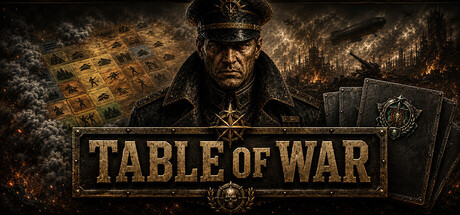


A tactics roguelike deckbuilder where you command an army, not a hero. Units move and fight on their own action points; your deck calls in reinforcements, ordnance and orders. Every soldier has a name, a rank, and exactly one life. Build the army. Read the board. Lose them anyway.

Sign in to add this item to your wishlist, follow it, or mark it as ignored

This game is not yet available on Steam

Coming soon

Interested?
Add to your wishlist and get notified when it becomes available.
 

About This Game

YOU COMMAND THE ARMY, NOT A HERO

Most deckbuilders hand you one fighter and a stack of verbs. Table of War hands you a company.

Your units move and fight on their own action points — walk them, flank them, hold a ridge with them,

no card required. The deck sits on top of that as your [b]command channel[/b]: reinforcements, ordnance,

standing orders, structures, and the fuel for your general's signature power. Two systems, two jobs.

The board is the tactics. The deck is the strategy.

EVERY SOLDIER HAS A NAME

Your roster is persistent and it is permanent. Troops carry their name, rank, experience and scars from

battle to battle, promote through a branch-specific rank ladder, and earn permanent perks at camps.

They do not come back. A rifleman you have carried since Act 1 — three promotions, a medal, a nickname

you gave him yourself — dies to one badly-read artillery arc, and the next battle starts without him.

The run economy is built around that: survivors carry forward, salvage buys what you can afford to

replace, and every reckless push is a decision about who you can stand to lose.

THE BOARD FIGHTS BACK

Battles are fought on procedurally generated, non-rectangular maps — eight silhouettes carved out of

void, so no two fronts have the same shape.

  • Zones of control — you cannot sprint past an armed enemy. Lines have to be broken, not dodged.

  • Flanking — a second body adjacent to the target, not to you. Positioning is a two-unit problem.

  • Fog of war — with a movement rule that stops you sleepwalking into the dark.

  • Terrain and cover — forest, hills, water and rock; some of it carveable, most of it not.

  • Environmental hazards — inferno, toxic, mire and EMP fields, plus drifting storms that wander the board and hurt whoever is standing in them. Including the enemy. There is a whole pacifist toolkit built on that fact.

  • Friendly fire — artillery splashes. It does not check whose uniform it is landing on.

  • Objectives that are not "kill everything" — survive N turns, hold a position under contest.

  • Raiders — a fast thief that crashes a skirmish, grabs your salvage and runs for the map edge. Kill it before it gets there or the money is gone for good.

And you can see it coming. Enemy intent is telegraphed on your turn: ghosted enemy positions, projected

attack arrows, damage numbers, and a two-tier danger overlay separating "they can reach here" from

"they can shoot you from here" — all of it updating live as you move. Turn it on, turn any layer of it

off, play it blind if you want the fear.

THREE COMMANDERS, THREE DIFFERENT GAMES

  • The Warlord— cheap reinforcements and a Wrath gauge that fills on every kill and every loss. Spend it on Rally the Horde: two free riflemen, deployed at the front, right now.

  • The Engineer — the first structure each turn is free, and adjacent power plants charge a gauge that fires Overcharge: every turret double-fires, command points surge, damage repairs.

  • The Nomad — the HQ is a vehicle. There is no fixed base to defend because there is no fixed base. Movement builds Momentum; spend it on Break Camp and the whole army acts again.

Each brings its own starting army, deck skew, and a dozen strictly exclusive cards nobody else can draft.

BUILD A RUN THAT BREAKS THE GAME

  • 94 cards across six categories, 34 of them commander-exclusive, nearly all upgradeable.

  • 35 relics with compounding effects — and eight of them are cursed, which you will find out.

  • 53 events with real double-edged choices, some gated behind relics you are carrying.

  • Curses the enemy injects into your own deck, removable only at an Outpost, for a price.

  • Four acts — First Contact, Two Fronts, Encirclement, Conquest — on a branching node map with seven node types. A Field Compass relic lets you jump tracks entirely.

  • Eight hand-authored bosses, each with its own mechanic: endless waves, halved damage unless you flank, a curse every single turn, and one that changes the rules at half health.

  • Fourteen elite variants and five enemy archetypes that reshape a battle before it starts, and tell you which one you are facing before you commit.

THEN RAISE THE STAKES

Twelve rungs of Ascension, each stacking one more rule on top of the last, themes rotating as you climb.

Seven run modifiers you can stack yourself for score. A Daily Commission everyone plays on the same seed.

Fifty-five achievements, sixteen collectible board chips, and a seeded-run field so you can hand somebody

an exact run and dare them.

AT A GLANCE

  • 3 commanders · 4-act branching expedition · 7 node types · permadeath roster

  • 94 cards · 35 relics · 53 events · 55 achievements · 12 ascension rungs · 7 run modifiers

  • 32 unit and structure classes · 14 elite variants · 5 enemy archetypes · 4 bosses

  • Procedural non-rectangular battlefields · fog of war · zones of control · hazards · friendly fire

  • Seeded runs · Daily Commission · save and resume mid-run

  • Fully offline. No account, no launcher, no telemetry, no ads, nothing to buy.

TRY IT BEFORE YOU WISHLIST

The demo runs in your browser — no download, no install, no account: @

AI Generated Content Disclosure

The developers describe how their game uses AI Generated Content like this:

The game code, art, and sound was all generated by a combination of Generative AI tools.

System Requirements

Windows
macOS
    Minimum:
    • OS: Windows 10 64-bit (version 1803 or later)
    • Processor: 64-bit dual-core, 2.0 Ghz
    • Memory: 4 GB RAM
    • Graphics: Integrated graphics with hardware acceleration
    • Storage: 400 MB available space
    • Additional Notes: Requires the Microsoft Edge WebView2 runtime, installed automatically if not already present. Mouse required. Landscape display.
    Recommended:
    • OS: Windows 11 64-bit
    • Processor: 64-bit quad-core, 2.5 Ghz
    • Memory: 8 GB RAM
    • Graphics: Any dedicated GPU, or modern integrated graphics
    • Storage: 500 MB available space
    • Additional Notes: Requires the Microsoft Edge WebView2 runtime, installed automatically if not already present. Mouse required. Landscape display.
    Minimum:
    • OS: macOS 12 Monterey
    • Processor: Apple Silicon (M1 or later), or 64-bit Intel Core i5 dual-core 2.0 GHz
    • Memory: 4 GB RAM
    • Graphics: Integrated graphics (Apple Silicon GPU, or Intel Iris / Radeon Pro)
    • Storage: 500 MB available space
    • Additional Notes: Universal build — runs natively on both Apple Silicon and Intel, no Rosetta. Uses the system WebKit, so there is no runtime to install (unlike the Windows WebView2 note). Mouse or trackpad required. Landscape display.
    Recommended:
    • OS: macOS 13 Ventura or later
    • Processor: Apple Silicon (M1 or later)
    • Memory: 8 GB RAM
    • Graphics: Apple Silicon integrated GPU
    • Storage: 500 MB available space
    • Additional Notes: Universal build — runs natively on both Apple Silicon and Intel, no Rosetta. Uses the system WebKit, so there is no runtime to install (unlike the Windows WebView2 note). Mouse or trackpad required. Landscape display.
* Starting February 15, 2024, the Steam Client will no longer support 32-bit games or macOS 10.14 or lower.
Review Filters