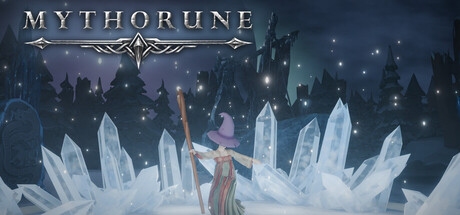


An endless co-op action-RPG dungeon crawl. Descend floors that never scale to you, slot runes that rewrite your skills into new weapons, mine the walls, and loot relics of world myth. Play couch, LAN and online in one six-hero party, or host your own server. No microtransactions.

Sign in to add this item to your wishlist, follow it, or mark it as ignored

This game is not yet available on Steam

Planned Release Date: Sep 30, 2026

This game plans to unlock in approximately 4 weeks

Interested?
Add to your wishlist and get notified when it becomes available.
 

About This Game

MYTHORUNE

A cooperative descent into darkness

Heroes go down into the dark together. Everything else is built around not getting in the way of that.

No level scaling. Floor 40 does not quietly become as hard as you are. The world has a difficulty, and you either meet it or go back and get stronger. This is why a level means something here: an upgrade changes a fight, and a stronger friend joining your game actually helps you. Games that scale to the player hand you a reward and cancel it with the same arithmetic that granted it.

Nothing to buy. No battle pass, no seasons, no cosmetics store, no premium currency. You bought a game.

Play however you can physically sit. Five on one couch. LAN, so a house shares one world. Online with friends anywhere. And mixed, which is the one that usually gets skipped: two people on the sofa and two across the country, in the same party. A party holds six.

Host your own server. One button in the launcher says Open the gates, and your machine becomes the world. Others join by typing an address, from the game or from a browser. No account, no matchmaking service, no dependency on anyone else staying online. If you want a private world for six months for four friends, you have one, and it sits on your hard drive.

The descent

Mythorune is an endless dungeon crawler. Floors run past 250 and keep going.

Each region has its own weather and its own shape: the Widow's Caverns, the Cursed Crypts, the Blighted Mire, the Burning Depths, the Frostbound Halls, and the Flower-Fruit Wilds, where real rivers carve the floors and you cross them at fords. Storms roll across the open floors. Wind moves through grass in fields you can watch bend under it. Water runs as a real wave field, so wakes spread, cross each other and bounce off shores instead of scrolling past as a texture.

Four classes: Barbarian, Wizard, Hunter, Læknan. Even the healer is armed: her mending ray is the same ray that sears the undead, and stone and gale answer her when she is not mending. None of them exists to stand behind the others, and a party of three Wizards is a legitimate party.

Loot runs common, magic, rare, legendary, set, mythic, and RED. Legendaries are not adjectives stapled to a noun. They are named relics out of world myth: Gungnir, Excalibur, the Aegis of Zeus, the Yata no Kagami, Sleipnir's hooves, the Apple of Idunn. Finding one is finding a specific object with a story attached, not a good roll.

Weapons and armour can be bound to beast spirits. Masks carved from what you killed go on your face. Cards cut from monsters socket into gear. Ore dug out of the walls upgrades anything.

The four heroes and their fuel

Six skills each, and they run on four resources that behave nothing alike.

The Wizard burns Seidr, which regenerates on its own. She can stand and pour damage until the bar empties, then wait. The Barbarian runs on Wod, which starts empty, does not regenerate, and only fills when he kills something. He earns his big moves by fighting; standing still gives him nothing. The Hunter uses Veidr, in between, with slow passive regeneration. The Læknan runs on Önd, which returns quickly and asks a different price: her strongest work is a thread, and a thread is a tether she has to stand in.

That difference is most of what separates the classes in a fight. The Wizard opens strong and fades. The Barbarian opens with nothing and gets more dangerous the longer the room lasts. The Hunter has to spend at a rhythm. The Læknan chooses, every second, between mending and striking, because both come out of the same green bar. She is also the only hero whose power splits its books: Faith pays for her healing, Intelligence for her damage.

Skills are named for what they take from: Splinter of Gungnir, Breath of Niflheim, Mjolnir's Fall, Sleipnir's Bound, Skadi's Volley, Shears of the Norns, The Wild Hunt.

Runes rewrite skills

Every skill has three or four rune variants, and a rune does not add a percentage. It changes what the skill is.

Bifrost, the Wizard's channel, is a beam that sears the first enemy it touches and drains Seidr for every second you hold it. Slot Isa and it becomes a lance of pure cold that drains far slower, a beam you hold rather than spend. Slot Kenaz and it becomes a jet of fire, far wider, engulfing everything around the point it strikes. Slot Laguz and it becomes a caustic ray that bores straight through enemies and keeps going.

Same button, four different weapons. Whether you want single-target burst, sustain, an area sweep or a line down a corridor is a build decision, not a menu preference.

Channelled skills have their own economics. Bifrost's reach grows with your level, from a stub at unlock to something that crosses the screen, thickening as it lengthens. It demands a real reserve of resource before it will start at all, then drains until you are empty. You cannot tap it. Committing to a channel means committing.

Loot, and what an affix actually does

Eleven equipment slots: weapon, offhand, cape, head, chest, legs, boots, hands, gauntlets, ring, amulet. Plus a bag slot and a potion slot.

Affixes are the usual attributes (strength, intellect, dexterity, vitality, faith, armour, crit chance, crit damage, attack speed, life, life on hit, movement speed, gold find) and then the ones that shape a build: elemental damage by school, primary and secondary attack damage, and per-class skill damage. A wizard-damage roll on a ring is worthless to the Hunter standing next to you, which is what makes trading inside a party worth doing.

Rarity runs common, magic, rare, legendary, set, mythic, RED. The number of affixes climbs with rarity, and so does a damage multiplier, but RED sits outside the ladder: it multiplies again on top of mythic.

Items arrive unidentified. You can read base damage and armour, which is enough to weigh whether a relic is worth the fee, but the affixes and the real name stay hidden until Auric appraises it. The veil is enforced on the server rather than in the interface, so the secrets are not sitting in the page waiting to be read.

Bags, potions, ore, cards

Bags take a slot and add inventory cells. A worn sack carries a few. A void cache carries far more. Space is a stat you equip.

Potions heal a percentage and, from rare upward, carry a buff: speed, haste, damage, resource, or invulnerability. A RED potion is the only one with more than one, and always includes an invulnerability window.

Ore comes out of the walls, once breakable walls are switched on in the options. You mine it, it stacks by rarity, and it upgrades gear of that rarity. There is one grade per tier, up to Starfall Ore, which is the only thing that will lift a mythic.

Cards drop from monsters and socket into gear that has a card slot. Card slot punches cut another slot into a piece, up to five. A well-slotted rare can outlive a legendary you found later.

Beast spirits bind to gear and chain, so several sworn pieces compound. The binding is read out of the item's name, so a spirit-sworn relic announces itself.

Floors, and what is in them

Floors are generated rather than authored, and the deep ones are larger and more tangled than the shallow ones. You find the stairs, or you don't, and the minimap flags them once a floor has been picked over. Floors restock out of sight, so a level you cleared an hour ago is not empty when you come back through it.

Walls are breakable. Some are ordinary rock hiding ore, some are cracked plugs sealing shortcuts and back chambers, and mining changes the shape of the floor you are standing in.

Boss floors are one enormous arena cut into the maze, and the arena keeps widening with depth. During a boss round the bosses are marked purple on the minimap regardless of what you have explored, because hunting a boss around a floor is not the interesting part of a boss.

Death is counted against the party rather than the individual. Enough of them and the dark casts everyone back.

Playing together

Six can share one world, and the party genuinely mixes: couch players in one room, LAN players in the house, online friends anywhere, all at once.

Party voice runs push-to-talk on a key you choose.

The strongbox is shared storage, and it is Auric's cache. Everything you deposit sits in a raven's hoard, which is a joke the game does not explain until much later.

Story

You are dreaming, and at some point you realise it.

Then you wake up. Then you wake up again. A run of false awakenings, each one convincing right up until it isn't. Eventually you wake in your own room, except the room is faded and drowned in purple static, and something is calling you.

It is a raven.

On the shelf in that room is one object from every culture you just dreamt. Each is a gift from a friend, and each has a story behind it. That shelf is the only exposition the opening gives you, and it quietly answers a question you would otherwise never think to ask: why these six worlds? Because you know people there.

The raven is Auric, a spirit guide who travels mythology itself. Not the astral plane, but the substrate the gods are made of, where Wukong's mountain and Kaliya's poisoned river and the eclipse that swallows the sun are less separate worlds than separate rooms of one sleeping mind. He caught you projecting. He was impressed. He would like your help.

What he wants is runes, and the alphabet is the point. Elder Futhark is your language, not the pantheon's. The gods you meet are Chinese, Japanese, Hindu, Norse and Filipino, and they owe each other nothing. A rune is how you write down what you took from one of them. That is why a monkey god and a world serpent can share a game without either being flattened into the other: they were never meant to be the same tradition. The runes are your record, not their religion.

So you go down. Six realms, six guardians, six powers written into six letters. Auric is on every floor, cheerful, useful, and never fighting.

Spoilers

Everything below gives away the plot, including the ending. Stop here if you would rather find it.

Auric is the weaker party, and that is the whole character. He cannot fight gods, which is exactly why you exist to him. He can only reach people who project the way you do, and those people are always better than him. He does not take; he receives. His charm is not power, it is compensation. He flatters because he cannot compel, and jokes because wit is the only leverage he has ever had. His engine is envy rather than ambition, which is more pathetic than a mastermind and more dangerous in one specific way: desperate things move first.

His name has been telling you the whole time. Auric means of gold, and gold is useless. Too soft for a blade or a tool, good only for decorating or hoarding. The wolf who opposes him is Ferric, of iron: common, dull, strong, everywhere. Nobody hoards iron. You make things out of it.

The raven and the wolf are not a tidy symmetry. They are a real relationship. Ravens follow wolves, and are called wolf-birds for it. A raven can find a carcass but cannot open one, because its beak will not tear hide. So it calls the wolves in and eats what their jaws open. The first sound in the game is a bird calling a predator toward a kill. None of that is metaphor.

The objects on your shelf are doorways. Six friends, six gifts, six roads, which is how you reach six realms at all, and why Auric has none of his own. He has no bonds, so he has never had a door. What he hoards is roads, not trinkets.

That makes his theft something worse than burglary. Take the doorway and you can never reach that friend again. He does not take a keepsake, he takes the person. And once he holds the only road to someone, he is the only thing left that can wear their face. The transformation is not a trick he performs. It is what remains of them.

He is also a god eater. He gains the power of every rune you take, at the moment you take it. You are not his employee, you are his hands. Six gods robbed on his behalf is not six errands. It is six meals.

Which makes the ending close cleanly. He arrives holding your six runes, and someone wielding your borrowed power cannot exceed you. He can only ever be you, secondhand, losing to the person he borrowed it from.

AI Generated Content Disclosure

The developers describe how their game uses AI Generated Content like this:

Pre-rendered AI Generated content was used in this game.

System Requirements

Windows
macOS
SteamOS + Linux
    Minimum:
    • Requires a 64-bit processor and operating system
    • OS: Windows 10
    • Processor: Intel i3 9300, AMD Ryzen 2200
    • Memory: 8 GB RAM
    • Graphics: NVIDIA GeForce GTX 750TI, AMD Radeon R7 265
    • Storage: 2 GB available space
    Recommended:
    • Requires a 64-bit processor and operating system
    • OS: Windows 11
    • Processor: AMD Ryzen 3600, Intel i5 9600
    • Memory: 16 GB RAM
    • Graphics: NVIDIA GeForce RTX 1650, AMD Radeon RX 550
    • Network: Broadband Internet connection
    • Storage: 2 GB available space
    Minimum:
    • Requires an Apple processor
    • OS: Tahoe 26.5.2
    • Processor: Apple M1
    • Memory: 8 GB RAM
    • Graphics: Embedded apple silicon gpu cores
    • Storage: 2 GB available space
    Recommended:
    • Requires an Apple processor
    • OS: Tahoe 26.5.2
    • Processor: Apple M4
    • Memory: 24 GB RAM
    • Graphics: Embedded apple silicon gpu cores
    • Network: Broadband Internet connection
    • Storage: 2 GB available space
    Minimum:
    • OS: 64-bit Ubuntu 18.04+, Debian 10+, openSUSE 15.5+, or Fedora Linux 39+
    • Processor: Intel i3 9300, AMD Ryzen 2200
    • Memory: 8 GB RAM
    • Graphics: NVIDIA GeForce GTX 750TI, AMD Radeon R7 265
    • Storage: 2 GB available space
    Recommended:
    • OS: 64-bit Ubuntu 22.04
    • Processor: AMD Ryzen 3600, Intel i5 9600
    • Memory: 16 GB RAM
    • Graphics: NVIDIA GeForce RTX 1650, AMD Radeon RX 550
    • Network: Broadband Internet connection
    • Storage: 2 GB available space
Review Filters