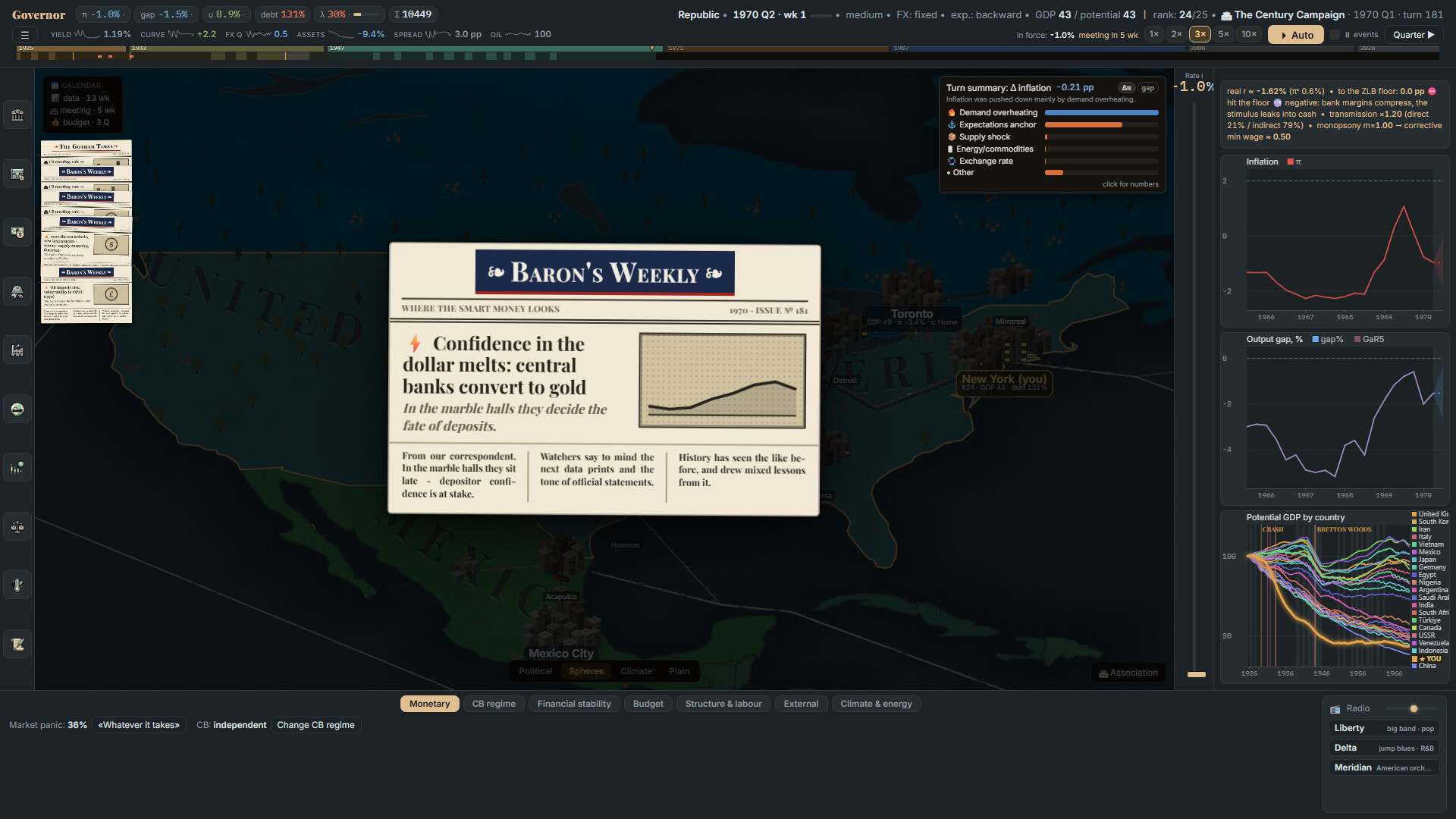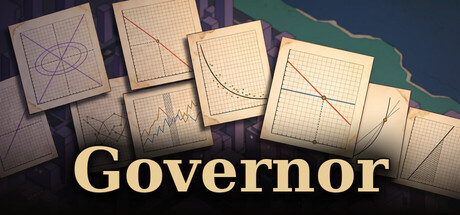

An economics strategy game about running a central bank. Underneath is the three-equation model: IS curve, Phillips curve, policy rule. Steer one economy from 1925 to 2025 through the crises that actually happened, and read the result off a city that grows or empties.

Sign in to add this item to your wishlist, follow it, or mark it as ignored

This game is not yet available on Steam

Planned Release Date: Aug 31, 2026

This game plans to unlock in approximately 2 weeks

Interested?
Add to your wishlist and get notified when it becomes available.
 

About This Game

You run a central bank. One lever matters more than the rest - the nominal policy rate - and behind it sit forty-odd others that unlock only once history has invented them. The economy answers every move you make, one quarter late.

A real model, not a mood

Governor runs on the Carlin-Soskice three-equation model, the one macroeconomics is actually taught with:

  • The IS curve - the output gap responds to last quarter's real rate, to the real exchange rate, to the fiscal impulse and to macroprudential braking.

  • The Phillips curve - non-linear and inertial. Overheating pushes inflation up faster than a slump pulls it down, and downward nominal wage rigidity blocks the way below zero.

  • The policy rule - the optimal rate is derived from the central bank's loss function, not fitted to a curve. An adviser computes it every turn. You are under no obligation to listen.

The rate you set is nominal. The real rate falls out of the Fisher equation through expectations, and expectations depend on whether anyone believes you: the anchor drifts up while you hit the target and erodes when you miss. There is an effective lower bound. There is inflation bias if the bank is not independent. There is Okun's law, and a bank lending markup stacked on top of whatever you set.

Below that sits endogenous Solow growth with hysteresis, WS/PS microfoundations for equilibrium unemployment, public finance with a debt accumulation law and a sovereign risk premium, an open economy with a UIP exchange rate and a balance of payments, a Minsky financial cycle, and inequality tracked as Gini.

1925 to 2025

The century campaign runs 404 consecutive quarters, 118 scripted historical events and five forks where history could have gone the other way:

  • 1951, the Accord - keep the bank independent, or hand the rate back to the Treasury.

  • 1971, Camp David - close the gold window, or defend Bretton Woods out of reserves.

  • 1979, Volcker - break inflation with the rate, or reach for price controls.

  • 1985, the Plaza - sign the accord on the dollar, or decline.

  • 2008, the Lehman weekend - backstop the system, let it fall, or improvise.

The 1929 crash, three waves of banking panics, the NIRA and the Wagner Act, a war economy with the Fed pegged to Treasury needs, Bretton Woods, the OPEC embargo, the Volcker disinflation, Black Monday, the S&L crisis, the Asian crisis, the dot-com bust, subprime, Lehman, the pandemic and the 2021-22 inflation - all of it arrives on schedule. The only open question is what you do about it.

Play the century whole, or take any one of its seven eras as a standalone scenario. Five tutorial missions and three dozen sandboxes come with it.

An economy you can look at

The state of the economy is drawn as a city on an isometric world map, and the drawing is not decoration. Building height and density track cumulative real GDP; street traffic tracks the output gap; the palette warms with inflation and cools in a slump; construction starts when potential is rising and money is cheap. You will see a crisis in the skyline before you open a chart.

Around it: a world map with era-accurate borders, up to 24 competing countries each running its own central bank, a gravity model of trade, tariffs and trade wars. An optional mode - off by default - turns on spheres of influence: era blocs, satellites, credit dependency and the client-state path.

If you would rather have numbers than pictures, there is a terminal: four tabs of tables and charts, a decomposition of every change in inflation and in the output gap by driver, and an influence map of 106 model variables and the 276 links between them.

The Association

Once a year the Economic Association convenes and takes your policy apart. Its chair grants one permanent bonus and one permanent penalty - a choice of school you will live with for the rest of your term.

Multiplayer

Two players or more, over LAN or through an internet relay. Each player gets a country and a full instance of the model; after every turn the world is stitched together from mirrors of the other economies, so your surplus is somebody else's deficit. Loans between players are a lever too.

Three languages

English, Russian and Simplified Chinese - full interface, including the in-game explanations of the model.

What is not here

No random numbers standing in for an economy, no intended solution, and no story to pull you out of a stagflation you caused. There is a model, a century of history, and your own loss function.

AI Generated Content Disclosure

The developers describe how their game uses AI Generated Content like this:

Some of the pre-rendered 2D art shipped with the game (era intermission illustrations, panel icons, campaign cover images and the Economic Association hall with economist portraits) was produced with generative image tools (fal.ai, Krea) from prompts authored by the developer, then post-processed by hand and by scripts in tools/. No generative AI is used at runtime. The game's simulation code, UI, isometric city renderer, world map (built from Natural Earth data) and all text, including the three interface languages, are authored by the developer.

System Requirements

    Minimum:
    • Requires a 64-bit processor and operating system
    • OS: Windows 10 (64-bit)
    • Processor: x86-64, 2 cores
    • Memory: 4 GB RAM
    • Graphics: Integrated graphics. No dedicated GPU required - the game renders on Canvas 2D.
    • Storage: 700 MB available space
    • Sound Card: Any
    • Additional Notes: Minimum screen resolution 1024x700. An internet connection is required only for multiplayer.
    Recommended:
    • Requires a 64-bit processor and operating system
    • OS: Windows 11 (64-bit)
    • Processor: x86-64, 4 cores
    • Memory: 8 GB RAM
    • Graphics: Integrated graphics.
    • Storage: 1 GB available space
    • Sound Card: Any
    • Additional Notes: 1920x1080 or higher. A century-long campaign keeps 404 turn records in memory, so more RAM helps on long runs.
There are no reviews for this product

You can write your own review for this product to share your experience with the community. Use the area above the purchase buttons on this page to write your review.

Review Filters