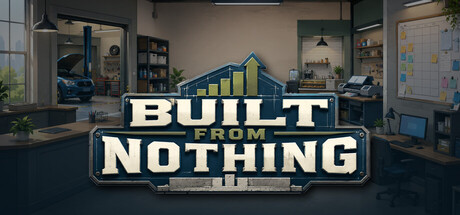

Build a business from the ground up. Choose your industry, manage money, equipment, employees, customers, debt, and unexpected disasters. Every decision shapes your reputation, growth, and whether your company becomes an empire—or collapses under its own ambition.

Daftar masuk untuk menambah item ini ke senarai hajat anda, ikuti atau tandakannya sebagai diabaikan

Bahasa Bahasa Melayu tidak disokong

Produk ini tidak menyokong bahasa tempatan anda. Sila semak senarai bahasa yang disokong di bawah sebelum membuat pembelian

Permainan ini belum tersedia di Steam lagi

Tarikh Keluaran Dirancang: 2026

Berminat?
Tambah ke senarai hajat anda dan terima pemberitahuan apabila permainan sudah tersedia.
 

Tentang Permainan Ini

Build It. Grow It. Try Not to Destroy It.

Built From Nothing is a decision-driven business management simulator where you start with limited money, questionable equipment, and a company that exists mostly because you decided it should.

Choose an industry, name your business, secure funding, purchase equipment, hire employees, serve customers, and attempt to build something stable before debt, bad decisions, equipment failures, and human behavior bring it all crashing down.

There is no single correct path to success.

You can grow slowly, avoid debt, and build a dependable local business—or borrow aggressively, expand quickly, and hope the increased revenue arrives before the payments do.

Every choice shapes the company you create.

Choose Your Business

Select from several industries, each with its own equipment, employees, customers, risks, and opportunities.

Run businesses such as:

  • An automotive repair shop

  • A print and sign company

  • A restaurant or bakery

  • A computer repair and managed IT operation

Each industry uses the same deep management systems while introducing different jobs, equipment, staffing needs, customer expectations, and industry-specific disasters.

You are free to name the company, choose how it is funded, and decide what kind of reputation it will build.

Start With Almost Nothing

Every business begins with limited resources.

You may have enough money for reliable equipment—or enough to make payroll—but probably not both.

Choose how your company begins:

  • Use personal savings and avoid monthly loan payments

  • Take out a small business loan for additional starting capital

  • Accept investor funding and deal with outside expectations

  • Make riskier financial decisions when traditional funding is unavailable

Early decisions can follow your company for years.

That cheap machine may keep the doors open today, but repeated breakdowns, wasted materials, and lost customers may eventually cost far more than buying something better.

At the same time, premium equipment can become an expensive mistake if your business cannot generate enough work to justify it.

Manage More Than Money

Revenue is only one part of running a company.

You will need to balance:

  • Cash flow

  • Payroll

  • Rent and utilities

  • Loans and equipment financing

  • Inventory and operating costs

  • Customer satisfaction

  • Employee morale

  • Equipment condition

  • Reputation

  • Work capacity

  • Long-term growth

A profitable company can still fail if its money is tied up in unpaid invoices, excessive inventory, or financed equipment.

Growth is useful—but uncontrolled growth can be just as dangerous as having no customers at all.

Buy Equipment That You Can Actually Afford

Every major equipment purchase involves a tradeoff.

Used equipment may be cheap, but unreliable.

Entry-level equipment may be dependable, but slow.

Premium equipment may increase quality and capacity while creating crushing monthly payments.

Equipment can:

  • Wear out

  • Break unexpectedly

  • Require maintenance

  • Waste materials

  • Slow down production

  • Affect employee morale

  • Limit which jobs you can accept

  • Create opportunities for larger contracts

The most expensive option is not always the best choice, and the cheapest option is not always a mistake.

The correct decision depends on the company you have built.

Hire People, Not Production Bonuses

Employees have their own skills, personalities, expectations, strengths, and problems.

An employee may be highly skilled but unreliable. Another may be inexperienced but loyal and eager to improve. A talented worker may leave after being denied a raise, while a difficult employee may become essential during a crisis.

Manage:

  • Hiring

  • Pay

  • Training

  • Morale

  • Workload

  • Stress

  • Loyalty

  • Customer-service ability

  • Internal conflicts

  • Promotions and management roles

Your employees remember how you treat them.

Supporting someone during a customer dispute may improve loyalty. Blaming them without evidence may solve an immediate problem while creating a much larger one later.

Deal With Customers

Not every customer wants the same thing.

Some care about price. Others expect perfect quality, immediate service, or personal attention.

Customers may become long-term accounts, recommend your business, leave negative reviews, refuse to pay, demand refunds, or return with problems caused by previous work.

Your company can become known for:

  • High quality

  • Low prices

  • Fast turnaround

  • Excellent customer service

  • Reliability

  • Premium service

  • Cutting corners

  • Constant delays

Your reputation determines which customers and contracts become available.

Make Difficult Decisions

Unexpected situations force you to choose what kind of owner you will become.

A customer claims an employee damaged their property. The employee denies it.

Do you refund the customer, defend the employee, investigate, split the cost, or refuse responsibility?

A valuable employee requests a raise while the company is struggling to make payroll.

Do you increase their pay, promise a future review, deny the request, or risk losing them?

A major contract could transform the business—but only if you finance new equipment and hire more people immediately.

Do you take the opportunity or protect the stable company you already have?

Decisions may affect:

  • Cash

  • Reputation

  • Customer loyalty

  • Employee morale

  • Staff turnover

  • Future opportunities

  • Legal risk

  • Long-term event chains

The full outcome may not be revealed immediately.

A choice that appears correct today may create an entirely different problem weeks later.

Survive Business Disasters

Running a company means dealing with situations no reasonable person would have planned for.

Expect:

  • Equipment failures

  • Customer complaints

  • Supplier delays

  • Employee conflicts

  • Regulatory inspections

  • Missed deadlines

  • Material shortages

  • Legal threats

  • Bad reviews

  • Unpaid invoices

  • Sudden opportunities

  • Completely avoidable catastrophes

Failure is not only a punishment.

A failing business can create some of the game’s funniest and most memorable stories.

Grow at Your Own Pace

Build a small, stable local company or attempt to create a large regional operation.

As the business grows, you can unlock:

  • Better equipment

  • Larger facilities

  • Bigger contracts

  • New customer types

  • Higher-risk opportunities

The challenges change as the company expands.

At first, you may personally handle every job. Later, your success depends on the managers, systems, equipment, and company culture you created.

Eventually, the business may become large enough that surviving your own growth becomes the primary challenge.

Create Your Own Story

There is no fixed path and no single definition of success.

You may build a careful, debt-free operation that grows slowly.

You may create a premium company known for exceptional work.

You may operate a chaotic discount business held together by used equipment and one exhausted employee.

You may finance rapid expansion, dominate the market, and then discover that revenue and cash flow are not the same thing.

Every company becomes its own story.

You begin with a name, a little money, and an idea.

Everything after that is what you build from nothing.

Pendedahan Kandungan Dihasilkan AI

Pembangun menerangkan cara permainan mereka menggunakan Kandungan Dihasilkan AI seperti berikut:

AI Used to Generate SOME Game Aspects such as backend simulations and Graphical Textures. ALL AI Usage is Pre-Rendered and approved by Development team before being built into the game.

Keperluan Sistem

    Minimum:
    • Memerlukan pemproses 64-bit dan sistem pengendalian
    • OS: Windows 10 64-bit
    • Pemproses: Intel Core i3-6100 / AMD FX-8350 or better
    • Memori: 4 GB RAM
    • Grafik: Intel HD Graphics 530 / NVIDIA GTX 650 / AMD Radeon HD 7750 or better
    • Storan: 1 GB ruang tersedia
    Dicadangkan:
    • Memerlukan pemproses 64-bit dan sistem pengendalian
    • OS: Windows 10/11 64-bit
    • Pemproses: Intel Core i5-8400 / AMD Ryzen 3 1200 or better
    • Memori: 8 GB RAM
    • Grafik: NVIDIA GTX 1050 / AMD RX 560 / Intel Iris Xe or better
    • DirectX: Versi 11
    • Storan: 2 GB ruang tersedia
Tiada ulasan untuk produk ini

Anda boleh menulis ulasan anda untuk produk ini untuk berkongsi pengalaman anda dengan komuniti. Untuk menulis ulasan anda, gunakan kawasan di atas butang pembelian pada halaman ini.

Penapis Ulasan