

DraFG adds generated frames to games without modifying them. Choose no added latency extrapolation or cleaner interpolation across six models. Native on Windows, Linux and Apple Silicon macOS.
Release Date:
Q4 2026
Developer:
Publisher:
Tags

Sign in to add this item to your wishlist, follow it, or mark it as ignored

Join the DraFG Playtest

Request access and you’ll get notified when the developer is ready for more participants.
This game is not yet available on Steam

Planned Release Date: Q4 2026

Interested?
Add to your wishlist and get notified when it becomes available.
 

About This Software

Real-time frame generation without modifying the game

DraFG captures your game through normal operating-system APIs, generates additional frames, and presents the result through its own window or overlay.

No mods, engine hooks, code injection, or per-game integration required.

Built for smooth, low-latency motion

DraFG supports both interpolation and extrapolation, letting you choose between smoother motion reconstruction and lower-latency output.

Its Surge model family is designed for fast real-time generation, with support for multi-frame generation and adjustable interpolation buffering for different performance targets.

Game capture and offline video

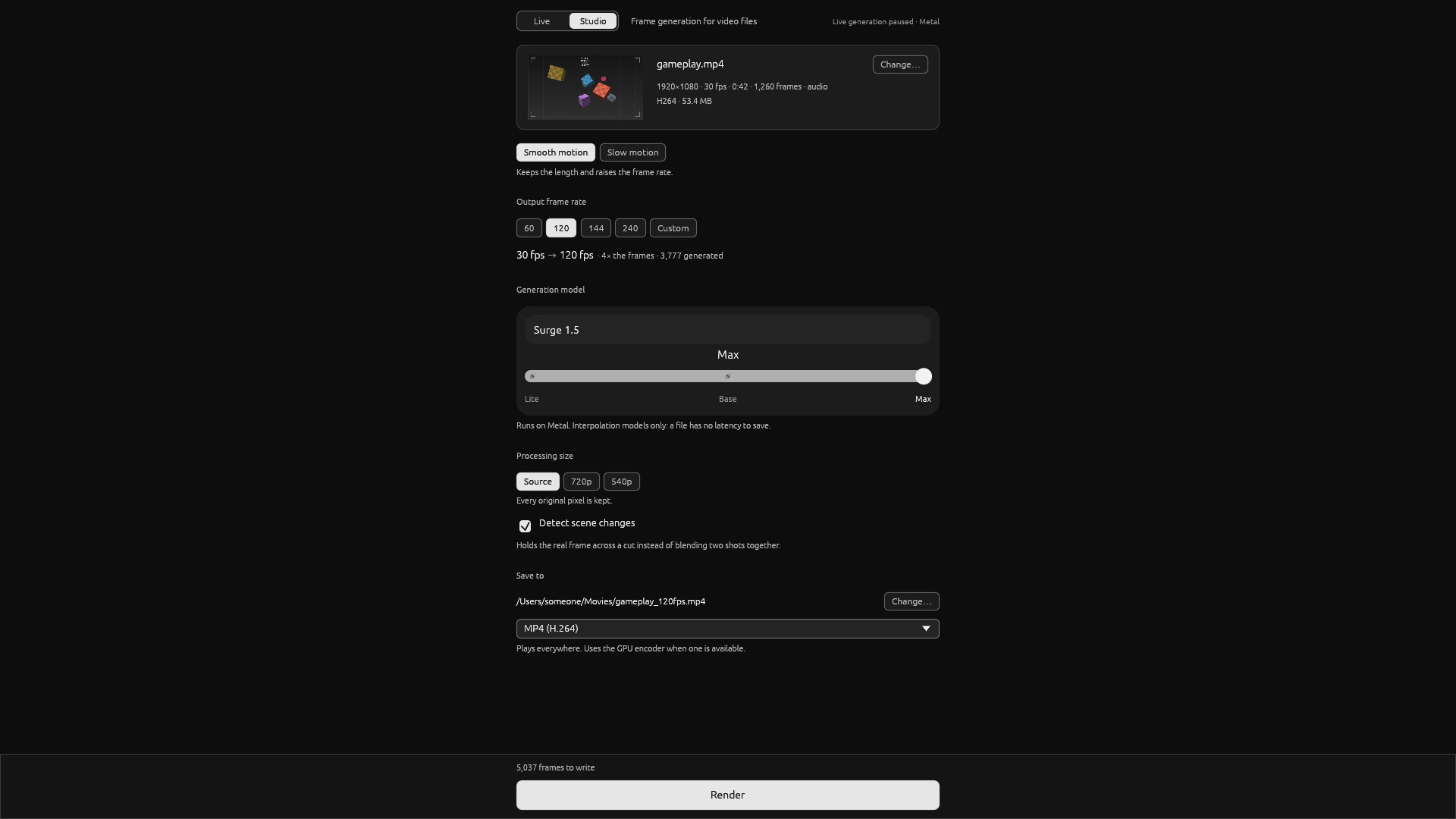
Use DraFG in real time for games, or switch to Studio Mode to process existing video files.

Studio Mode supports:

  • Frame interpolation

  • Higher-frame-rate output

  • Slow motion

  • Multi-frame generation

Flexible performance tuning

Choose from resolutions ranging from 360p to 4K, including 16:10 and ultrawide formats.

You can adjust models, generation mode, resolution, buffering, upscaling, sharpening, capture source, and A/B passthrough while DraFG is running.

Live statistics help track generation time, frame pacing, frame-budget usage, and missed deadlines.

Native and cross-platform

DraFG is written in Rust as a native application, with no Python environment or external machine-learning framework required.

  • Windows — CUDA, Vulkan

  • macOS — Metal on Apple Silicon

  • Linux — CUDA, Vulkan on KDE Plasma Wayland

System Requirements

Windows
macOS
SteamOS + Linux
    Minimum:
    • Requires a 64-bit processor and operating system
    • OS: Windows 10 64-bit
    • Processor: x64 dual-core CPU
    • Memory: 4 GB RAM
    • Graphics: GTX 1660 / RTX 2060 / RX 5600 XT or newer (Vulkan 1.2 required)
    • Storage: 1 GB available space
    Recommended:
    • Requires a 64-bit processor and operating system
    • OS: Windows 10/11 64-bit
    • Processor: x64 quad-core CPU
    • Memory: 8 GB RAM
    • Graphics: RTX 4060 / RX 7600 or better
    • Storage: 1 GB available space
    Minimum:
    • Requires an Apple processor
    • OS: macOS 13 Ventura
    • Processor: Apple M1
    • Memory: 8 GB RAM
    • Graphics: Metal-compatible GPU
    • Storage: 1 GB available space
    • Additional Notes: Native Metal, Apple Silicon only. Actively cooled Macs are recommended for long sessions.
    Recommended:
    • Requires an Apple processor
    • OS: macOS 14 or newer
    • Processor: Apple M-series with active cooling
    • Memory: 16 GB RAM
    • Graphics: Metal-compatible GPU
    • Storage: 1 GB available space
    • Additional Notes: Native Metal, Apple Silicon only. Actively cooled Macs are recommended for long sessions.
    Minimum:
    • OS: Ubuntu 22.04 or equivalent
    • Processor: x64 dual-core CPU
    • Memory: 4 GB RAM
    • Graphics: GTX 1660 / RTX 2060 / RX 5600 XT or newer (Vulkan 1.2 required)
    • Storage: 1 GB available space
    • Additional Notes: KDE Plasma 6.6.3+ and Wayland is required.
    Recommended:
    • OS: up-to-date distribution
    • Processor: x64 quad-core CPU
    • Memory: 8 GB RAM
    • Graphics: RTX 4060 / RX 7600 or better
    • Storage: 1 GB available space
    • Additional Notes: KDE Plasma 6.6.3+ and Wayland is required.
Review Filters