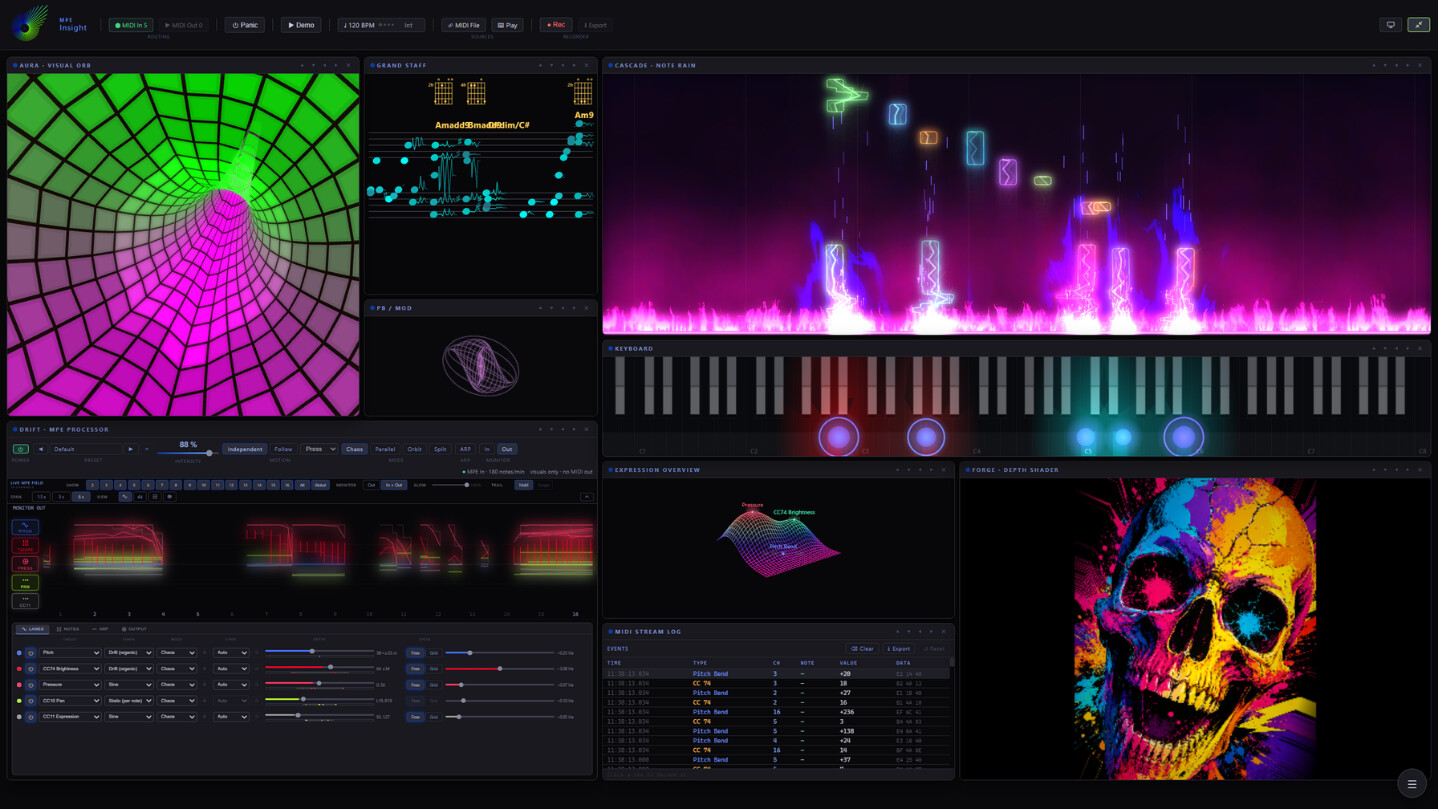

A real-time MIDI and MPE visualizer, monitor and expression analyzer. DRIFT turns any MIDI or computer keyboard into an expressive MPE instrument. Your playing drives 24 AURA visual engines, CASCADE note-rain and the FORGE depth engine. More than a visualizer: sound and image share one data stream.

Sign in to add this item to your wishlist, follow it, or mark it as ignored

Buy MPE Insight


About This Software

MPE Insight is a real-time MIDI and MPE visualizer, monitor and expression analyzer. Visualize your performance, inspect every MIDI message and explore per-note pressure, pitch bend, timbre and velocity as you play.

It is more than a visualizer: it is a creative tool for performers, composers, educators and visual artists, where sound and image share the same expressive data stream.

No MPE controller? No problem. DRIFT transforms any ordinary MIDI keyboard into an expressive MPE instrument, adding per-note pressure, pitch and timbre so your playing comes alive. No keyboard at all? Type on your computer keyboard and every module answers.

Create visuals directly from your performance with 24 real-time AURA engines, explore notes in CASCADE's musical visualizations, and enter 3D worlds with the FORGE depth engine.

KEY FEATURES

  • Full per-note expression tracking: each finger acts as its own control layer. Pressure, pitch bend (glide), timbre (CC74), velocity and release velocity, tracked per note and per channel

  • DRIFT processor: turns any ordinary MIDI keyboard into an expressive MPE controller. Randomized per-note pressure, pitch and timbre motion, plus octave layers, a chord machine with scale lock, note spread, bend quantize, humanize and a full arpeggiator that runs free or locks to incoming MIDI Clock. Every module, and every synth downstream, then reacts as if played on an expressive controller

  • 24 real-time AURA visual engines: particles, tunnel, kaleidoscope, contour, DNA, orrery, silk flames, photo swarm, tonewheel and more, switchable instantly without breaking the performance

  • CASCADE note-rain: a piano-roll-style rain of notes above the keyboard, driven live by your MPE. Eight combinable render layers (Bars, Particles, Lightning, Code Rain, Plasma, Waveform, Vines, Stars), a chrome finish and other materials, hand-split colouring and bloom. At the key line, ten impact layers you can stack in any combination: glow flash, sparks, ripple, fountain, firework, flames, water geyser, rain, lightning and a vortex that stands as long as the note is held, all of them either in the colour of the note that set them off or in one shared colour of your own

  • CASCADE Play a Picture: turn a picture, a drawing or plain text into a falling score. Pixels and glyphs map to notes through a scale and root of your choice, play back on CASCADE's own transport, and export as a Standard MIDI File for your DAW. No keys needed

  • FORGE depth engine: turns any image, video or live webcam feed into a 3D scene you fly through. AI depth, parallax, camera flight, feedback trails, Living World scene styles and a full FX rack (glitch, mosaic, false color, depth of field, fog, infinity spiral, retro pixel VHS), all shaped live by your MPE gestures

  • FORGE Cells: a screen pass over the finished frame, not another effect in the rack. Whatever FORGE just drew gets redrawn cell by cell as ASCII, halftone or dither, over any source and on top of everything else, with cell size, contrast and levels under your hand. Type your own character set and the ramp re-sorts itself by density

  • FORGE point cloud: let the picture fall apart into a cloud of points, each one sitting at its own depth, and spin it under the camera. Hard dots, soft splats, or characters you type in yourself, so the image comes back written in your own letters

  • FORGE module feed: route any other module into FORGE and fly through your own visuals in 3D. AURA, CASCADE, the live notation, the Expression Overview, the Keyboard, even several at once, blended

  • FORGE Conductor: a music-driven auto-director that moves the camera in sync with your playing. Play hard and it gets bold, play soft and it calms down, stop and the world keeps breathing on its own

  • Keyboard: an 88-key piano display with eight visual designs, from a realistic Classic through Glass, Neon, Minimal and Dark to a continuous Fingerboard touch surface, a flowing Motion ribbon and a top-down Pixel Grid LED view. The Pixel Grid alone gives you three layouts: a dotted piano silhouette, an equal-width chromatic field, and the button-accordion grid where every interval spans the same distance in every key. Each key carries its MPE channel colour, pressure as fill and a pitch-bend ring drawn at your instrument's real range; touch or click any key to play real MPE notes, horizontal for pitch bend, vertical for pressure or timbre

  • MIDI Stream Log with four views of the same stream, picked per instance so two logs side by side can watch one performance two different ways: Events is the real-time table of every message with timestamp, type, channel, note, value and raw hex, exportable as CSV; Notes is a voice journal of what is sounding where; Channels breaks an MPE zone down channel by channel; Stats keeps the running counts. Eight message types carry their own colour, editable per log, and the palette moves all four views at once

  • Log as a video overlay: eight presets come in pairs, the plain panel and the same view chrome-less, floating over the visual modules for a stream or a capture

  • Live Grand Staff notation with four ways to read the same playing: Now (only what you hold), Time (a scrolling timeline), Flow (every note a ribbon whose length is its duration and whose curve is the bend) and Weave (the staves give way to an interval field, where every major chord is the same triangle in every key)

  • Lead-sheet export: turn any recorded take into sheet music. A paginated grand staff with chord symbols, engraved straight from your performance and saved as a single PNG

  • 9 modules running simultaneously and freely arrangeable. Five analysis modules: an 88-key Keyboard with eight visual designs, PB/Mod expression graphs, an Expression Overview with five view modes (Lines, 3D Box, Radar, Landscape 3D, Rack), a MIDI Stream Log with four views (Events, Notes, Channels, Stats) and the live Grand Staff notation. Then the three visual engines, AURA, CASCADE and FORGE, and the DRIFT processor

  • Built-in MIDI file player: load a .mid and every module plays it, with full transport for play, pause, seek, loop and speed. The file runs through exactly the same path as live input, DRIFT included

  • Steadier tempo tracking from incoming MIDI Clock: the reading is built with a robust estimator over the whole pulse window instead of two endpoints, then trimmed, so a single late pulse no longer bends it. The readout holds one number where it used to swing, and the same steadied reading is what goes into the tempo map of a recording and into DRIFT's arpeggiator timing. Checked against fifteen recorded clock captures from Windows and macOS hosts

  • Full MPE recording with tempo-aware export to MIDI (Type 0 / Type 1) and CSV for DAW integration

  • Reads your instrument: MPE Insight picks up the real pitch-bend range your controller reports (RPN 0) and draws every bend at its true size, instead of assuming a standard

  • Modular, freely arrangeable workspace: resize and rearrange every module into your own layout, and open multiple instances of a module at once

  • Presets everywhere as starting points rather than a library: two for each of the 24 AURA engines with the MPE Insight signature at the top, scenes for CASCADE and FORGE, and a set in every analysis module. Load one, change anything, save it as your own

  • Three-tier snapshot system: unlimited, reorderable Global Snapshot playlists (full app state, exportable and importable as one file, or mark the ones you want and export just those), plus dedicated AURA and per-module snapshots

  • MIDI Learn: assign a Note, CC (pedal), or Program Change to flip through your Global Snapshots hands-free during a live set, or to arm the FORGE Conductor and ride its range and cycle speed from a knob

  • Guided tour on first launch: a short clickthrough introduces the toolbar and all nine modules, one card each with that module's own animation beside it and Demo Mode playing underneath. Skip it at any point, or replay it later from the About menu

  • One Play pill for every way of playing without a controller: the computer keyboard, and Mouse Mode for drawing notes with the pointer. MIDI Out goes back to being ports and routing

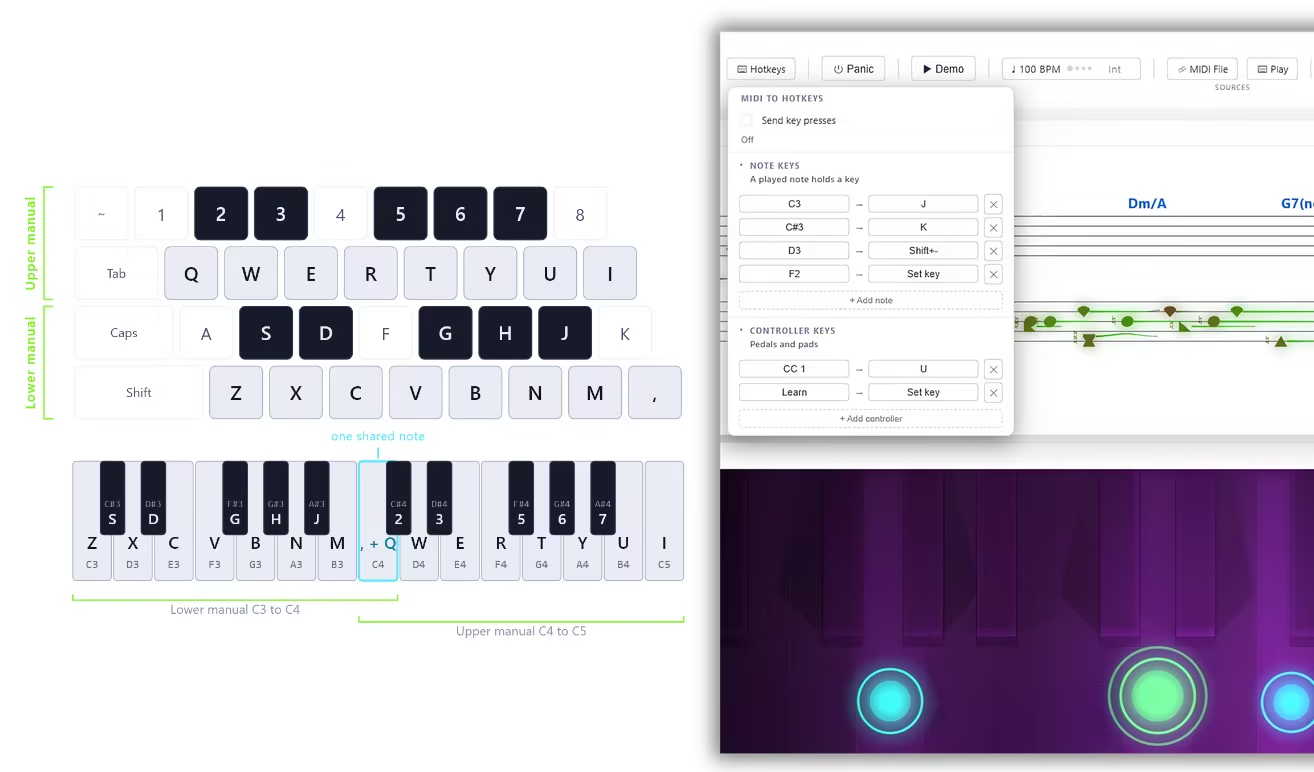
  • Typing Keys: play the whole app on your computer keyboard when no controller is around. Two manuals laid out in real piano geometry, space bar for sustain, and with DRIFT armed every typed note arrives as a full MPE voice, in every module and at every synth downstream

  • Built-in Demo Mode with full MPE simulation: explore every module without a controller connected

  • Live MIDI output: play visuals directly via mouse/touch, or forward incoming MIDI through to another device

  • Fits your setup: switch the whole app between 88, 61, 49 and 25 keys, and put any module, or all of them, on a transparent background for overlay use in your video mix

  • Per-channel filtering and MIDI Clock/BPM sync for tight integration with the rest of your setup, plus sustain pedals of either kind: a switch or a continuous half-pedal, detected on its own and invertible for pedals wired the other way round

  • Multiple MIDI devices active at once, auto-detected on connect

MPE Insight turns your performance data into something you can see, explore and perform.

System Requirements

    Minimum:
    • Requires a 64-bit processor and operating system
    • OS: Windows 10 / 11
    • Processor: Requires a 64-bit processor and operating system
    • Memory: 8 GB RAM
    • Graphics: NVIDIA GTX 1060 / AMD RX 580 (or higher)
    • Storage: 750 MB available space
    • Sound Card: -
    • VR Support: -
    • Additional Notes: An MPE-compatible MIDI controller is recommended for the full expressive experience. A built-in Demo Mode lets you explore every module without MPE hardware.
    Recommended:
    • Requires a 64-bit processor and operating system
    • OS: Windows 10 / 11
    • Processor: Intel Core i5 (or higher), AMD Ryzen 5 (or higher)
    • Memory: 16 GB RAM
    • Graphics: NVIDIA GTX 1060 / AMD RX 580 (or higher)
    • Storage: 750 MB available space
    • Sound Card: -
    • VR Support: -
    • Additional Notes: An MPE-compatible MIDI controller is recommended for the full expressive experience. A built-in Demo Mode lets you explore every module without MPE hardware.
Review Filters