
A real-time MIDI and MPE visualizer, MIDI monitor and MPE synth for any MIDI keyboard. See pressure, bend and timbre of every note as visuals, keys, pads and live sheet music, microtonal too. Draw MPE notes, learn songs, send MIDI out, export video and audio. DRIFT turns plain MIDI into MPE.

Sign in to add this item to your wishlist, follow it, or mark it as ignored

Buy MPE Insight


About This Software

MPE Insight is a real-time MIDI and MPE visualizer, MIDI monitor and MPE synth with live sheet music. It shows what you play on a MIDI keyboard: every note with its pressure, pitch bend and timbre, as visuals, keys, notation and raw MIDI data. It draws MPE notes, plays them on a built-in synth, records MIDI and exports video and audio.

No MPE controller needed. Any MIDI keyboard works.

Every module reads the same playing at the same moment. Place them side by side, open one twice, close what you do not need. Made for performers, composers and visual artists.

Falling notes, in 2D or 3D

CASCADE. Every note becomes a body that leaves the strike line and travels away. Pitch bend moves it sideways, CC74 lifts it, pressure makes it thicker. With 3D Tilt the floor tips back, with shadow, reflection and an optional sky. Impact effects and a glow bar react at the strike line.

Draw a note. It bends.

MPE Designer. A pen stroke is a note: its curve is the pitch bend, and pressure and timbre are painted into it. What you draw plays in every module, in time with the app.

  • Draw. Click for a note, drag for a glide.

  • Edit. Select, cut, copy, weld and quantize on a grid that follows a scale.

  • Shape. Pressure and controller lanes on each note.

  • Play and record. Set a loop, play the drawing, or record your playing straight into it.

  • Import and export. Import a MIDI file onto the pad, export your drawing as an MPE MIDI file, or render it as a video.

Hear it without a DAW

VOLT. A built-in MPE synth plays everything the app sends: your keyboard, the Designer, MIDI files, Typing Keys, the mouse and DRIFT, with a metronome click. Its effects sit in tabs, its window resizes from the corner, and a take can be saved as a WAV file with VOLT's sound. MIDI out reaches any other synth.

One field, many styles

AURA. Styles include ink in water, smoke, breaking glass, a starfield, a black hole, and the notes you play written out as words. Pressure, pitch bend and timbre each drive a different part of the style, per note.

Images and video with depth

FORGE. An image, a video, the webcam or another module becomes a scene with depth. Notes distort, light and color it, move a virtual camera or turn it into a point cloud. Depth for still images is computed locally.

Keys and pads, lit by your playing

Keyboard. A key lights with pressure and velocity, a ring shows CC74, and a Glow Trail fades behind each note. Piano designs, a fingerboard and microtonal tunings, with cent marks and note names on the keys. Scale Lock keeps what you play inside a scale, also from your MIDI keyboard, and every key can hold a chord of its own.

Pad grid. The Pixel styles turn the keyboard into a lit pad grid, like a hardware pad controller. Pixel Surface lays out notes in rows a fourth, a fifth or an octave apart, so a chord has the same shape in every key. Pad Matrix plays a chord on every pad, by root and chord type, and any pad can learn a chord of your own. Pad Live plays the chord you set on every root of its bottom row. With Pitch on, a sideways drag bends the whole chord.

Sheet music, as you play

Grand Staff. Writes what you hold in the key you set, names the chord, and shows the bend on each note, with cent values next to microtonal notes. Or read it scrolling in time, as ribbons, on an interval field, or as guitar tab in standard or all-fourths tuning.

Every MIDI message

LOG. Every message as a live table, with the raw bytes decoded. Or the same playing drawn as lines, a 3D box, a radar or a landscape. Export what the table shows as CSV.

Control. The wheels of your keyboard as sliders or rings, an Expression Pad you play with the mouse, or Pixel Control: a lit pad surface split into faders, XY fields, triggers, pressure fields and switches. Every area sends to a target you choose, and so do the wheels.

Any keyboard. Or none.

An MPE controller sends pitch, pressure and timbre for every note. An ordinary MIDI keyboard sends the notes, and DRIFT adds the movement. No keyboard on the desk? Then one of these:

  • Typing Keys. Two manuals under your hands on the computer keyboard, with the sharps on the row above. Those are key positions, not letters, so QWERTY, QWERTZ and AZERTY fall under the same fingers. Space is the sustain pedal.

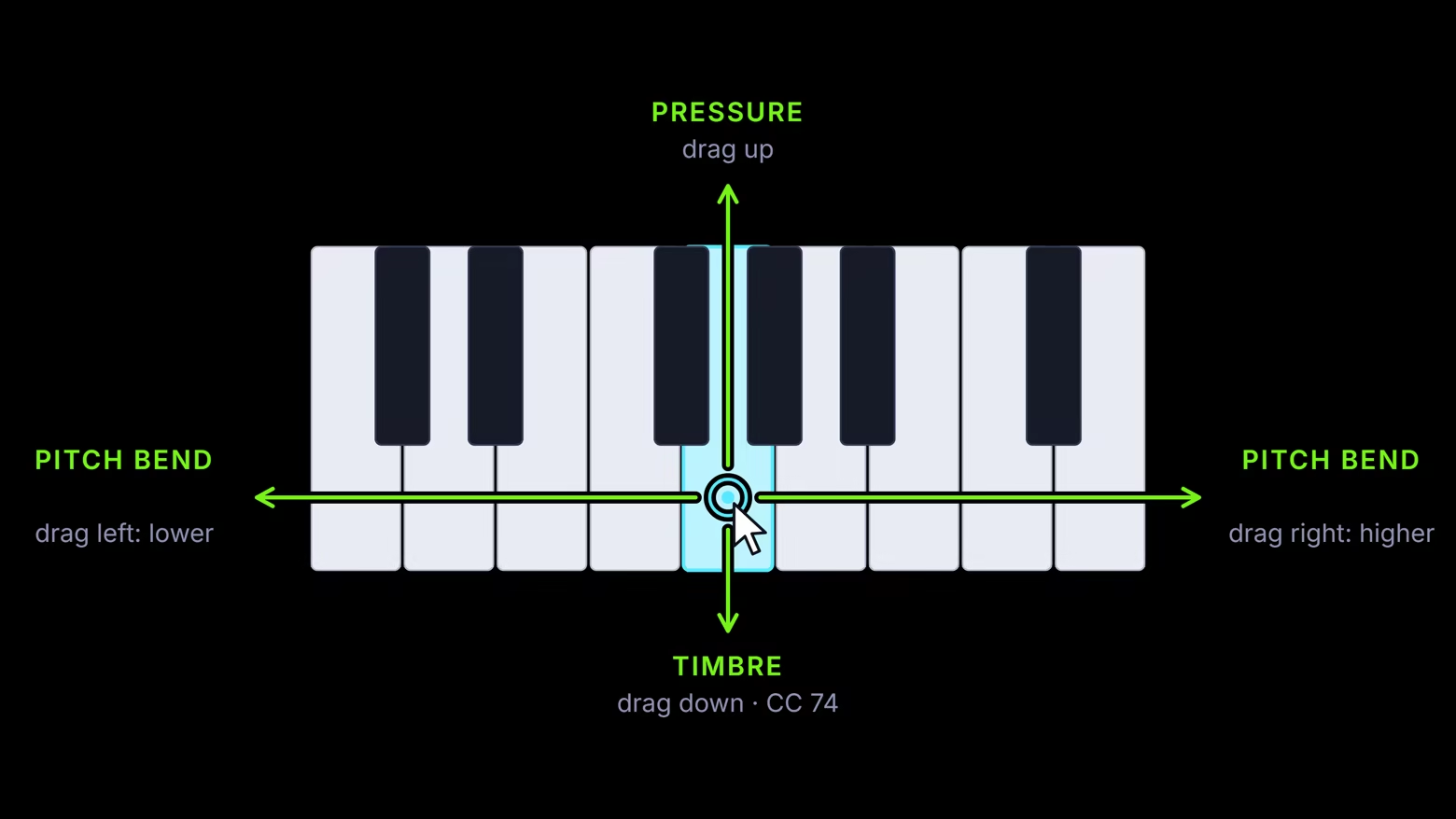
  • Mouse. Click or touch a key to send a real MPE note. Drag sideways for pitch bend, up for pressure, down for timbre. Each pointer gets its own member channel, so chords on a touchscreen work.

  • A MIDI file. Drop a .mid anywhere in the window, press Play, and every module plays it like live input, at the app tempo, with the built-in synth as its sound.

  • Learn mode. Load a MIDI file, switch on Learn mode and press Play: the song waits at every chord until you play it, on the screen or on your MIDI keyboard. The keyboard lights up what comes next, CASCADE drops the notes onto the keys and holds them there, and the Grand Staff shows the next four bars with the chord to play framed.

  • Demo. Plays on its own with nothing connected and steps through the presets, for setting up a look before anyone is watching.

  • Hotkeys. The other direction: notes and controllers from your MIDI hardware press real computer keys in whatever app is in front, so a pedal can arm the recording in your DAW.

Plain MIDI in, MPE out

DRIFT gives every note you hold on an ordinary MIDI keyboard its own motion in pitch, pressure and timbre, for every module and for your synth. Lanes with their own shape and speed, octave layers, a chord machine and an arpeggiator. Connect lets each new chord glide from the last one while you hold it with your fingers or the pedal, without a new attack. Scale snaps notes and bends to a root and scale.

Specifications

  • Input: any MIDI device, several at once, MPE optional, bend range read from the instrument

  • Sound: VOLT, a built-in MPE synth, plus MIDI out and Thru to any other

  • Recording: MIDI Type 0 or Type 1 with tempo map, CSV, a notation sheet as PNG pages

  • Video and audio: MP4 in 16:9, 9:16 or 1:1, HD or 4K, 30 or 60 fps, with your logo and text. The sound alone as WAV, 48 kHz, 24 bit. 4K at 60 fps is encoded on the graphics card

  • Tempo: internal or MIDI Clock, tap tempo, count-in, bar lines. MIDI files follow the app tempo

  • Keyboard range: 88, 61, 49 or 25 keys, plus a printable key strip for behind your keys

  • Stage and stream: Stage View hides the interface, every module except FORGE can sit on a transparent background, and looks switch from a pedal or a MIDI control

  • DAW: runs next to your DAW, follows its MIDI Clock, and what you record goes back in as a MIDI file

  • Themes: nine color themes for the window, from Black to Paper, and a dice next to every color pair for new colors

  • Graphics: WebGL2 for 3D

System Requirements

    Minimum:
    • Requires a 64-bit processor and operating system
    • OS: Windows 10 / 11
    • Processor: Requires a 64-bit processor and operating system
    • Memory: 8 GB RAM
    • Graphics: NVIDIA GTX 1060 / AMD RX 580 (or higher)
    • Storage: 750 MB available space
    • Sound Card: -
    • VR Support: -
    • Additional Notes: Works with any MIDI keyboard, MPE optional. Without one, the computer keyboard and the mouse play it.
    Recommended:
    • Requires a 64-bit processor and operating system
    • OS: Windows 10 / 11
    • Processor: Intel Core i5 (or higher), AMD Ryzen 5 (or higher)
    • Memory: 16 GB RAM
    • Graphics: NVIDIA GTX 1060 / AMD RX 580 (or higher)
    • Storage: 750 MB available space
    • Sound Card: -
    • VR Support: -
    • Additional Notes: Works with any MIDI keyboard, MPE optional. Without one, the computer keyboard and the mouse play it.