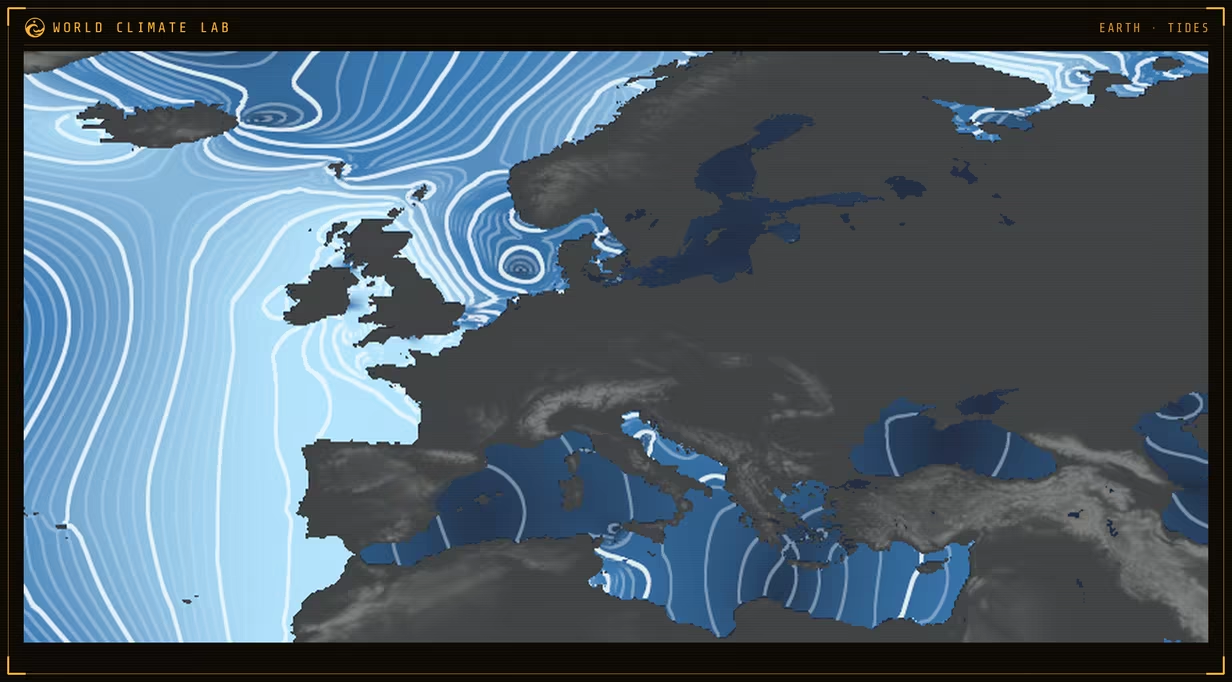

World Climate Lab is a real-time planetary climate simulator. Import your own terrain or sculpt a world in the topography editor, then watch a living climate emerge from physics: winds, oceans, cloud bands and ice. Every climate is calculated, not painted.

Sign in to add this item to your wishlist, follow it, or mark it as ignored

Early Access Game

Get instant access and start playing; get involved with this game as it develops.

Note: Games in Early Access are not complete and may or may not change further. If you are not excited to play this game in its current state, then you should wait to see if the game progresses further in development. Learn more

What the developers have to say:

Why Early Access?

“World Climate Lab has a solid, working foundation, but a planetary climate sandbox can grow in many directions, and the people who use it for their own worlds should shape the directions it takes. Releasing in Early Access lets the worldbuilding and simulation community directly influence which new planetary features, climate models, classification tools, and editor capabilities get built. Their feedback won't just find bugs; it will decide what the simulator becomes.”

Approximately how long will this game be in Early Access?

“We plan for an Early Access period of roughly six months, though this may be adjusted as we respond to community feedback and the scope of features players request.”

How is the full version planned to differ from the Early Access version?

“We plan to use the Early Access period primarily to refine and polish the simulator based on player feedback. This includes improving usability, smoothing rough edges in the interface and editor, fixing issues that emerge through varied use, and tuning the simulation and rendering for a wider range of hardware. Where the community identifies valuable additions, we would like to incorporate them, but our central goal is a more polished, stable, and refined experience rather than a fundamentally different one.”

What is the current state of the Early Access version?

“The Early Access version is fully playable and stable. You can build worlds or import your own terrain, run real-time physics-based climate simulations, terraform real planetary bodies, and explore climates across a wide range of rotation regimes, atmospheres, planet sizes, and star systems including binaries. The core simulation, topography editor, and planet rendering are all functional. Early Access will focus on expanding the breadth and depth of what can be simulated and created and to see if worldbuilder want to try our more experimental simulation layers that are not yet fully stable but that some might appreciate, guided by community feedback.”

Will the game be priced differently during and after Early Access?

“No. We plan to keep the price the same during and after Early Access.”

How are you planning on involving the Community in your development process?

“We plan to gather feedback through the Steam Community forums, and direct player suggestions, and to use that input to prioritise which worlds, features, and tools we develop next. The worldbuilding and simulation communities have deep, specific knowledge, and we want that expertise to shape the simulator's direction.”
Read more

Buy World Climate Lab


Report bugs and leave feedback for this game on the discussion boards

See all discussions

About This Game

World Climate Lab puts a full climate model on your desktop. Give it any world and it works out the climate: where the winds blow, where the rain falls, where ice forms and deserts open, and how the oceans carry the heat. It runs live on your graphics card, and you watch the world settle into its climate, year by year, in a few minutes.

Bring the map you have drawn and find out what its weather would really be. Or ask what if: what if Earth spun backwards, circled a red dwarf, or had a moon close enough to flood its coasts at every tide?

Bring your own world

Your maps are more than pictures here. Each one tells the model something real about the world, and the climate answers.

  • Heightmap: greyscale or colour, at any size; 16-bit maps keep every gentle slope, and mountains rise only as high as the planet's gravity and rock allow

  • Sea mask: draw your coastlines exactly as you want them, whatever the heights say, or raise and lower the sea with a single slider

  • Depressions mask: keep basins dry below sea level, like the Dead Sea or a Mediterranean cut off from the ocean; their air is denser and warmer, rivers run into them and end there, and lakes form where the water allows

  • Sea floor: upload a bathymetry map and the tides follow it, piling up in shelf seas and ringing in resonant bays; without one, the game builds continental shelves, slopes and abyssal plains for you

  • Earth comes with its real coastlines and its real sea floor

Or build one

The Topography Creator is a full terrain editor inside the game.

  • Start from a blank ocean, import a map, or generate a world of drifting plates

  • Sculpt on the globe with 73 brushes, stencils and a library of generated landmasses

  • Reshape the whole planet with a height curve, then erode it and carve its river valleys

  • Trace over reference images with guide overlays

  • Export your terrain as 16-bit maps, or send it straight to the simulation

Any star, any orbit, any sky

A planet circling two suns, a moon kept warm by tides alone, a world tipped on its side: set it up and the climate follows.

  • Stars from cool brown dwarfs to hot blue stars, old white dwarfs, and pairs of stars

  • Each star's own light reaches the climate: a red dwarf's infrared warms snow and ice differently from sunlight

  • Any distance, eccentricity and season of closest approach

  • Tilt up to 180 degrees, so a world can spin backwards and see its sun rise in the west

  • Any day length, a face locked to its star, or the 3:2 spin Mercury is held in

  • A planet or a moon, with up to three moons of its own raising tides and warming it from within

  • Air from a trace to 100 bar of nitrogen, carbon dioxide, hydrogen or methane, with ten trace gases from oxygen to ammonia

  • An atmosphere profile that shows whether a person could breathe there, and why not

Watch it settle

Every change ripples through the whole system. Slow the spin and the climate bands widen. Lock the world to its star and it splits into a warm day side and a frozen night side. Thicken the air, move a coastline or dim the star, and the world finds its new climate. The Energy Flow view traces where the planet's energy goes and tells you whether the world has settled, is still warming or cooling, or is running away.

22 ways to read a world

Every map comes from the same run, so the rivers follow the rain, the forests follow the water and the ice follows the cold.

  • Surface: topography, rivers and lakes, ice cover

  • Satellite: a true-colour view from space, with clouds, a night side, and plants coloured by their own star's light

  • Vegetation: vegetation cover and soil moisture

  • Climate: climate zones, temperature, rain and snow, aridity

  • Atmosphere: pressure, cloud, winds, humidity, dew point, wet-bulb heat and the energy budget

  • Oceans: surface and deep currents, current paths and tides

Hover anywhere for the numbers, step through the seasons of the orbit, switch between map and globe, and show temperature, rain and pressure as contours.

Climates Earth never had

Earth's climate zones describe one kind of world. Here, Earth-like worlds get Köppen's 31 classes, while slow-turning and tidally locked worlds get systems of their own, built for places where day and night replace the seasons: twilight cloud forests, frozen night wastes, and seas from permanent ice to boiling water.

Take it with you

  • Plain maps or framed posters with title and key, up to 8192 by 4096

  • Every layer at once, or a full year of seasons

  • Animations of a year of clouds, winds, currents, temperature or rain

  • The climate itself as data for other software: temperature, rain, snow, soil water, climate classes and more, yearly and month by month

  • A seamless year of cloud maps at 8192 by 4096 for animation

Checked against Earth

The Earth preset, with its real coastlines and sea floor, is measured against the observed climate zones of 1991 to 2020 whenever the model changes. A Data Bank of illustrated pages explains every control, the climate systems, and what the model does and does not simulate. A Detailed model with a twelve-layer deep ocean is available as an experimental beta.

Made to run on your machine

  • Performance settings for laptops and older graphics cards, which change the pace but never the results

  • Interface size from 75 to 300 percent

  • English, French, Spanish, German, Polish, Russian, Simplified Chinese and Traditional Chinese

AI Generated Content Disclosure

The developers describe how their game uses AI Generated Content like this:

AI helped localise languages I don't currently have resources for, but it will be fully human once the final UI and text are finalised and resources become available. Non-user-facing efficiency tools have been used in development. All art, science implementation, and research are human.

System Requirements

    Minimum:
    • Requires a 64-bit processor and operating system
    • OS: OS Version: Windows 10 64-bit
    • Processor: Intel Core i5-8400 / AMD Ryzen 5 2600
    • Memory: 16 GB RAM
    • Graphics: Vulkan-compatible dedicated GPU with 6 GB VRAM, NVIDIA GTX 1660 / AMD RX 5600 XT or better
    • Storage: 2 GB available space
    • Sound Card:
    • Additional Notes: Requires a Vulkan-compatible graphics driver. Large exports, cinematic frame dumps, and generated maps may require additional disk space.
    Recommended:
    • Requires a 64-bit processor and operating system
    • OS: Windows 10 or Windows 11 64-bit
    • Processor: Intel Core i5-12400 / AMD Ryzen 5 5600
    • Memory: 32 GB RAM
    • Graphics: NVIDIA RTX 3060 12 GB / AMD RX 6700 XT 12 GB or better
    • Storage: 4 GB available space