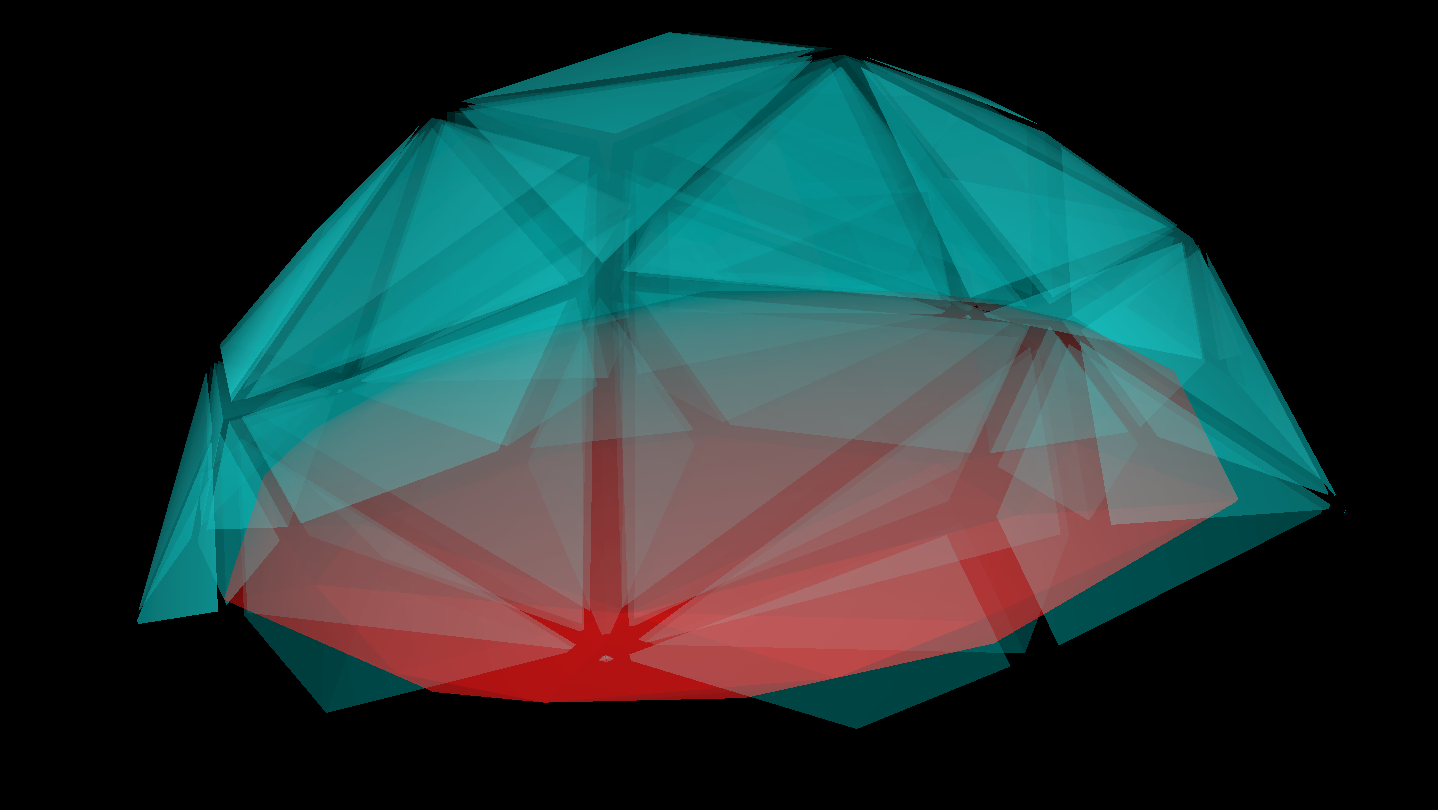

A set of mini-games and sandbox for those who are curious about Euclidean 4D space. Try color matcher Ring Logic and Magic Manycell puzzle inspired by Magic Cube. Explore all 6 known regular polychorons, or create your own.

Sign in to add this item to your wishlist, follow it, or mark it as ignored

Early Access Game

Get instant access and start playing; get involved with this game as it develops.

Note: Games in Early Access are not complete and may or may not change further. If you are not excited to play this game in its current state, then you should wait to see if the game progresses further in development. Learn more

What the developers have to say:

Why Early Access?

“I didn't research the Steam developer community suggestions so did the worst thing possible by releasing in EA mode. Now I wish I'd just released a demo and kept in Upcoming. Still going to finish this by releasing out of Early Access after adding remaining planned features.”

Approximately how long will this game be in Early Access?

“7-12 months.”

How is the full version planned to differ from the Early Access version?

“New variety of Ring Logic game is planned to be added - survival mode where new cells are spawned during shifting so player has to effectively clean them up to avoid board overloading.

Another mini-game is planned to be added - an arcade 4D space shooter with all degrees of freedom.

Besides, some Steam systems may be added (but not guaranteed) such as achievements and full Steam controller support.”

What is the current state of the Early Access version?

“1.5 of 3 mini-games are available to play, Exploration sandbox is available. Localization infrastructure is done and languages are being added.

Controls configuration needs work but is functional (players can assign gamepad axes and buttons).”

Will the game be priced differently during and after Early Access?

“At this time there are no plans to change the price when leaving Early Access.”

How are you planning on involving the Community in your development process?

“Any suggestions and bug reports provided by the community via Community Discussion forum will be addressed.”
Read more

Buy Polychoron Explorer

SPECIAL PROMOTION! Offer ends October 26

30% off. $9.99 normally, discounted to $6.99
 

Report bugs and leave feedback for this game on the discussion boards

See all discussions

About This Game

Explore 4D world as viewed by the eyes of imaginary 4D creature that uses volumetric (3D) space for visual sensing instead of planar (2D) space like we do.

This game is a collection of mini-games and tools that allows player to interact with 4D Polytopes also known as Polychorons, which are 4D analogs of polyhedra such as cube. 

There are currently 2 mini-games and 1 tool available, with one additional new mini-game planned to be added before release out of Early Access.

Ring Logic is a color matcher game based on 3D manifold of a 4D polychoron. Each cell of a polychoron is assigned a color. Player can shift cells along the Great Rings of a polychoron to create connected groups of cells of the same color that disappear when enough are connected. Goal of the game is to clear the initially near-full board. Another mode is planned where prolonged playing is facilitated by spawning more cells during gameplay.

Magic Manycell is a puzzle game inspired by Magic Cube. Just like a cube that has 6 square faces, each of which is split into 3x3 smaller squares, in 4D a tesseract has 8 cubic cells, each of which is split into 2^3 or 3^3 smaller cubic cells. Then, in Magic Cube, player can rotate 3x3x1 slice of the cube around single axis; in 4D, player can rotate 3x3x3x1 slice, but unlike Magic Cube, there are more than 1 ways to rotate this slice.

Besides the "hard" mode of Tesseract-based Magic Manycell where player can only rotate the 3x3x3 cube cell together with other cubes connected via 4D by common faces, there is a much easier mode available where each cell's cubes can be rearranged independently of their 4D neighbors - this is called Independent mode.

Currently 3 different Polychorons are supported for Magic Manycell game - Tesseract with cells divided into 8 cubes (2x2x2), Tesseract with cells divided into 27 cubes (3x3x3) and a 16-cell which has its cells intact but still can be split in 2 halves to be rotated against each other so it feels like a natural fit for this game. More figures may be added in the future.

In addition to these two mini-games, Polychoron Explorer naturally includes Explorer mode.

This exploration sandbox was created to observe convex polychorons without any gameplay goals. To better understand their geometry, players can assign colors to cells or hide them. It's also possible to explore 3D scan of a polychoron instead of its 3D projection.

Besides all of the regular polychorons (5-cell, 8-cell, 16-cell, 24-cell, 120-cell and 600-cell), it is possible to create new convex polychorons to explore using Scan feature which allows to cut scanned polychoron in 2 parts and then select any of the parts for exploration.

Another mini-game planned to be added to this package is not specifically related to polychorons - it's going to be about 4D space navigation.

System Requirements

    Minimum:
    • Requires a 64-bit processor and operating system
    • OS: Windows 10
    • Processor: x86_32 CPU with SSE2 support, x86_64 CPU with SSE4.2 support, ARMv8 CPU
    • Memory: 4 GB RAM
    • Graphics: Integrated graphics with full Vulkan 1.0 support, Direct3D 12 (12_0 feature level) support
    • DirectX: Version 12
    • Storage: 150 MB available space
    • Sound Card: Not needed
    • VR Support: Not used
    Recommended:
    • Requires a 64-bit processor and operating system
    • OS: Windows 10
    • Processor: x86_32 CPU with SSE2 support, x86_64 CPU with SSE4.2 support, ARMv8 CPU
    • Memory: 4 GB RAM
    • Graphics: Integrated graphics with full Vulkan 1.0 support, Direct3D 12 (12_0 feature level) support
    • DirectX: Version 12
    • Storage: 150 MB available space
    • Sound Card: Not needed
    • VR Support: Not used
Review Filters