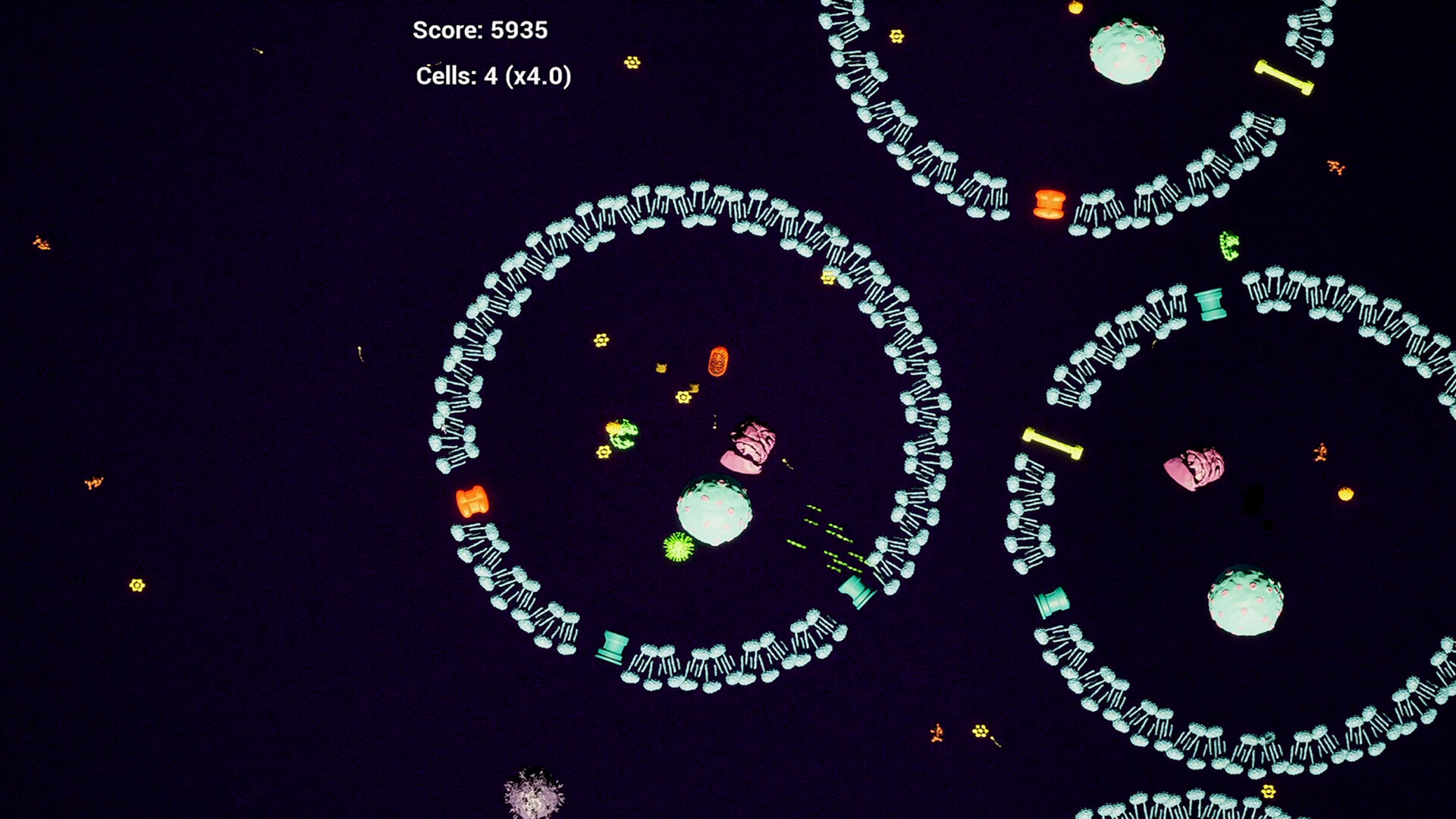

Manage a colony of living cells. Build phospholipid membranes, place organelles, fight viral infections, detect cancer, and divide your cells to grow. Learn real cell biology through gameplay — no tutorials, no lectures, just discovery. Built by a doctor who learned C++ with AI.

Sign in to add this item to your wishlist, follow it, or mark it as ignored

Coming Soon To Early Access

The developers of this game intend to release as a work in progress, developing with the feedback of players.

Note: Games in Early Access are not complete and may or may not change further. If you are not excited to play this game in its current state, then you should wait to see if the game progresses further in development. Learn more

What the developers have to say:

Why Early Access?

“Cellula started as an experiment: can one doctor with free AI tools build a game that teaches real biology through gameplay? The answer turned out to be yes — but there's so much more to add.

The core simulation is functional and educational. Cells grow, divide, fight viruses, develop cancer, and respond to immune cells. But biology is vast. Hormone signaling, diabetes scenarios, additional virus types, more organelle interactions, and community-requested features are all possible.

Early access lets players shape what Cellula becomes. Your feedback will determine which systems get built next. A biology teacher might want detailed cellular respiration. A student might want more visual feedback on transport. A curious gamer might want harder survival challenges.

Cellula will be in early access until the community agrees it's a complete educational experience. The full version will include more organelle types, expanded immune responses, additional disease scenarios, and whatever else players help prioritize. The price may increase as features are added.”

Approximately how long will this game be in Early Access?

“6 to 12 months, depending on community feedback. The core simulation is complete and playable now. The timeline depends on how many features the community wants to see added — new organelle types, hormone signaling, diabetes scenarios, additional virus mechanics, and more. The game will leave early access when players feel it's a complete educational experience.”

How is the full version planned to differ from the Early Access version?

“The Early Access version is a complete, playable cell biology simulation with working membrane physics, organelle economy, viral infection, cancer mechanics, immune response, and cell division.

For the full version, we plan to expand in several directions based on community feedback:

Additional Organelles and Systems — We plan to add the Endoplasmic Reticulum as a functional organelle, expand the Golgi apparatus with more shipping options, and implement peroxisomes for reactive oxygen species management.

Disease Scenarios — We plan to add diabetes mechanics (insulin signaling, GLUT transporter sensitivity), autoimmune conditions, and bacterial infections that behave differently from viruses.

Hormone and Signaling — We plan to implement inter-cellular signaling pathways that let cells communicate and coordinate responses to threats.

Expanded Immune System — We plan to add Natural Killer cells, macrophages, cytokine storms as emergency abilities, and more nuanced antibody responses.

Educational Tools — We plan to add optional visualization modes that show resource flows, membrane transport rates, and cellular processes in more detail for classroom use.

Quality of Life — We plan to improve the user interface, add more control options, implement save/load functionality, and polish the overall experience based on player feedback.

The scope and priority of these additions will be shaped by the community. Nothing is set in stone. The goal is to build the best educational cell simulator possible, and the players will help decide what that means.”

What is the current state of the Early Access version?

“The Early Access version is a fully playable cell biology simulation with complete core systems:

Fully Functional Membrane System — Build a phospholipid bilayer from individual physics-based bricks that self-assemble, attract and repel each other, and can be clicked and dragged. Grow the membrane by purchasing phospholipids from the Smooth ER.

Complete Organelle Economy — Place mitochondria (ATP production), ribosomes (protein synthesis), lysosomes (waste management), Smooth ER (phospholipid synthesis), Golgi apparatus (inter-cellular shipping), and a nucleus (build menu). Each organelle functions with real resource costs and outputs.

Molecular Transport — Glucose, amino acid, and lipid molecules float in the plasma and are pulled toward matching transporter proteins embedded in the membrane. Values are configurable.

Viral Infection — Viruses dock on GLUT1 transporters, inject DNA that seeks the nucleus, and turn infected cells into virus factories. Infected cells eventually lyse, releasing more viruses.

Immune Response — B-cells patrol and produce antibodies. T-cells can be summoned to hunt cancer cells. Antibodies have a small chance of causing autoimmune reactions.

Cancer Mechanic — Every cell division carries a risk of cancer, with the chance increasing with each generation. Cancer cells grow uncontrollably and spread.

Cell Division — Divide cells by clustering membrane bricks around nuclei, splitting resources, and assigning organelles to daughter cells. Each cell maintains its own independent economy.

Scoring System — Score increases based on cell count and survival time. High scores persist between sessions. Apoptosis can be triggered voluntarily for bonus points.

Audio — Sound effects for building, dividing, viral docking, cell lysis, and UI interactions.

Known Limitations — Click detection can be finicky with many overlapping organelles. Some organelle models are placeholder assets. No save/load system yet. Balance is still being tuned.

The game is stable, educational, and fun for multiple play sessions. It teaches real cell biology through gameplay without tutorials or lectures.”

Will the game be priced differently during and after Early Access?

“Yes. We plan to gradually raise the price as we ship new content and features. Early Access supporters will get the best price and help shape the game's development.”

How are you planning on involving the Community in your development process?

“Cellula is being built for learners, teachers, and curious gamers — so your feedback should shape what it becomes.

We plan to actively monitor Steam discussion forums, where players can suggest features, report bugs, and share their experiences. Feature requests that gain community support will be prioritized for development.

Teachers and students are especially encouraged to share how Cellula works in their classrooms. Their feedback will directly influence educational features, visualization tools, and curriculum alignment.

Balance changes, new organelle types, disease scenarios, and quality-of-life improvements will all be driven by what players actually want — not what we assume they want.

We also plan to share development updates regularly, so the community can see what's being worked on and provide input before features are finalized.

In short: you tell us what would make Cellula better, and we'll build it. This game exists to teach biology through gameplay. Nobody knows what that needs to look like better than the people playing it.”
Read more
This game is not yet available on Steam

Planned Release Date: Jun 29, 2026

This game plans to unlock in approximately 6 days

Interested?
Add to your wishlist and get notified when it becomes available.
 
See all discussions

Report bugs and leave feedback for this game on the discussion boards

About This Game

Cellula is a cell biology simulator disguised as a strategy game. Manage a colony of living cells, build their membranes from individual phospholipid bricks, place organelles, fight viruses, detect cancer, and divide your cells to grow. No tutorials. No lectures. Learn real biology by doing.

WHAT YOU'LL DO

Start with a single cell — a ring of phospholipid bricks that self-assembles via physics. Place GLUT1 transporters to import glucose, amino acid transporters for proteins, and lipid transporters for membrane growth. Build mitochondria to produce ATP, ribosomes to synthesize proteins, and lysosomes to clean up waste. Grow your membrane by purchasing phospholipids from the Smooth ER. Ship resources between cells with the Golgi apparatus.

Then things go wrong.

Viruses drift toward your cells and dock on the very transporters you built to feed them. They inject viral DNA, which slithers toward your nucleus. If it reaches it, your cell becomes a virus factory and eventually bursts, releasing more viruses. Cancer can emerge from cell division — a dark, sinister nucleus that grows uncontrollably and spreads. You can summon T-cells to hunt it down, or B-cells to produce antibodies, or trigger apoptosis to sacrifice a dying cell for the good of the colony.

Every lesson is learned through failure. Your cells will die of waste toxicity because you forgot lysosomes. Your colony will collapse because you placed too many transporters and gave viruses easy entry. You'll learn what every organelle does — not because you studied it, but because your cells kept dying without them.

KEY FEATURES

  • Real Cell Biology — Every system is based on actual cellular mechanics: surface area-to-volume ratio, membrane transport, metabolic waste, viral entry, immune response, and cancer development

  • Physics-Based Membrane — Build your cell wall from individual phospholipid bricks that self-assemble, attract and repel each other, and can be clicked and dragged

  • Complete Organelle Economy — Mitochondria (ATP production), Ribosomes (protein synthesis), Smooth ER (phospholipid synthesis), Lysosomes (waste management), Golgi Apparatus (inter-cellular shipping), and more

  • Molecular Transport — Glucose, amino acids, and lipid molecules float in the plasma and are pulled toward matching transporters like magnets

  • Viral Infection Cascade — Viruses dock on transporters, inject DNA, and turn your cells into virus factories if they reach the nucleus

  • Immune System — B-cells patrol and produce antibodies. T-cells hunt cancer. Cytokine storms can destroy everything

  • Cell Division — Grow your membrane, split your cells, allocate organelles between daughter cells. Each cell has its own independent economy

  • Cancer Mechanic — Every division carries risk. The chance increases with each generation, just like real telomere shortening

  • No Tutorials — Learn by doing, failing, and discovering. The game never tells you what to do. The consequences teach you

BUILT BY A DOCTOR WHO LEARNED TO CODE

Cellula was created by Dr. Patrick Gallaway, a former physician with a philosophy degree, who learned C++ in real time using free AI tools. It was built in three weeks with zero budget as proof that educational games don't need big studios or big funding — just accurate simulation and respect for the player's intelligence.

EARLY ACCESS

Cellula is in active development. Your feedback will shape what comes next — new organelle types, hormone signaling, diabetes scenarios, additional virus types, and more. Join the community and help build the future of educational gaming.

AI Generated Content Disclosure

The developers describe how their game uses AI Generated Content like this:

Cellula was developed with the assistance of generative AI tools. The developer used AI to help write C++ code, generate 3D organelle models from text descriptions, and create UI button artwork. No AI-generated content appears in the final game without human modification, curation, and integration.

This project is itself a demonstration of how AI can democratize game development — allowing a single developer with domain expertise but limited programming experience to build something that previously required a full studio.

All game design, biological accuracy, educational content, and creative direction were provided by a human physician and educator.

System Requirements

    Minimum:
    • Requires a 64-bit processor and operating system
    • OS: Windows 10
    • Processor: Intel Core i5-6600 or AMD Ryzen 3 1300X
    • Memory: 8 MB RAM
    • Graphics: NVIDIA GeForce GTX 960 (4GB) or AMD Radeon R9 380
    • DirectX: Version 11
    • Storage: 2 GB available space
    Recommended:
    • Requires a 64-bit processor and operating system
There are no reviews for this product

You can write your own review for this product to share your experience with the community. Use the area above the purchase buttons on this page to write your review.

Review Filters