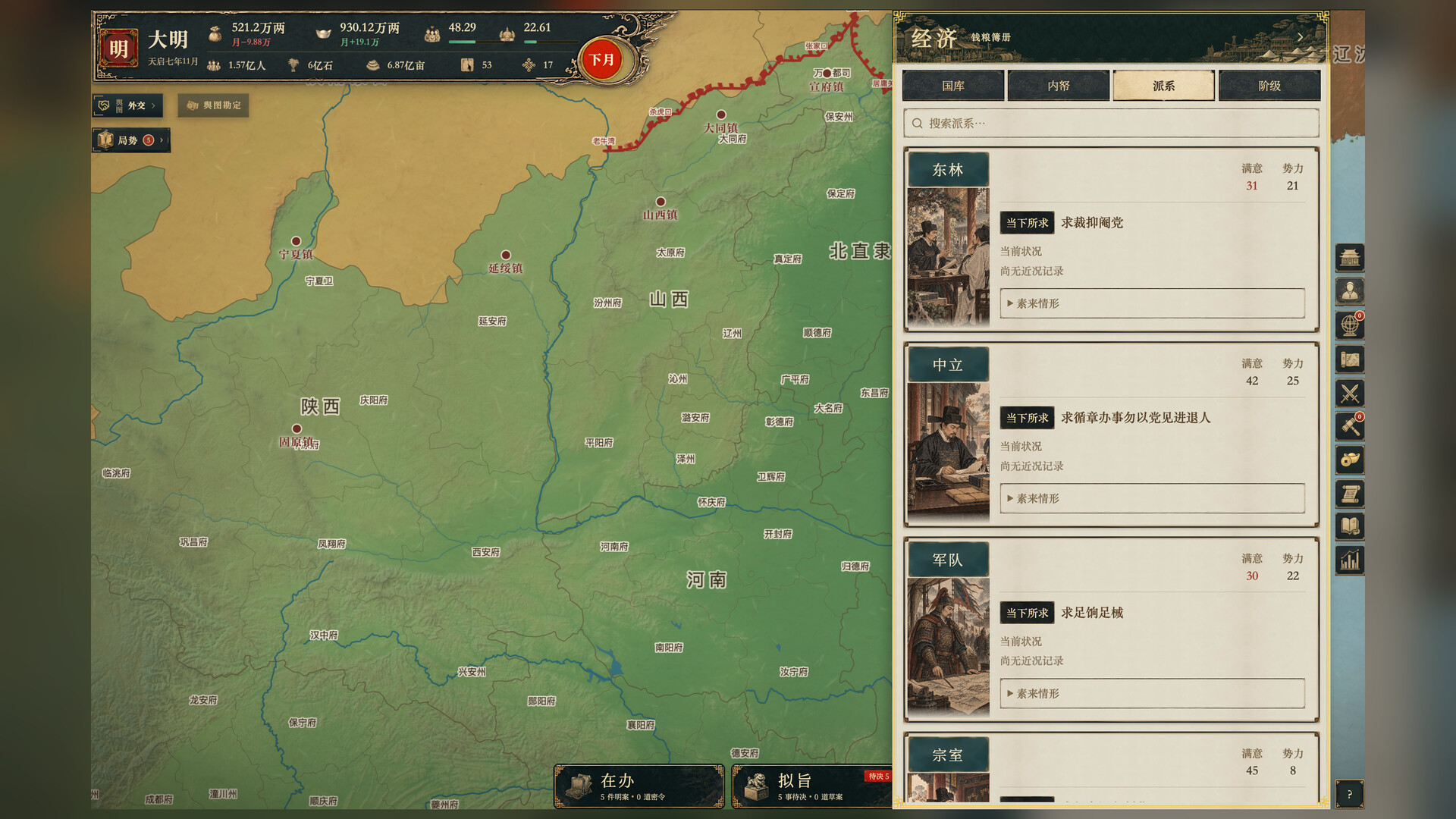


Each round lasts one month. At the start of every month, you review last month’s status: tax income, military expenditure, regional disasters, officials’ assignments and the actual execution of imperial decrees.

Sign in to add this item to your wishlist, follow it, or mark it as ignored

English language not supported

This product does not have support for your local language. Please review the supported language list below before purchasing

Coming soon

This item is not yet available

Interested?
Add to your wishlist and get notified when it becomes available.

Check out the full game


About This Demo

You are the Chongzhen Emperor.

You know that in seventeen years Beijing will fall, and that a tree on Coal Hill is waiting for you. You also know the Ming did not die at the hands of a single enemy. It died of an empty treasury, a bleeding Liaodong frontier, roaming refugees, factional infighting, bureaucratic evasion, unpaid soldiers, and one "Noted" after another that changed nothing.

This time, every edict is yours to decide, every battle yours to draw, every tael yours to account for.

[HOW IT PLAYS]

One turn is one month. Three steps, every month:

Read the reports

How much tax came in, how much pay went out, where disaster struck, and what actually became of your last edict.

Issue edicts

Appoint and dismiss, adjust taxes, raise armies, build, research, negotiate. Drafts can be edited, rejected, or approved.

Promulgate and settle

The month is simulated and time moves forward. A monthly gazette, written in the style of a Ming court bulletin, tells you what happened across the realm.

Edicts do not always land as written. Not enough silver, low imperial authority, provinces withholding revenue, factions obstructing, an incompetent official in charge: every link can bend the result. An edict is not a button. Execution is the battlefield.

[WHAT YOU CAN DO]

- Appoint and dismiss, summon historical statesmen by name, let one man hold two posts, or leave an entire ministry empty

- Imprison, convict, exile, execute. Stripping a prince of his fief requires a case and evidence; princes and ministers go through the same judicial chain

- Issue secret orders to the Embroidered Uniform Guard. Investigations advance monthly, and hard evidence can anchor a conviction

- Adjust taxes (land tax, Liao levy, salt tax, commercial tax, or invent your own), survey farmland, uncover hidden fields, reform surcharges, merge poll tax into land tax, abolish the Liao levy, open the seas and establish customs

- Draw silver from the privy purse, cut clan stipends and official salaries, open granaries for relief

- Raise, march, reorganize, split, merge, re-command, disband, arm, and pay your armies

- Build and demolish, tune blueprint output

- Research technology, and create your own: describe a technology, a national policy, or a building, the AI defines its stats and construction time, and it becomes real in your save, with real monthly output and real upkeep

- Negotiate peace, form alliances, sign treaties, change the era name, rename the dynasty

[SIGNATURE SYSTEMS]

Battle sandbox: draw your plan on the map, the AI judges the picture

When two armies meet, there is a battle. Before it begins you enter the sandbox: real unit designations and strengths on the left, real terrain in the middle. Drag army tokens onto the map, mark the main thrust, reserves, and engagement lines with freehand strokes, arrows, regions, and text, then write one line of intent. Seal the sandbox, and a multimodal model looks at the picture you drew and rules on victory, course, and casualties in one pass. No parsing arrows into coordinates and plugging them into a strength formula.

Army pay is computed, not assumed

Soldier pay = troop type headcount × unit cost. Arms upkeep = equipment in the field converted to silver by combat value. Fielded equipment wears down by a monthly percentage; stockpiled equipment does not. Pulling weapons back into the armory is a genuinely profitable move. Shortfalls are flagged in red.

Buildings earn money, and carry poison

A customs barrier costs 20,000 taels a month and returns 160,000 to the treasury, while adding +8 corruption and +4 unrest. A maritime customs office returns 400,000 with +16 corruption. Do the math yourself.

Office powers: authority is handed down one cell at a time

Each ministry is a lane, vacancies are dotted boxes, factions are color-coded. You grant each office its powers (finance, personnel, military, works, justice). Withhold "military" from the Ministry of War, and it cannot move a single army.

Issue tracks and officials in charge

Every reform and crisis becomes a trackable progress bar with an assignable official. The official applies a percentage modifier: in good conditions gains are amplified, in bad ones losses are. Unattended issues do not stand still. With no one responsible, they slowly rot.

Provincial governors act on their own

A province with a governor handles one matter a month on its own (relief sales, land surveys, bandit suppression, wall repair). Governors of poor integrity skim a little on the side. Dismiss a governor without replacing him, and that province is truly left unattended.

People arrive and depart on the historical calendar

169 historical figures with portraits and status (serving, dismissed, imprisoned, exiled, retired, deceased). Xu Guangqi grows old. Yuan Chonghuan goes to prison. Leave them alone and history takes its course.

National policy trees

Four policy trees with construction times, prerequisites, and mutually exclusive branches. Policy effects live in entities: an established ministry, a building, a tax line, or a modifier. Abolish the ministry and the effect stops that instant. There is no "light it up for a permanent +10%".

[CONTENT]

- 169 characters (67 at court at the default start, the rest arrive and depart on the historical calendar)

- 58 regions: the two capitals and thirteen provinces, the nine frontier garrisons, the Later Jin, Mongolia, Korea, Japan, Annam, Ü-Tsang, and more

- 29 powers

- 31 armies: troop composition, arms, supply, morale, drill, mobility, arrears, loyalty

- 65 building types

- 41 technologies in five branches: military, education, finance, agriculture and medicine, craft

- 43 national policies in four trees: military, science, internal security, taxation

- 7 factions: Donglin, eunuch party, imperial loyalists, Western learning, neutrals, the army, and more

- 44 random events, 32 starting events, 30 national events, 100 battle events, 27 disasters

- 64 regional conditions: drought, locusts, uprising, tax revolt, gentry overreach, clean administration, and more

- 123 governor actions

- 112 social class entries

Only four global indicators: Treasury, Privy Purse, Popular Support, Imperial Authority.

The opening monthly balance is −200,000 taels. You are robbing Peter to pay Paul from month one. Imperial clan stipends alone cost 660,000 taels a month.

[DESIGN PRINCIPLES]

- No cheats: no gifted super-weapons, no loyal ministers falling from the sky, no one-click restoration through the tech tree, no universal reform button.

- No greenhouse: the opening is not a pile of free buffs. Every positive tier has a mirrored negative tier. You will know exactly how you died.

- Numbers land somewhere: every edict ends up in a column of the state machine.

- Your saves stay on your own machine.

AI Generated Content Disclosure

The developers describe how their game uses AI Generated Content like this:

1. 此游戏内图片素材大量使用AI生成。
2. 此游戏不存在拟人对话功能,实时生成只用于世界推演。
3. 此游戏回合推演均使用大模型进行实时生成

System Requirements

    Minimum:
    • Requires a 64-bit processor and operating system
    • OS: WIN10
    • Processor: INTEL I3
    • Memory: 4096 MB RAM
    • Graphics: GTX1060
    • Network: Broadband Internet connection
    • Storage: 2046 MB available space
    Recommended:
    • Requires a 64-bit processor and operating system
    • OS: WIN10
    • Processor: INTEL I5
    • Memory: 4096 MB RAM
    • Graphics: GTX1060
    • Network: Broadband Internet connection
    • Storage: 4096 MB available space
Review Filters