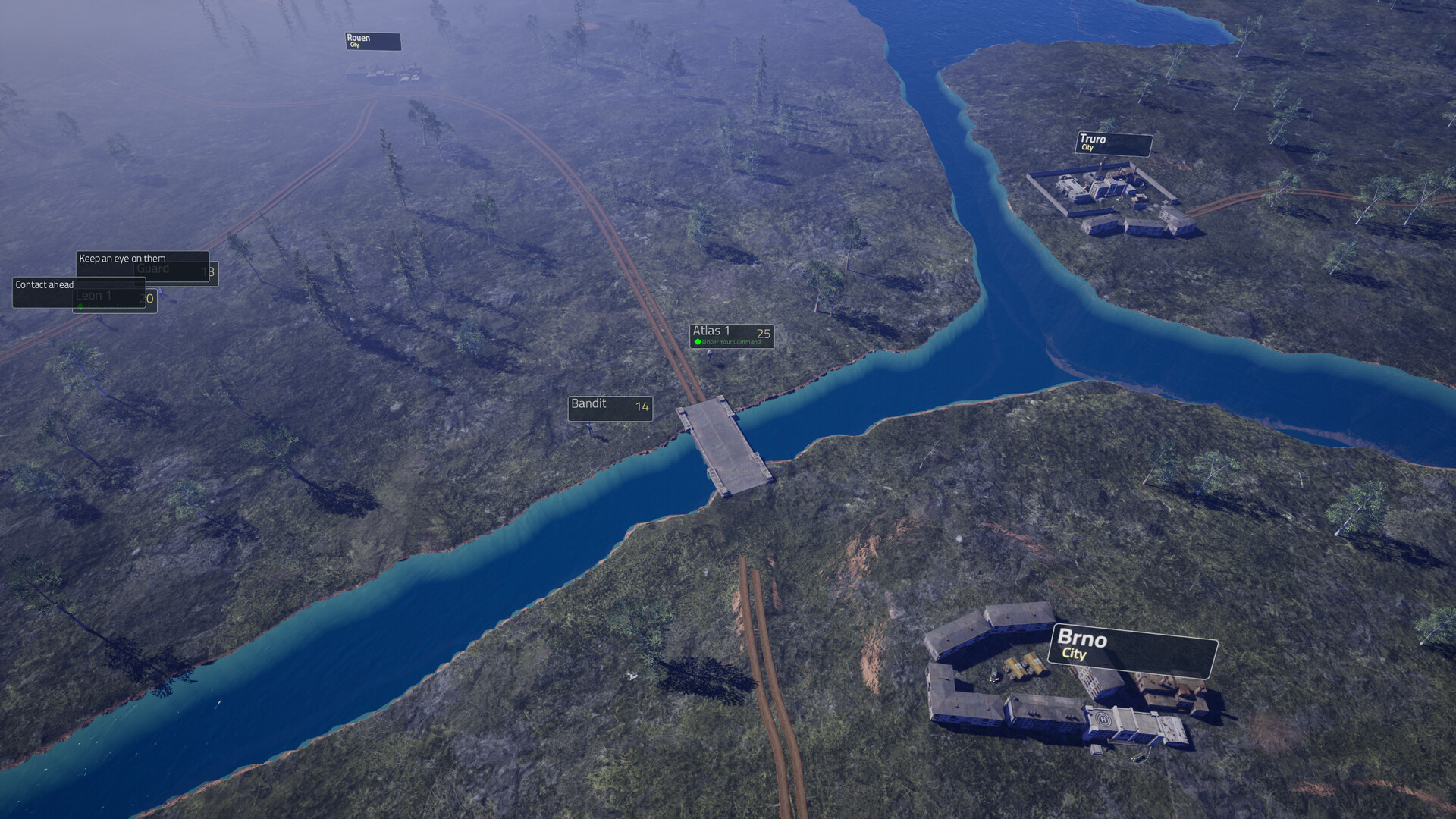


Echoes: Unforgotten is a difficult top-down strategy about holding together a collapsing region with limited troops, physical logistics and incomplete information. Every death leaves Blood behind, pushing the region further towards collapse, every delay strengthens resistance.

Sign in to add this item to your wishlist, follow it, or mark it as ignored

This game is not yet available on Steam

Coming soon

Interested?
Add to your wishlist and get notified when it becomes available.
 

About This Game

There is no perfect plan. Only one that might work.

You send a patrol into the mist.

Something is moving ahead.

Are they refugees searching for shelter? Bandits waiting beside the road? Or Echoes already heading towards the nearest settlement?

At first, you see only distant figures. As your squad approaches, they become UNKNOWN. Identification takes time, and the thicker the mist becomes, the longer you must wait for an answer.

By then, it may already be too late to turn back.

Echoes: Unforgotten is a difficult top-down strategy about taking control of a region that is already collapsing.

Starting from a single capital, you must secure cities and villages, organise production, upgrade settlements, maintain physical supply lines and command a limited number of squads.

You will never have enough troops, time or information to protect everything.

You can only decide what matters most.

Make decisions without the full picture

You are not an all-seeing commander.

The mist hides movement across the region. Your squads may notice something in the distance, but identifying it requires getting closer and waiting for a clear report.

What appears to be a single unknown figure may be a group of refugees.

It may also be several Echoes moving together.

As the region deteriorates, the mist becomes denser and identification takes longer. You still have to decide whether to investigate, retreat or send reinforcements before you fully understand what is waiting ahead.

Information does not arrive automatically.

It has to survive the journey.

Information has to survive the road

Resources, messages and reports do not move instantly between settlements.

Every courier must physically leave a city or village and travel through the region. Roads may pass near bandit camps, Echo nests or territory that has not been observed for days.

Couriers carry information between settlements, but they provide no live vision while travelling. A returning courier may bring news of disease, shortages, theft or unrest.

They may arrive with the requested supplies.

They may return without the cargo after being attacked.

Or they may never return at all.

Couriers are not disposable markers. They are people taken from the population of the settlement that sent them. If a courier dies on the road, the message and cargo may be lost — along with one of the people you were trying to protect.

Larger caravans can transport more resources, but they also become more valuable targets.

Protecting every road is impossible. Losing the wrong delivery may leave an entire city without food, medicine or materials when it needs them most.

Every person matters

Population is the foundation of the region.

People work in cities and villages. They produce food, medicine, chemicals, materials and weapon parts. They become soldiers, couriers and guards.

Every unit you create comes from the same population you are trying to save.

Replacing a destroyed squad may weaken the settlements supporting it. Sending more couriers may improve your supply network, but every journey places another person at risk.

A failed assault does not only reduce your military strength.

It leaves fewer people to produce, defend and rebuild what remains.

Build a network that can survive

Cities and villages serve different roles across the region.

Agricultural settlements keep the population fed. Industrial cities provide materials. Medical centres produce the supplies needed to fight disease, while military cities support the forces defending your territory.

Upgrade buildings and develop settlements around the needs of your campaign.

But production alone is not enough.

Food can spoil. Medicine is constantly consumed. A city may have large reserves while another settlement starves on the opposite side of the region.

The resources may exist, but they still need to reach the people who need them.

Every new settlement gives you more production, more population and more options.

It also gives you another place that can be isolated, damaged or destroyed.

The region is already falling apart

The world does not wait for your attention.

Independent cities reinforce their garrisons. Bandits occupy roads and may launch attacks against exposed settlements. Refugees flee collapsing regions. Echo nests grow and release new threats into the world.

Cities can also suffer lasting damage.

An assault may leave a wall collapsed, reducing the city’s ability to defend itself until repairs are completed. In a decaying post-apocalyptic region, walls and infrastructure may also fail without an enemy standing at the gates.

Scarce materials spent rebuilding one city cannot be used to upgrade another.

While you focus on one crisis, something else may already be going wrong.

Every victory has a cost

Capturing a settlement gives you territory, population and access to new production.

It also produces blood.

Every death feeds the Blood spreading across the region. Enough casualties can push a stable area into instability, thicken the mist and make every future decision more dangerous.

Winning one battle may leave you too weak to fight the next.

Waiting is not necessarily safer.

Independent cities strengthen their forces as time passes. Attack early and you may face fewer defenders, but risk sending an army that is not prepared. Wait too long, and the same city may have several additional squads protecting it.

Capturing a village may provoke retaliation from the city controlling it.

Assaulting a city may draw every nearby defender into the battle.

You may win the settlement and still lose control of the campaign.

Command forces you cannot easily replace

Your command capacity is limited.

You cannot protect every settlement, escort every caravan and investigate every unknown contact at the same time.

Concentrating several squads can end a battle quickly and reduce casualties. But while your army fights in one region, your capital or supply routes may be left undefended.

Splitting your forces allows you to cover more territory, but isolated units are easier to surround and destroy.

Surviving squads gain experience, progressing from Novice to Advanced and eventually Veteran.

Veterans are difficult to create and painful to lose. They can survive battles that would destroy inexperienced units and escape threats that slower squads cannot outrun.

Sending a novice patrol too deep into the mist may turn reconnaissance into a retreat it cannot survive.

Buy yourself time

Echoes are not always difficult to destroy in direct combat.

Their real strength lies in what happens when they reach a settlement before your army does.

A lost village can cut off production, kill its population, feed the Blood and destabilise the entire region.

The danger is not always whether you can stop them.

It is whether you can reach them in time.

Echoes are easy to stop when your forces are already waiting. Slowing traps and sacrificial outposts buy you the time needed to reach the settlements they threaten next.

Cleared locations such as bandit camps can be converted into outposts designed to attract nearby Echoes and delay their movement.

An outpost may hold long enough for reinforcements to arrive.

It may draw a horde away from a vulnerable village.

Or the threat may take another route, leaving the resources invested in it unused.

Not every defence is built to survive.

Sometimes its only purpose is to fall before something more important does.

Adapt to every campaign

The region changes between playthroughs.

Villages can appear in different prepared locations, changing available routes and the structure of your supply network. Cities may begin with different strengths. Nearby regions may already be unstable, while bandit camps and Echo nests block roads that were safe during an earlier campaign.

A strategy that worked before may fail under a different starting situation.

Randomness does not decide whether you win.

It changes how you have to think.

One campaign may reward an early assault on a weak city. Another may force you to rescue refugees, contain a growing nest or abandon expansion until your supply network is secure.

There is no single correct route.

Only a series of decisions whose consequences you must survive.

Survive the Final Week

There is no countdown telling you when you will finally be ready.

One moment, your couriers are travelling. Your squads are following their orders. You are trying to solve another shortage, repair another city or prepare another assault.

Then the horn sounds.

Sirens begin echoing through the cities.

The Final Week has started.

For seven days, nests release everything they have and the remaining settlements are pushed towards collapse.

Your forces must intercept hordes, defend distant cities, place slowing traps and sacrifice outposts to buy time.

You may mobilise the population, build barricades or seal the gates of the capital.

You may order an evacuation, abandoning every city and village outside the capital in an attempt to save whoever can still reach it.

Final Orders are not simple upgrades.

They decide what you are prepared to sacrifice.

You may survive the Final Week and still know that the region was lost.

Your final rank depends not only on whether the capital survives, but on what remains after the last day: the cities and villages you protected, the population you saved and the decisions you made when saving everything was no longer possible.

Will the region forget you and you will become Forgotten or remember you as Shattered, Unbroken or Unforgotten?

System Requirements

    Minimum:
    • OS: Windows 10 64-bit
    • Processor: TBA
    • Memory: 8 GB RAM
    • Graphics: TBA
    • DirectX: Version 12
    • Storage: 20 GB available space
    • Sound Card: DirectX Compatible
    Recommended:
    • OS: Windows 10 64-bit
    • Processor: TBA
    • Memory: 8 GB RAM
    • Graphics: TBA
    • DirectX: Version 12
    • Storage: 20 GB available space
    • Sound Card: DirectX Compatible
Review Filters