

Playto reads the text on your PC game screen and shows the translation wherever you want it — dialogue, menus, items, wherever you point. It never touches the game's files; AI on your PC does the translating. Save the words you read, review them, and learn a language as you play. 23 languages.

Sign in to add this item to your wishlist, follow it, or mark it as ignored

Early Access Software

Get involved with this software as it develops.

Note: This Early Access software is not complete and may or may not change further. If you are not excited to use this software in its current state, then you should wait to see if it progresses further in development. Learn more

What the developers have to say:

Why Early Access?

“Playto combines real-time game translation with language learning — a category that doesn't really exist yet. The translation engine works, but the learning system around it is still being built. Which games to prioritize, which languages to expand next, what study tools actually help retention — these decisions should be driven by real users playing real games. Early Access is the right place to build this together.”

Approximately how long will this software be in Early Access?

“Approximately 6–12 months. The timeline depends on how quickly we can ship the planned features (see below) and validate them with community feedback. We'll leave Early Access when the learning tools, language coverage, and community features reach a level where we're confident in the full experience.”

How is the full version planned to differ from the Early Access version?

“The full version will add significant features beyond the current Early Access build:

- **Expanded language pair support** — The EA version works best with English ↔ Japanese. Full version targets reliable quality across CJK languages (Chinese, Korean) and major European languages, with per-language tuning.
- **Community game glossaries** — A shared glossary system where players contribute and refine translation dictionaries for specific games. Each game has unique terminology that generic translation misses.
- **Learning analytics and progress tracking** — Vocabulary growth visualization, difficulty-adapted word suggestions, and data-driven study recommendations based on your play history.
- **Mobile companion app** — Review your saved vocabulary and practice quizzes on your phone, synced with your PC dictionary. Study on the go without your gaming PC.
- **Improved quiz and practice modes** — More exercise types beyond the current spaced repetition flashcards, including context-based recall and game-scene association.
- **Per-game translation profiles** — Optimized settings and prompts for popular games, developed with community feedback to handle game-specific fonts, UI layouts, and terminology.
- **Content engine** — A public database ranking games by language difficulty (CEFR level), helping learners pick games that match their skill level.

Some of these features depend directly on Early Access user feedback to shape their design.
”

What is the current state of the Early Access version?

“The translation foundation is functional: real-time OCR screen capture, cursor-point translation, text-to-speech, a personal dictionary, and basic spaced repetition quizzes. It works with any PC game. All translation processing runs locally on your machine using open-source AI models — no internet connection required during gameplay.

What's still early-stage: translation quality varies significantly by game (font style, art direction, and text density all affect accuracy). Language support beyond English ↔ Japanese is functional but not yet well-tuned. The learning tools (quizzes, progress tracking, vocabulary review) are basic — they work, but they don't yet adapt to your level or give you meaningful feedback on your progress. There are no community features yet (glossary sharing, game profiles). These are the areas where Early Access development is focused.”

Will this software be priced differently during and after Early Access?

“We plan to increase the price when Playto leaves Early Access, as the feature set will be substantially larger. Getting Playto during Early Access is the best deal.”

How are you planning on involving the Community in your development process?

“Community input directly shapes what we build next:

- **Game requests** — Tell us which games you want better support for. We prioritize per-game translation tuning based on what the community is actually playing.
- **Language pair priorities** — Which language combinations matter most to you? Community demand determines our expansion order.
- **Bug reports and accuracy feedback** — Reports on specific games help us improve the OCR and translation pipeline where it matters.
- **Glossary contributions** — We're building a community glossary system where players can share and refine game-specific terminology. Your corrections make Playto better for everyone playing the same game.
- **Feature feedback** — Steam discussions and our Discord server are where we hear what's working, what's not, and what's missing. Development priorities shift based on this feedback.”
Read more

Download Playto Lite: Game Screen Translator

Buy Playto


Report bugs and leave feedback for this software on the discussion boards

See all discussions

About This Software

Learn a language through the games you love. Playto reads the text on your PC game screen and shows the translation right there — JRPGs, visual novels, strategy games, anything with text on screen. Keep the words that catch your eye in your Word Book and review them later.

What Playto is

Before you buy, here is what Playto does and does not do.

  • Reads the screen, shows the translation where you want it — Next to the original, at the bottom of the screen, or anywhere you place it. Playto never touches the game's files, so unlike a mod or a translation patch, the text inside the game is not replaced.

  • Ready as soon as it's installed — No detailed setup. Launch your game, choose where to read, and it works.

  • Machine translation by AI on your PC — No translation is perfect. The original is always shown alongside, and you can retranslate any line you don't like from the Log.

  • Some games can't be read — Games whose anti-cheat blocks screen capture can't be read. Borderless windowed mode is recommended.

  • A translator and a language-learning tool — Keeping the words you read in your Word Book and making them stick through review is part of the job.

Translate any spot you point at — dialogue or UI


Whatever the game, you can read any spot you like — not just subtitles. Choose from four ways to read.

  • Cursor-follow — Reads the text wherever you point your mouse. For dialogue, menus and item descriptions.

  • Fixed region — Keeps reading a set area, such as subtitles or a status bar.

  • Window mode (beta) — Translates the whole screen in the background and shows translations only when you want them.

  • Spot Translate — One key freezes a single frame; pick the words you want and only those are translated. For fast scenes and scrolling chat.

Translations appear wherever you want them on screen, so there's no need to pause the game.

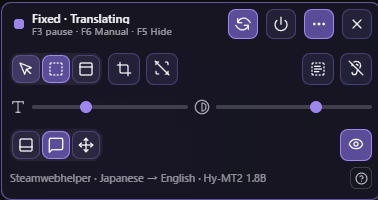
A small bar on top of the game, right where you play


In resident mode, instead of switching to the Playto window, a small bar appears on top of the game. Playto recognizes the game you're playing, and when you switch games the bar follows.

  • Change how it reads — Cursor-follow, fixed region or window, one click each. You can re-place the reading frame on the spot, too.

  • Adjust the look — Text size and background opacity on sliders; put the translation at the bottom of the screen, next to the original, or anywhere you like.

  • Spot Translate — From a button on the bar, freeze one frame of the screen and translate only the words you want.

  • Control it with keys — Pause, switch between auto and manual, and show or hide translations with shortcut keys. The bar shows the current state and the keys you can use, plus the game, languages and translation model in use.

Fits your screen — and your taste

You decide how translations look, so they never get in the way of the game.

  • Position — Next to the original, in a bar at the bottom, or anywhere you like.

  • Look — Adjust background opacity and text size until it blends into the game.

  • Difficult-word highlights — Hard words in the original are colored by difficulty.

  • Several areas at once — Dialogue, name plates and quest logs, each translated at the same time.

Speed while you play, accuracy afterwards

While you play, the point is to understand the game and keep going — so translation never keeps you waiting.

  • During play — A small model answers on the spot.

  • Word explanations and re-reading — These can wait, so a larger model handles them.

  • Heavier models available — Choose from models such as Gemma and Qwen. They can be more accurate, but you wait longer and they compete with your game for the GPU.

  • Fix any line you don't like — Retranslate or edit from the Log, and pin how character names and terms are written with the Glossary (a per-game term list).

After playing, grow your Word Book


So the words you read don't just slip by.

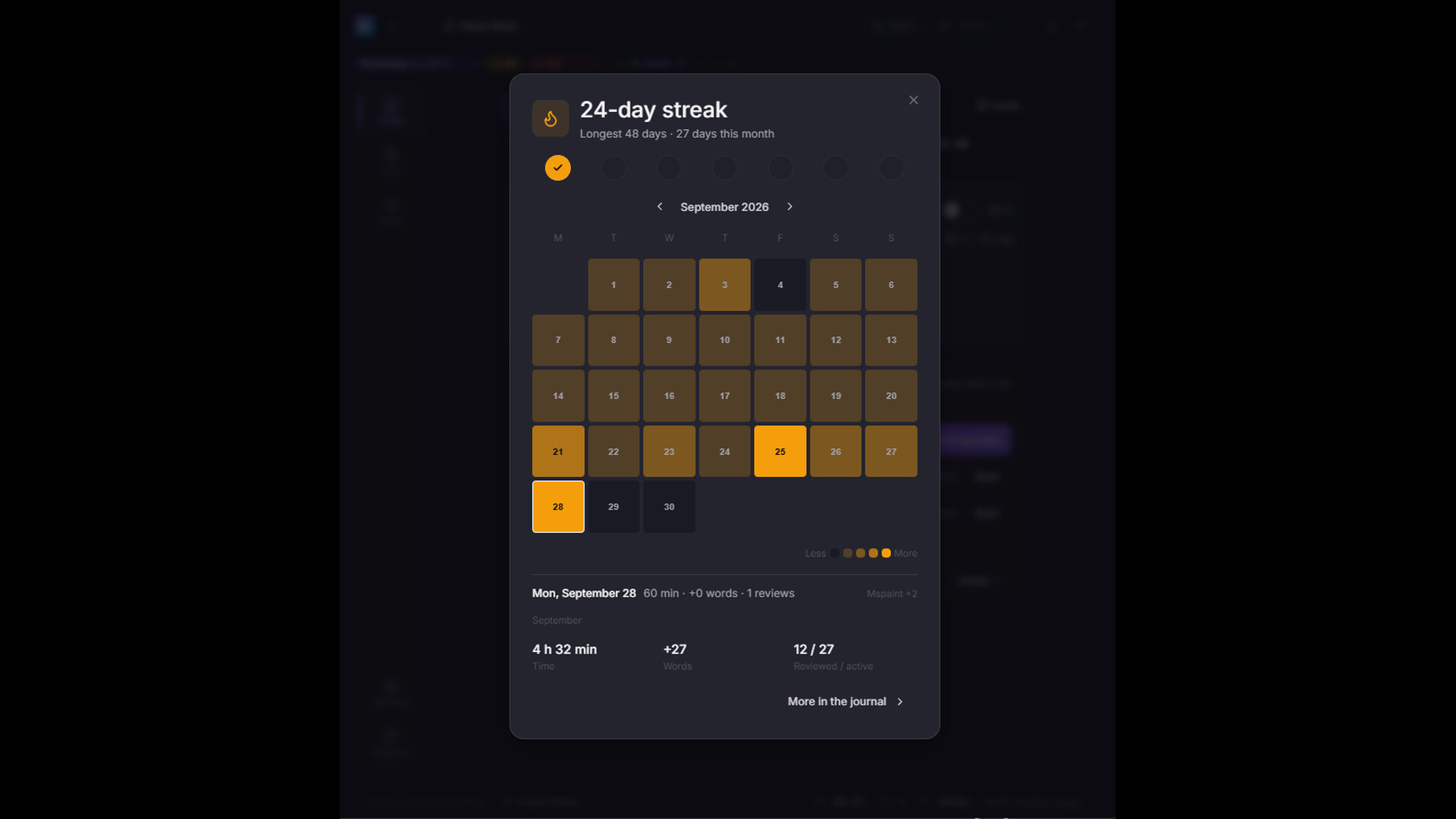
  • Session review — When you stop playing, look back over the text you met today. You can put it off and open it later from Home.

  • Saving is easy — Words that came up again and again are already suggested; check them and save the ones you want.

  • Difficulty badges — JLPT N5–N1 for Japanese, CEFR A2–C2 for other languages, so you can tell at a glance which words deserve attention.

Keep the scenes you played, in an album


Words are easier to remember with the scene they appeared in — so Playto keeps the whole screen.

  • Keep the scene — The screen as you saw it, the original text and its meaning, saved scene by scene.

  • Review anywhere with Anki — Export the album in Anki format (.apkg) and review the scenes on your phone's Anki app or wherever you like. The Word Book exports as TSV, too.

Make it stick with review and quizzes


The words you kept, one more time before you forget them.

  • Reviewed before you forget — Saved words and sentences come up on a spaced-repetition (SRS) schedule that follows the forgetting curve.

  • 8 quiz modes — Flashcards, multiple choice, fill-in-the-blank, dictation and more.

  • A dictionary of your own — Your Word Book grows with every game you play.

Two ways to read the screen

Pick the reading method to match how the game's text looks.

  • Text reading (Text) — Recognizes the characters on screen — fast and light. The one for everyday use.

  • Image reading (Image) — Hands the screen itself to an AI vision model. Decorative fonts, brush lettering, vertical text and lettering painted into the artwork can be read.

  • Everything goes to the log — Every translation shown is kept in the log to read back after you play. Switch methods at any time.

Game Audio (Beta)

Lines that never appear on screen can be study material too.

  • Voice lines become text — Spoken lines are transcribed and translated while you play, and collected in their own log. Save a line you like with its audio clip.

  • Only the game's audio — Your mic, music apps and voice chat are never captured.

  • Availability — Verified with Japanese and English. Paid edition, Windows 10 (2004) or later.

Playto Cloud (Beta)

Optional cloud translation for when your PC struggles to run a model, or when you want to start right away (off by default).

  • Start right away — Translate without waiting for the model download, with no load on your PC.

  • A large model translates — Line by line, by a large model. Not as fast as local translation on a PC with headroom to spare.

  • Image reading (Image) too — Press the shortcut key (F4 by default) and the whole screen at that moment is read, so the lines on it are translated together, in context. Each shot uses credits, so it runs only when you press the key.

  • In beta — Free trial credits included. If enough people ask, we'll consider one-time token packs or a subscription. See our privacy policy for what is sent.

More features

The ones that didn't fit above.

  • Translations on your stream (OBS) — Add the translations to your stream as an OBS Browser Source. Works with Game Capture.

  • Automatic log — Everything you encounter is recorded. Check a meaning or a reading any time.

  • Local first — Translation runs on your PC, and once the models are installed it works without an internet connection. Screen text leaves your PC only when you use Playto Cloud. Anonymous usage statistics are sent only if you agree.

  • 23 languages — Chinese (Simplified), Chinese (Traditional), Czech, Danish, Dutch, English, Finnish, French, German, Greek, Hungarian, Italian, Japanese, Korean, Norwegian Bokmål, Polish, Portuguese, Romanian, Russian, Spanish, Swedish, Turkish, Vietnamese.

Before you start

System requirements, and what the first few minutes look like.

  • About a minute to set up — The translation model comes bundled. Only language pairs that include Danish, Finnish, Hungarian, Norwegian, Romanian or Swedish need a separate model download (2–6 GB).

  • Tutorial and guides — On first launch, a practice game walks you through reading, translating, saving and reviewing once. When you're stuck, there are 50+ in-app guides and in-app support.

  • Try Playto Lite first — Local AI needs GPU VRAM in addition to your game (typically 2–4 GB). Playto Lite is the free version — please confirm it runs on your PC. Playto Lite is Windows-only.

  • Text-to-speech — Available for English, Japanese, Spanish, French, Italian and Portuguese.

  • Linux (beta) — Standard edition only. Runs on 64-bit Linux with glibc 2.39 or later (Ubuntu 24.04 or equivalent, or newer). Some features differ by OS and by desktop (KDE / GNOME, Wayland / X11); see for what works where. Steam Deck is not supported.

AI Generated Content Disclosure

The developers describe how their game uses AI Generated Content like this:

Playto uses AI models (LLMs) to generate real-time translations of on-screen game text. All AI processing runs entirely on your machine using local models — no data is sent to external servers. The AI is also used for OCR (optical character recognition) to read text from game screens. No pre-generated AI content is included; all translations are generated live during use.

System Requirements

Windows
SteamOS + Linux
    Minimum:
    • Requires a 64-bit processor and operating system
    • OS: Windows 10 64-bit
    • Processor: Intel Core i5 / AMD Ryzen 5 (with AVX2 support)
    • Memory: 8 GB RAM
    • Graphics: DirectX 11 compatible GPU. Local AI runs on the CPU by default; an NVIDIA (CUDA) or Vulkan-capable GPU enables faster acceleration
    • DirectX: Version 11
    • Network: Broadband Internet connection
    • Storage: 5 GB available space
    • Additional Notes: AI models (about 2–6 GB) download on first run. For GPU acceleration, keep your GPU driver up to date — 4 GB+ VRAM recommended. No dedicated GPU? CPU mode works (slower)
    Recommended:
    • Requires a 64-bit processor and operating system
    • OS: Windows 11 64-bit
    • Processor: Intel Core i7 / AMD Ryzen 7
    • Memory: 16 GB RAM
    • Graphics: NVIDIA GPU (CUDA) or Vulkan-capable GPU, 6 GB+ VRAM, with an up-to-date driver
    • DirectX: Version 11
    • Network: Broadband Internet connection
    • Storage: 10 GB available space
    • Additional Notes: Keep your GPU driver current (especially on the latest-generation GPUs). If CUDA isn't supported, Vulkan and CPU modes are available.
    Minimum:
    • OS: Ubuntu 24.04 or equivalent, or later (glibc 2.39+), 64-bit
    • Processor: Intel Core i5 / AMD Ryzen 5 (with AVX2 support)
    • Memory: 8 GB RAM
    • Graphics: A Vulkan-capable GPU is recommended. Without one, Playto translates on the CPU (slower).
    • Network: Broadband Internet connection
    • Storage: 5 GB available space
    • Additional Notes: Standard edition only (Playto Lite has no Linux version). Tested on KDE Plasma (Wayland and X11) and GNOME. The translation model and the libraries Playto needs (WebKitGTK and others) come bundled; your desktop needs its xdg-desktop-portal backend, installed by default on KDE and GNOME. KDE Plasma: everything available on Linux works with every game. GNOME on Wayland: Proton and X11 games work fully; with a game that runs natively on Wayland,translations stay at the bottom of the screen and you set the area on Playto's preview, and Cursor Follow is not possible. X11 sessions work the same on any desktop. Wayland-native games ask once which window to share. Not on Linux yet: Cursor Follow, Resident mode, Game audio, Chinese read-aloud. Vietnamese text cannot be read on Linux. Steam Deck is not supported.
    Recommended:
    • OS: Ubuntu 24.04 or equivalent, or later (glibc 2.39+), 64-bit
    • Processor: Intel Core i7 / AMD Ryzen 7
    • Memory: 16 GB RAM
    • Graphics: A Vulkan-capable GPU with 6 GB+ VRAM and an up-to-date driver (Mesa or the vendor driver). Without one, Playto translates on the CPU (slower).
    • Network: Broadband Internet connection
    • Storage: 10 GB available space
    • Additional Notes: Keep your GPU driver up to date. If Vulkan can't be used, Playto says why and translates on the CPU. What works on each desktop (KDE Plasma, GNOME, X11):
Review Filters