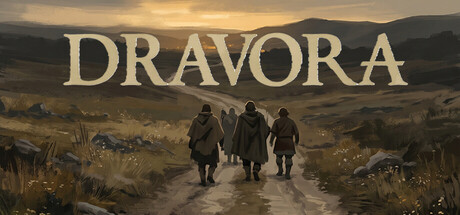


A dark fantasy narrative roguelite about three lives on one hard road: a fallen mercenary, an oath-singer's apprentice, and the youngest of three fen brothers. No combat screens. Every choice is made in words, and every choice follows you down the road.

Sign in to add this item to your wishlist, follow it, or mark it as ignored

This game is not yet available on Steam

Planned Release Date: Nov 17, 2026

This game plans to unlock in approximately 6 weeks

Interested?
Add to your wishlist and get notified when it becomes available.
 

About This Game

The Road Doesn't Care If You Make It

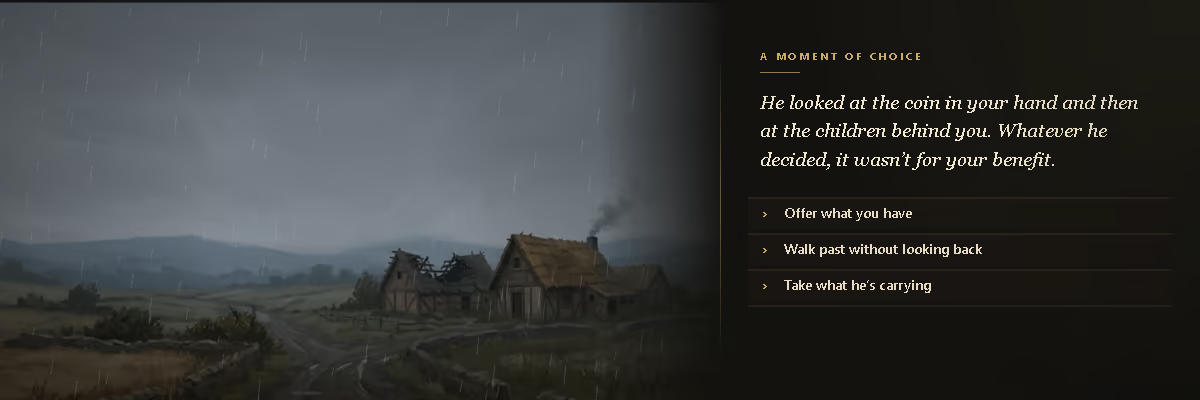
Dravora is a narrative roguelite about three people on the roads of a politically fractured, early medieval continent. There are no combat screens, no stat sheets, no skill trees. Every interaction is a choice made in words — and every choice has consequences that follow you down the road.

Your companions are people, not party members. They joined because your road overlaps with theirs. They have their own values, their own limits, their own reasons for traveling. Push them past those limits and it costs you. Protect what they care about and they'll follow you into places they shouldn't.

Three Origins on One Road

The Broken Crown. At Vaerhold, a fallen mercenary takes a contract to walk a lady and her young apprentice east. The road runs through Tarvenor, Cennovar and the Bound Tides. Food, coin and supplies run down, and word on the road is that somebody is worth money to somebody.

The Burned Cord. Seren of Bryenvar is an oath-singer's apprentice, sent out to sing at the moots of the west. There she meets the Burned Cord: westerners who say the settlement that ended the old order was kept to the letter and broken in spirit. Caelen, a ford-keeper's son who says what nobody else will, walks the circuit with her. What she hears on the road, she will have to answer for at home.

The Small Refusal. Emrec is the youngest of three brothers in the fen village of Mirefen. His brothers have work for him, the kind that pays and isn't asked about. He has a girl from the landing he means to marry, and nothing to marry her on. A short, hard story about one family and a few days of choices.

Who You Are Is What You Choose

There is no character creation screen. No alignment wheel. No morality meter.

Your character's identity emerges from what you do when the choices are hard and the answers aren't clear. Feed the starving refugees or save the food for your own people. Tell your party the truth about how bad things are or lie to keep morale alive. Face the bandits or find another way around.

Every decision quietly reveals who you were all along — and the world responds to who it sees. Your companions notice. The people you meet notice. By the end, you'll notice too.

Features

  • Three origins at launch — each with its own characters, road and story through the same living world. Different starting points, different stakes, different stories.
  • Choices that cascade — a decision at the river crossing echoes three days later when a consequence you didn't expect arrives. The game remembers what you did and builds on it.
  • Companions with their own agendas — they'll challenge your choices, reveal themselves over campfire conversations, and remember what you did.
  • An identity system that watches — no visible stats. Your personality emerges from accumulated choices and manifests through how the world treats you, what options you see, and what your companions say about you when they think you're not listening.
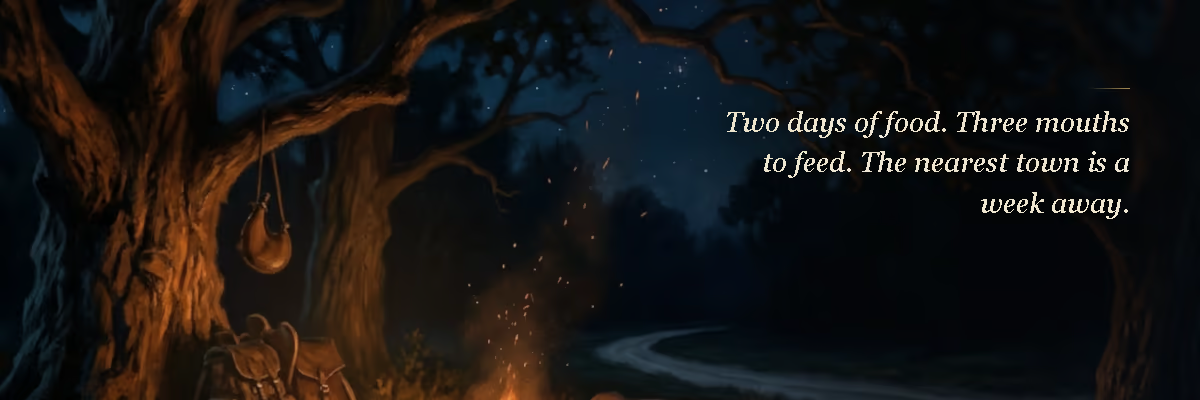
  • Survival through scarcity — food, coin, and supplies. Three numbers. The math is simple. The choices the math forces on you are not. Hunt, forage or stand watch at camp, trade at market, and go hungry when you can't.
  • Twelve endings and deep replayability — four in the Broken Crown, five in the Burned Cord, three in the Small Refusal. Different choices reveal different people, and every run ends with a story worth telling.
  • No combat minigames — when violence happens, it's a choice you make and a consequence you live with, not a screen you grind through.
  • Every road ends in a story — at the end of every journey your ending plays out and the road you took is written down. Who joined. Who left. Who didn't make it. Who you became.

Built By One Person

Dravora is developed by a solo developer using AI-assisted tools for art, code, and narrative drafting. No human artists, writers, or developers were displaced — without these tools, this game would not exist. Every creative decision, every piece of worldbuilding, every design choice is human-made. The tools helped build what one person couldn't build alone.

AI Generated Content Disclosure

The developers describe how their game uses AI Generated Content like this:

Dravora was developed by a solo developer with the assistance of AI tools. AI was used during development to assist with art generation, code development, and narrative drafting. All AI-generated content was reviewed, curated, and refined by the developer. The creative vision, world design, characters, and all design decisions are human-made.

Mature Content Description

The developers describe the content like this:

Dravora is a dark fantasy told in text over painted backgrounds: three stories, each a journey by road. Nothing is shown graphically; what happens is described in words.

Violence: fights, killing, wounds, corpses, hunting and death by starvation are described, some of it closely. Violence has costs and is not glorified.

Language: occasional profanity; a few lines are strong.

Sexual content: there is no nudity and no sex scene, shown or described. In two of the three stories, in one scene each, robbers speak of a woman in crude sexual terms and threaten her with sexual violence while a boy is present. The threats are not carried out.

Alcohol: characters drink wine, ale, cider and a fermented milk.

Crime: the player can choose to steal, rob, blackmail, smuggle, bear false witness and use forged papers; these choices usually carry costs. One of the three stories is told from inside a family of robbers: the player's character takes part in their frauds, burglaries and robberies.

Gambling: in one scene the player can stake the game's own coin on a game of chance at a tavern table. No real money is involved anywhere in the game.

Slavery exists in this world. In one scene people are sold at a market, and the player can buy a captive's freedom.

The game does not depict sexual violence, shows no minor in any sexual situation, and has no illegal drugs.

System Requirements

    Minimum:
    • OS: Windows 10 (64-bit)
    • Processor: Intel Core i3 / AMD equivalent (2.0 GHz or higher)
    • Memory: 4 GB RAM
    • Graphics: DirectX 11 compatible GPU with 1 GB VRAM
    • Storage: 2 GB available space
    • Sound Card: Any
    • Additional Notes: Mouse and keyboard required. 1280x720 minimum resolution.
    Recommended:
    • OS: Windows 10/11 (64-bit)
    • Processor: Intel Core i5 / AMD equivalent
    • Memory: 8 GB RAM
    • Graphics: DirectX 11 compatible GPU with 2 GB VRAM
    • Storage: 2 GB available space
    • Sound Card: Any
    • Additional Notes: 1920x1080 resolution recommended for best experience.
Review Filters