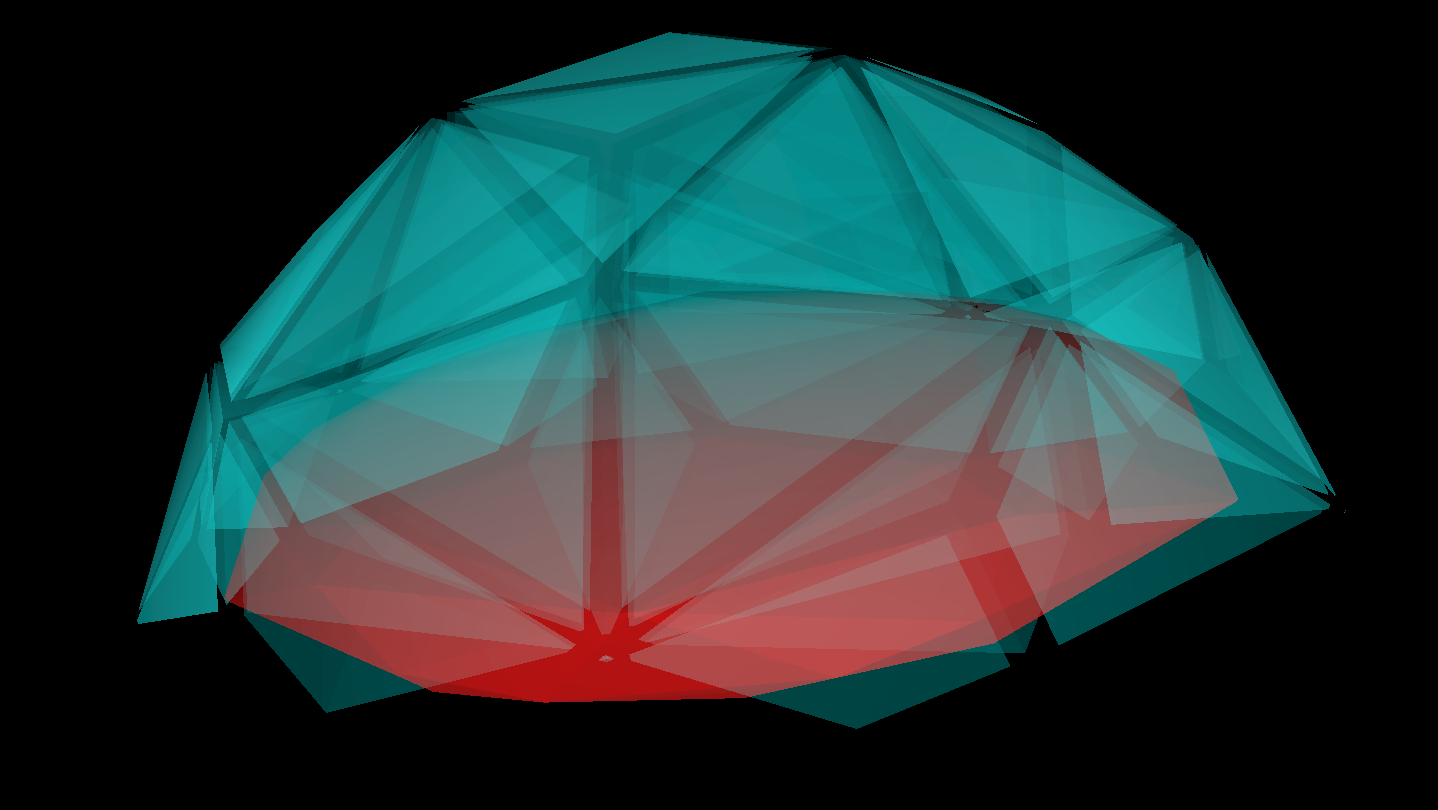


Tired of 2D and 3D games? Check out this puzzle game and sandbox for people curious about Euclidean 4D space. Solve Magic Manycell puzzle inspired by Magic Cube. Explore all 6 known regular polychorons (4D figures made of 3D bodies for faces), or create your own.

Sign in to add this item to your wishlist, follow it, or mark it as ignored

Early Access Game

Get instant access and start playing; get involved with this game as it develops.

Note: Games in Early Access are not complete and may or may not change further. If you are not excited to play this game in its current state, then you should wait to see if the game progresses further in development. Learn more

What the developers have to say:

Why Early Access?

“While developing a game set in the space of 4D polytope's manifold, entirely new 4D rendering engine was developed. While testing it, a specific framework was developed that allows to explore various convex polychorons through the ability to rotate around them and paint their cells in different colors. This process was found to be engaging and perhaps even slightly addicting, so it was decided that this functionality should be made into entirely separate sandbox-like experience in addition to actual gaming experience.

So it was decided to make exploration component a namesake of the project and its principal part. Since this component is close to completion, Early Access seems justified.

Early Access is needed to get feedback from the community. Developer has no access to any testers so can't release product in good conscience without additional community involvement.

Early Access goals are:

* Receive feedback from the users about additional features they expect and bugs.

* Obtain the playtesting for the game that is planned to be added in the future.

Regardless of success of this Early Access or lack thereof, developer plans to release final product in specified timeframe. Early Access is for people who find current set of features useful or wants to influence the development of current and upcoming functionality.”

Approximately how long will this game be in Early Access?

“1-4 months.”

How is the full version planned to differ from the Early Access version?

“It is currently planned to add at least one game before releasing final version of the product.

In addition, here are some planned features for exploration mode (more may be added according to community feedback):

* Implementing support for game controllers with in-game configuration, including UI access.

* Adding limited movement in 4D rather than always looking at the center of a figure.

* Create new figures by intersection of 2 existing figures.

* Precision instruments for specifying cutting hyperplane.”

What is the current state of the Early Access version?

“Exploration sandbox is complete. But some planned useful features are missing.

You can see the currently available features in the Full Product Description section.”

Will the game be priced differently during and after Early Access?

“At this time there are no plans to change the price when leaving Early Access.”

How are you planning on involving the Community in your development process?

“As a developer I intend to communicate with the community through Steam Discussions page for this product. I plan to check the forum daily and respond where appropriate.

Reported bugs will be addressed. Ideas for improvements and new features are also most welcome.

After the first game is finished, community will be kindly asked to play-test it and provide feedback for improvements before eventual release from Early Access.”
Read more

Buy Polychoron Explorer

 
See all discussions

Report bugs and leave feedback for this game on the discussion boards

About This Game

Explore 4D world as viewed by the eyes of imaginary 4D creature that uses volumetric (3D) space for visual sensing instead of planar (2D) space like we do.

A brand new 4D rendering engine was created for a Freespace-like game. Based on yet incomplete version of that engine, 2 modules were created and included into this package:

Magic Manycell is a puzzle game inspired by Magic Cube. Just like a cube that has 6 square faces, each of which is split into 3x3 smaller squares, in 4D a tesseract has 8 cubic cells, each of which is split into 2^3 or 3^3 smaller cubic cells. Then, in Magic Cube, player can rotate 3x3x1 slice of the cube around single axis; in 4D, player can rotate 3x3x3x1 slice, but not around single - around any of 3 orthogonal axes! (note: Manycell is a term used to describe Polychoron that has its flat cells split into smaller cells which all stay in original cell's flat subspace).

Currently 3 different Polychorons are supported for Magic Manycell game - Tesseract with 2^3 cells, Tesseract with 3^3 cells and a 16-cell which has whole cells but is such a special figure that it can be rotated like Tesseract 2^3 - by splitting it exactly in 2 halves.

In the future, it is planned to add more figures for this game mode - 24-cell and Tesseracts split in 4^3 and 5^3.

In addition to Magic Manycell, the package includes Explorer mode.

This exploration sandbox was created to observe 4D convex polychorons (which are 4D geometrical shapes made out of 3D shapes).

Currently implemented features are:

  • Pick any of 6 known regular polychorons to explore - 5-cell, 8-cell, 16-cell, 24-cell, 120-cell and 600-cell.

  • Look at the selected polychoron from any direction like an imaginary 4D creature would. This is achieved by 3D projection matrix technique where 4D objects are projected onto 3D spherical matrix like 3D objects are projected onto 2D matrix which we use to explore 3D world.

  • Several rendering customization options are available to make this complex display perceivable as a volume rather than as a picture.

  • Rotate around the polychoron using any of the 6 rotation axis-planes of 4D space using keyboard, mouse drag or controller analog axes. 

  • Paint any of the polychoron's cells into any color or turn them off completely. Save colorings to revisit them later. This allows player to follow particular cell's rotation relative to others and to follow polychora's cell rings.

  • Use Scan mode to explore polychorons by cutting them with 3D hyper-plane and see what comes out. This mode also allows full rotations, just like projection mode does.

  • Create your own polychorons by splitting the existing one in Scan mode or by providing your own geometry (programming experience needed to make your own geometry).

Besides these 2 modes, more gaming modes are being designed. At least 1 more mode is planned to be added to this package before Early Access ends.

System Requirements

    Minimum:
    • Requires a 64-bit processor and operating system
    • OS: Windows 10
    • Processor: x86_32 CPU with SSE2 support, x86_64 CPU with SSE4.2 support, ARMv8 CPU
    • Memory: 4 GB RAM
    • Graphics: Integrated graphics with full Vulkan 1.0 support, Direct3D 12 (12_0 feature level) support
    • DirectX: Version 12
    • Storage: 150 MB available space
    • Sound Card: Not needed
    • VR Support: Not used
    Recommended:
    • Requires a 64-bit processor and operating system
    • OS: Windows 10
    • Processor: x86_32 CPU with SSE2 support, x86_64 CPU with SSE4.2 support, ARMv8 CPU
    • Memory: 4 GB RAM
    • Graphics: Integrated graphics with full Vulkan 1.0 support, Direct3D 12 (12_0 feature level) support
    • DirectX: Version 12
    • Storage: 150 MB available space
    • Sound Card: Not needed
    • VR Support: Not used
There are no reviews for this product

You can write your own review for this product to share your experience with the community. Use the area above the purchase buttons on this page to write your review.

Review Filters