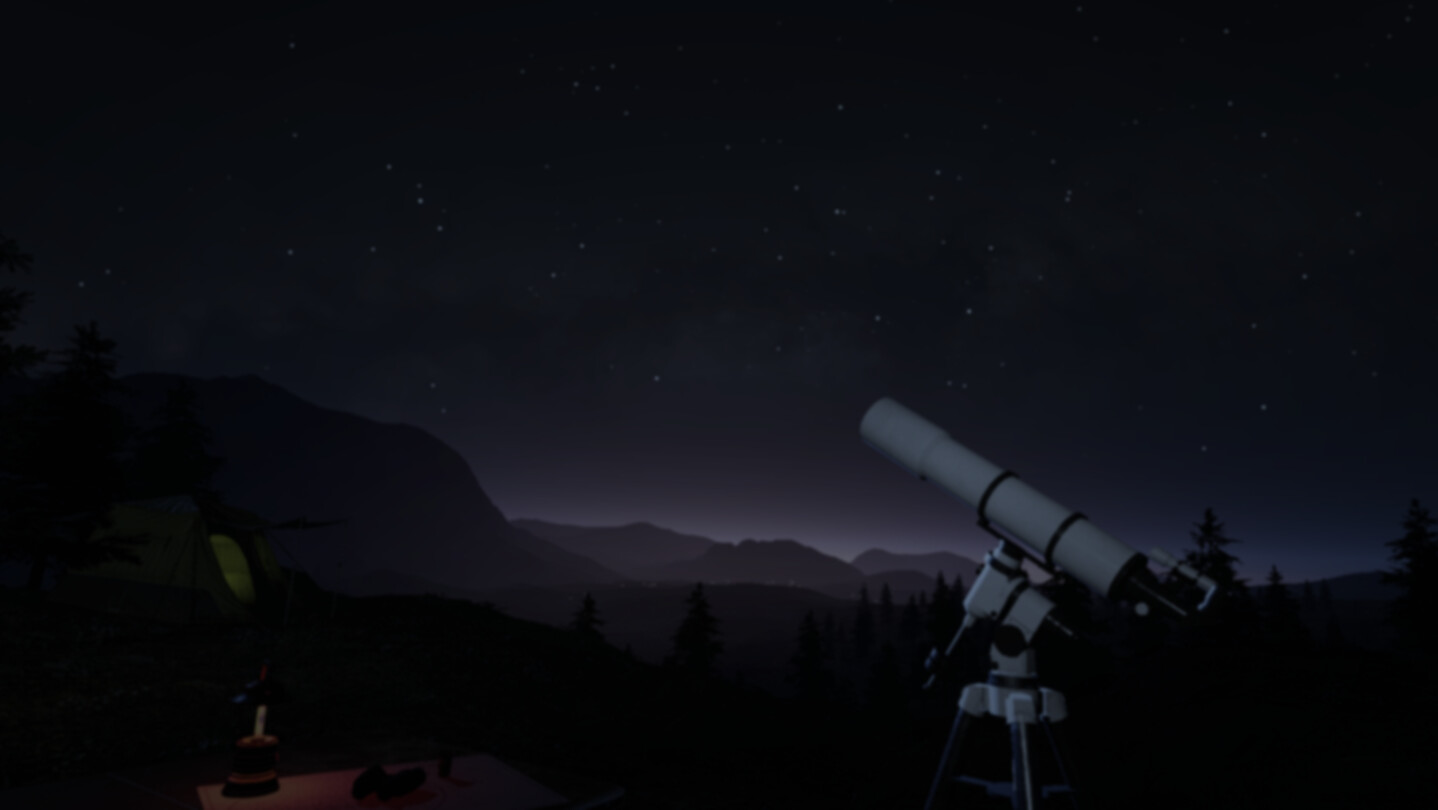

A first-person astronomy simulator built on real astronomical data. Set up, align, and operate your telescope as the sky changes with location, date, and time. Use star charts and bright stars to find targets, then observe the Moon, planets, and faint, distant deep-sky objects through the eyepiece.

Daftar masuk untuk menambah item ini ke senarai hajat anda, ikuti atau tandakannya sebagai diabaikan

Bahasa Bahasa Melayu tidak disokong

Produk ini tidak menyokong bahasa tempatan anda. Sila semak senarai bahasa yang disokong di bawah sebelum membuat pembelian

Permainan ini belum tersedia di Steam lagi

Akan datang

Berminat?
Tambah ke senarai hajat anda dan terima pemberitahuan apabila permainan sudah tersedia.
 

Tentang Permainan Ini

Night falls. The constellations slowly turn across the sky, the Moon and planets follow their own paths, and the Milky Way shifts as the hours pass. Set up your telescope, begin with a bright star you can recognize, and use a star chart to work your way toward the object you want to observe.

Stargazer Simulator is a first-person astronomy simulator built on real astronomical data. Your observing location, date, and time shape the night sky above you. Weather, light pollution, and atmospheric conditions affect what can be seen, while your equipment and its alignment influence both the search and the view through the eyepiece.

From the richly detailed surface of the Moon to bright planets, double stars of varying brightness and color, loose and densely packed star clusters, faint nebulae, and distant galaxies, each type of object has its own characteristic scale, brightness, and structure in the eyepiece—and calls for a different approach to finding and identifying it.

A NIGHT SKY IN MOTION

• The positions of stars, the Moon, planets, and deep-sky objects are calculated from real astronomical data.

• Your observing location, date, and local time determine each object’s direction, altitude, and observing window.

• Constellations, the Milky Way, twilight, and moonlight reshape the appearance of the sky over time.

• The changing seasons bring different observing targets and star-hopping routes.

The same observing site reveals a different sky from season to season. As the hours pass, the same target continues to change its altitude and direction.

SET UP AND OPERATE YOUR TELESCOPE

• Choose telescopes with different apertures, focal lengths, and optical designs.

• Extend the tripod and install the equatorial mount, counterweights, optical tube, and other accessories.

• Balance the entire setup, align the finder scope, and polar-align the mount.

• Switch eyepieces and Barlow lenses to change magnification, field of view, and exit pupil.

Your choice of equipment and the way it is set up affect the entire observing session. Balance changes how the telescope handles, finder-scope alignment affects pointing accuracy, and the eyepiece combination changes a target’s apparent size, brightness, and how easy it is to find. Different configurations suit different targets and create distinctly different observing experiences.

FIND TARGETS WITH STAR CHARTS

• Use star charts and a planisphere to understand the sky above you.

• Identify constellations and bright stars.

• Move from naked-eye reference stars toward fainter targets.

• Use the finder scope to narrow the search, then identify and confirm the target in the main telescope.

The search begins with the constellations and bright stars overhead. Move from one reference star to the next, gradually narrowing the target area until a close pair of stars, a loose cluster, or a faint patch of light enters the field of view. At that moment, the directions, separations, and field of view shown on the chart finally align with what you see through the eyepiece.

THROUGH THE EYEPIECE

• Aperture affects the telescope’s light-gathering power and resolution.

• The telescope’s focal length and eyepiece determine magnification, true field of view, and exit pupil.

• An object’s angular size, brightness, and surface brightness determine how it appears.

• Light pollution, moonlight, sky transparency, and atmospheric seeing alter visible detail and contrast.

Mountains and craters on the Moon can stand out in sharp relief. Planetary details may briefly sharpen when the atmosphere steadies. Double stars vary in brightness, color, and separation, while nebulae and galaxies emerge as faint forms against the background sky.

The same target can look different through different equipment, at different observing sites, and under different conditions.

GUIDED OBSERVING AND FREE EXPLORATION

• Learn about equipment, targets, and observing techniques through the in-game astronomy forum.

• Guided observations begin with the Moon and bright objects before moving toward fainter targets.

• Record the time, location, equipment, conditions, and what you saw in your observing log.

• In Free Observation mode, choose your location, date, time, and equipment, and plan your own observing session.

You can prepare for an entire night of deep-sky observing, or set up a simple telescope and look at the Moon for a while.

Keperluan Sistem

    Minimum:
    • OS: Windows 10 64-bit
    • Pemproses: Intel Core i5-8400 or AMD Ryzen 5 2600
    • Memori: 8192 MB RAM
    • Grafik: NVIDIA GeForce GTX 1060 6 GB or AMD Radeon RX 580 8 GB
    • DirectX: Versi 12
    • Storan: 40000 MB ruang tersedia
    • Kad Bunyi: DirectX-compatible sound card
    Dicadangkan:
    • OS: Windows 10 64-bit
    • Pemproses: Intel Core i5-8400 or AMD Ryzen 5 2600
    • Memori: 16384 MB RAM
    • Grafik: NVIDIA GeForce RTX 2060 6 GB or AMD Radeon RX 6600 8 GB
    • DirectX: Versi 12
    • Storan: 40000 MB ruang tersedia
    • Kad Bunyi: DirectX-compatible sound card
Tiada ulasan untuk produk ini

Anda boleh menulis ulasan anda untuk produk ini untuk berkongsi pengalaman anda dengan komuniti. Untuk menulis ulasan anda, gunakan kawasan di atas butang pembelian pada halaman ini.

Penapis Ulasan