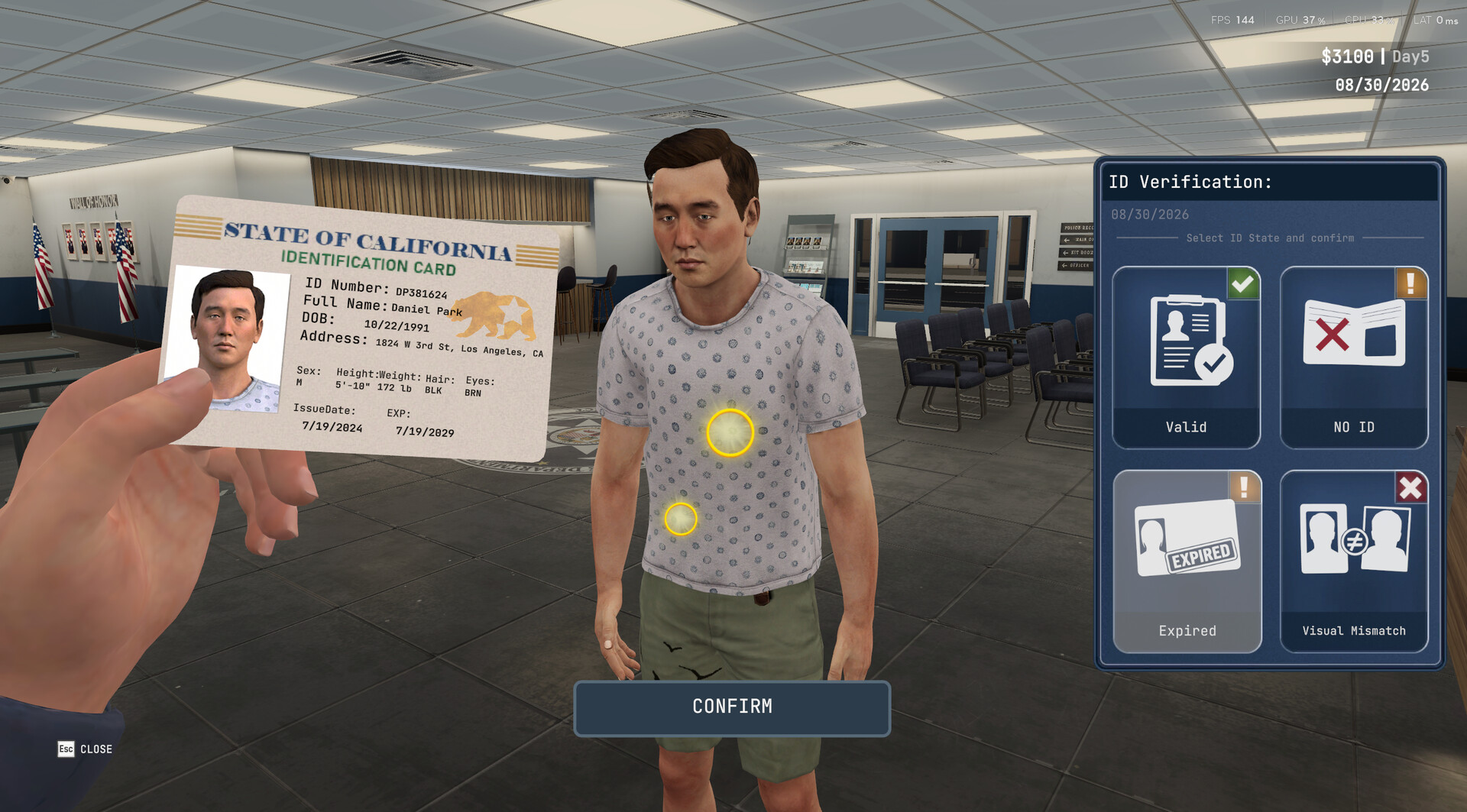


Police Officer is a first-person police station simulator where you manage a police station: process suspects, hear citizens’ pleas, and manage the daily chaos of law enforcement—one decision at a time.

Sign in to add this item to your wishlist, follow it, or mark it as ignored

This game is not yet available on Steam

Planned Release Date: 2026

Interested?
Add to your wishlist and get notified when it becomes available.
 

About This Game

Police Officer is a first-person police simulation where you step into the role of an everyday officer balancing paperwork, patrols, interrogations, and station management. From routine checks to high-pressure incidents, every decision shapes public trust, and your career.

Patrol, Check, and Enforce the Law

Keep the streets safe through observation, dialogue, and action.

  • Conduct ID and document checks during patrols

  • Intervene in crimes ranging from petty theft to serious offenses

  • Decide when to warn, fine, detain, or arrest

  • Handle immigration and residency cases through lawful procedures

  • Call for backup or de-escalate situations yourself

Every encounter forces a choice: follow protocol strictly, or adapt to the human situation in front of you.

Hands-On Police Work

Classic police actions turned into satisfying, skill-based gameplay.

  • Apply handcuffs with timing-based mini-games

  • Perform searches and evidence collection

  • File reports, log arrests, and process suspects

  • Run breathalyzers, scanners, and forensic tools

  • Escort detainees through holding cells and interrogation rooms

Mistakes cost time, reputation, and public confidence.

Hear the City's Pleas

Your station is the city's pressure valve.

  • Receive citizens reporting crimes, disputes, or emergencies

  • Listen to testimonies and spot contradictions

  • Decide which cases deserve immediate action

  • Deal with emotional, angry, scared, or manipulative visitors

Every citizen has a story — and not all of them are telling the truth.

Manage a Living Police Station

A police force runs on organization as much as authority.

  • Manage queues, holding cells, and interrogation rooms

  • Assign officers to desks, patrols, or investigations

  • Upgrade equipment, offices, and security systems

  • Balance efficiency, legality, and public satisfaction

As your station grows, chaos grows with it.

Consequences, Reputation, and Pressure

Your actions don't disappear into paperwork.

  • Build a reputation with citizens, colleagues, and superiors

  • Face inspections, internal reviews, and media scrutiny

  • Handle protests, overcrowding, and crisis moments

  • Shape the city's crime rate through your policing style

Be strict. Be fair. Be human.

The badge doesn't make the decisions; you do.

Additional Context

The game is set in a fictional modern American city, drawing inspiration from real-world policing structures, including local departments, state jurisdictions, and federal agencies. Some cases may involve immigration-related procedures, coordination with ICE, and enforcement priorities shaped by national policy shifts.

The city's legal and political environment reflects different periods of U.S. governance, including policy frameworks associated with Donald Trump–era administrations, as well as regional influences inspired by places like Minnesota. These elements exist as background systems, not narratives, and serve to ground the simulation in a believable contemporary setting.

For Players Who Know That Every Badge Carries Weight

The appeal of police simulation has always lived in the gap between the rule and the human being standing in front of it. Papers, Please made bureaucratic enforcement feel like a moral act at every checkpoint — and Police Officer operates with the same understanding. Players who loved the patrol loop of Police Simulator: Patrol Officers and wanted more depth in the human interactions will find it here. Those who spent hours in Contraband Police carefully logging infractions and building a reputation for rigor will recognize the same satisfaction in processing a difficult case correctly. And anyone who has played This Is the Police or This Is the Police 2 understands that running a law enforcement operation means constantly choosing which problems you can afford to solve and which ones you have to let pass.

The Street-Level Simulation

Games like Flashing Lights put you inside the emergency services loop — lights, sirens, response times, co-op radio chatter. Highway Police Simulator and Police Simulator: Patrol Duty explored the specific rhythm of traffic enforcement. The Precinct recently showed how much players hunger for a police-themed open world with real procedural weight. Police Officer goes deeper on the station side: the waiting room, the intake desk, the interrogation room, the holding cell. The chaos doesn't come from traffic; it comes from people, their needs, their lies, and their expectations. 911 Operator players know what it means to be the pivot point between a crisis and a resolution. Rescue HQ players understand the management layer underneath the sirens. Police Officer puts both in your hands.

Tactical Clarity and Protocol

SWAT 4 built a generation of players who understood that law enforcement gameplay doesn't have to be reckless to be tense, precision, protocol, and communication under pressure are their own kind of adrenaline. Ready or Not carried that tradition forward into a modern setting where every room clearance has procedural and ethical weight. Police Stories gave us the top-down version of that same discipline. Police Chief Simulator lets players build the institution from above. Police Officer operates at the street level: you are not the administrator deciding policy, and you are not the SWAT commander breaching a door. You are the officer at the counter, on the patrol beat, and across the interrogation table — and that middle ground is exactly where the interesting decisions live.

The Investigator's Mindset

L.A. Noire built its entire interrogation system around reading faces and deciding whether someone was lying, the same core skill Police Officer demands when a citizen's story doesn't quite add up. Disco Elysium showed that detective gameplay works best when the investigator's own psychology becomes part of the puzzle. Shadows of Doubt proved that a procedurally-generated city full of individually-simulated citizens creates genuinely unpredictable cases. Sherlock Holmes: Chapter One and Sherlock Holmes The Awakened demonstrated that deduction rewards patience and observation over action. Return of the Obra Dinn made pure logic feel thrilling. The Case of the Golden Idol and The Rise of the Golden Idol both showed how much players crave investigation mechanics that trust them to figure things out without hand-holding. Nobody Wants to Die showed that crime scene reconstruction can be its own genre. The Roottrees Are Dead proved players will happily spend hours cross-referencing evidence when the puzzle is tight. Police Officer's citizen interviews are built on the same principle: the truth is in there, and it's your job to find it.

Authority, Conscience, and Systems

Beholder and Beholder 2 explored what happens when the person enforcing the rules becomes indistinguishable from the system itself. Not Tonight brought document-checking to a nightclub door and made it carry the same bureaucratic dread as a border post. Orwell: Keeping an Eye On You handed players institutional surveillance authority and let them sit with what that means. Suzerain gave players a presidential chair and discovered that good intentions bend under structural pressure. Democracy 4 made clear that policies made in the abstract land on real people in concrete ways. Frostpunk 2 showed that management games become genuinely disturbing when the resources you're managing are human. These are the games Police Officer shares DNA with — simulations where the player holds institutional power and is asked, quietly and persistently, whether they're using it well.

The Criminal Economy

Schedule I approached the other side of the law with full simulation depth, showing how much players love detailed systems around illegal economies, which only makes sense when you're playing the officer trying to dismantle one. Crime Scene Cleaner demonstrated that procedural interactions with crime aftermath can be compelling in their own right. Prison Architect and Prison Simulator both explored what happens after the arrest, the correctional institution as a management puzzle with human stakes. Border Officer put players in the specific tension of a checkpoint where everyone has a story and not everyone is telling the truth. Prison Architect players who've spent hours maintaining order across a facility will recognize the same logic at work in Police Officer's station management layer.

Investigation Culture on PC

The detective and investigation genre has never been healthier on Steam. Her Story and Telling Lies showed that reading between the lines of recorded testimony, catching the hesitation, the deflection, the thing someone almost said, is a deeply satisfying game mechanic. Pentiment showed that historical evidence and human memory require the same kind of interpretive detective work. The field has exploded with titles that trust players to think: it's the genre for players who want engagement, not just reaction. Police Officer inhabits the same space. Every citizen who walks through your door is a puzzle. Every statement contains something true and something not quite right. The job is figuring out which is which, and deciding what to do about it.

For the Roblox Generation Growing Into Deeper Simulations

A huge community of players first experienced police roleplay on Roblox, in Jailbreak, where the cops-and-criminals dynamic plays out across an open world with tens of thousands of concurrent players; in Emergency Response: Liberty County, where the emergency services simulation gets serious about procedures and dispatch coordination; in Brookhaven RP and Greenville, where freeform city roleplay includes police as one of the defining social roles; in Mad City, where players cycle through heroes, criminals, and officers across a living environment; and in Da Hood, where street-level roleplay gets gritty and unscripted. Hillview County brought even more realistic county-based policing to the platform. For players who grew up in those servers and want something with more mechanical depth, more consequence, and more moral complexity: Police Officer is the next step. The same impulse that made you put on the uniform in Bloxburg and start directing traffic is here, with every decision now carrying real weight.

Build the Station. Earn the City's Trust. Do the Work.

The reputation system in Police Officer works the way reputation works in real institutions, not as a number to optimize, but as a social reality that shifts in response to everything you do. Players who've watched public approval move in unexpected directions in Democracy 4 will recognize the dynamic. Players who felt the ground shift under a decision that seemed right in Suzerain will recognize the feeling. A good police station isn't built by being strict. It isn't built by being lenient either. It's built by being consistent, honest, and responsive to what the city actually needs. That's the simulation. That's the job.

System Requirements

    Minimum:
    • OS: Windows 11
There are no reviews for this product

You can write your own review for this product to share your experience with the community. Use the area above the purchase buttons on this page to write your review.