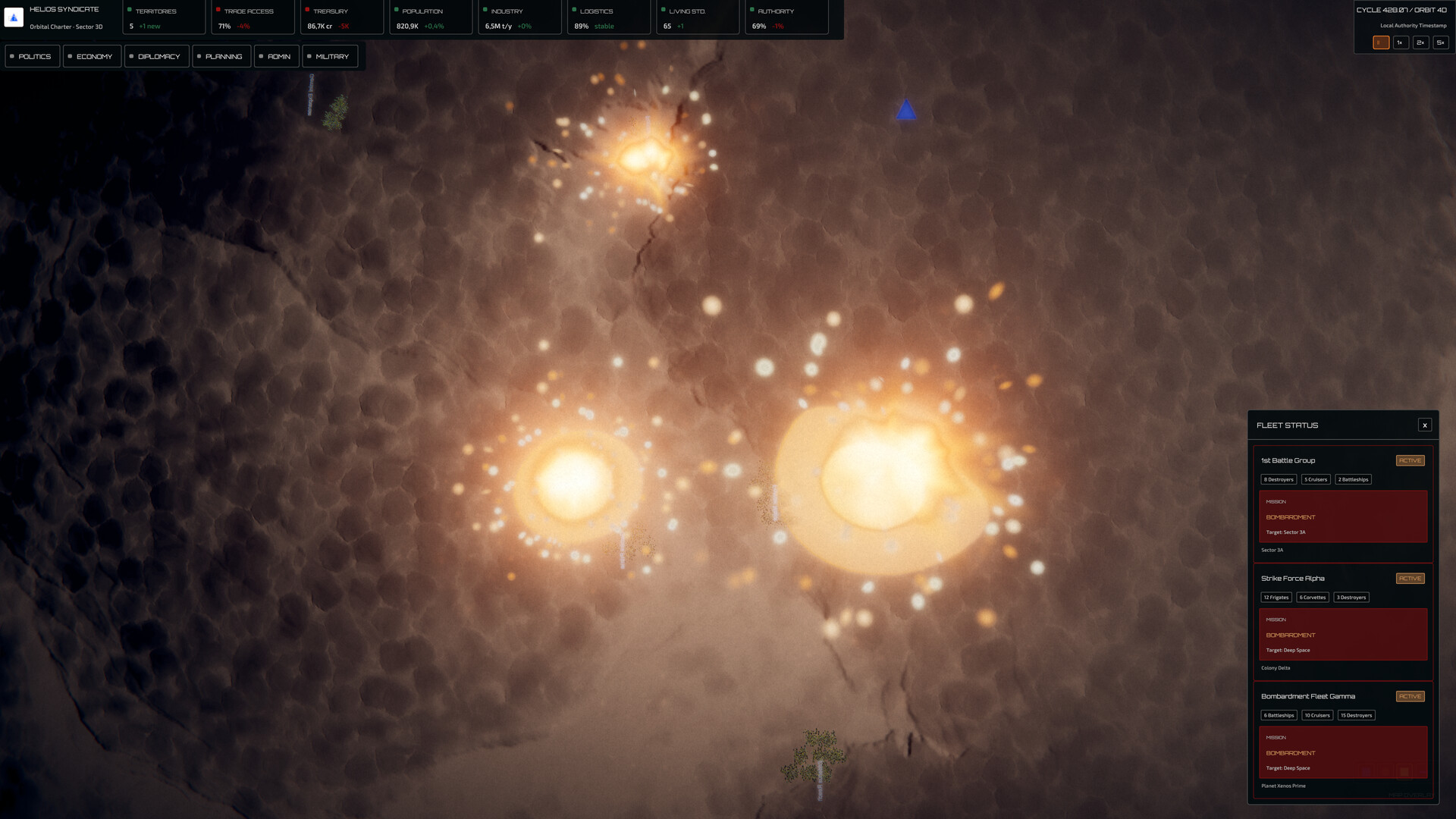


Un gioco di strategia spaziale su larga scala che mira a costruire e mantenere il potere in una galassia simulata. Costruisci, sviluppa e sopravvivi in ​​una galassia plasmata dalla storia e conseguenze.

로그인하셔서 게임을 찜 목록에 추가하거나, 팔로우하거나 또는 제외로 지정하세요.

한국어(을)를 지원하지 않습니다

이 제품은 귀하의 로컬 언어를 지원하지 않습니다. 구매하기 전에 아래에 있는 지원하는 언어 목록을 확인해주세요.

이 게임은 아직 Steam에 출시되지 않았습니다

출시 예정일: 2027년

관심이 있으신가요?
찜 목록에 추가하고 출시가 되면 알림을 받으세요.
 

게임 정보

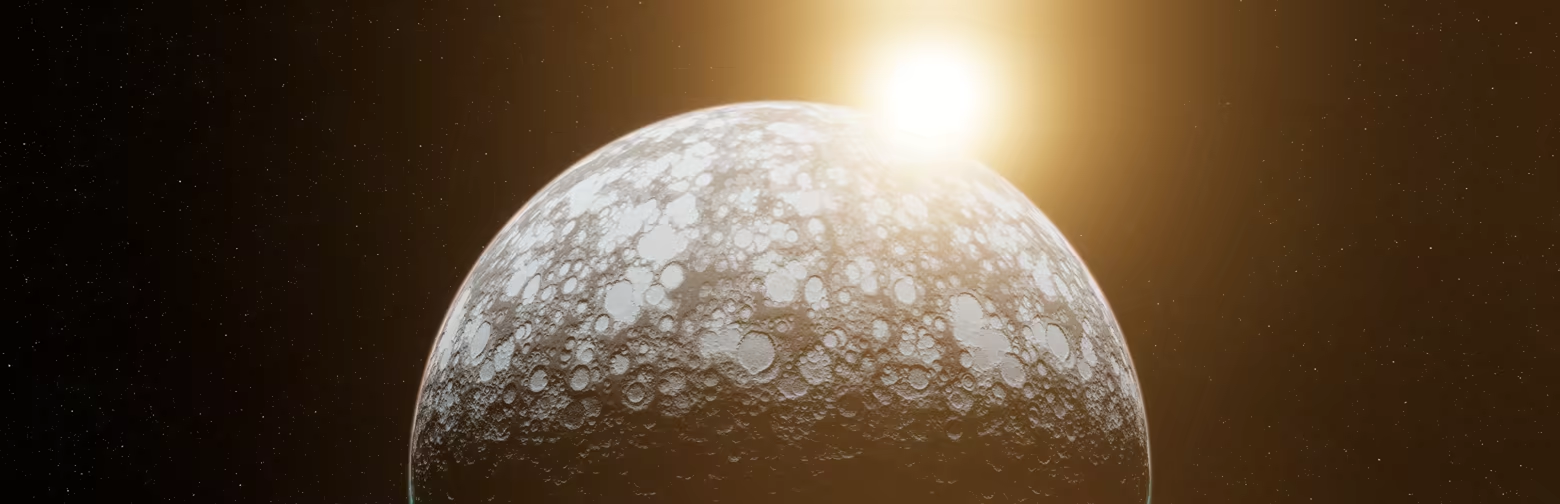
Antropico: Colonies is a large-scale space strategy game about building power inside a living galaxy.

You begin with a single foothold: an outpost on a hostile world. From there you expand across planets, infrastructure and institutions, shaping not only what you control, but how your authority works.

This is not a purely abstract map. You build real structures on real worlds. Placement, geography and access matter, and long-term development is never guaranteed.

There is no scripted ending and no forced victory condition. You play for survival, dominance or stability on your own terms, inside a galaxy that does not revolve around you.

Before you start, you can decide how old the galaxy already is. The world can begin as a young frontier, or as a space shaped by centuries of prior expansion, collapse, migration and conflict.

Some worlds can be changed over time. Most cannot. Fully habitable planets are rare, and when you secure one, it rewrites the scale of what your authority can become.

Power in Antropico is not only measured in territory. It is measured in legitimacy and control.

You define how your authority operates: what is allowed, what is enforced, what is tolerated. Your political structure shapes daily life across worlds, and worlds respond.

Choose the direction of your system: corporate freedom or state planning, rigid security or permissive civil rights, centralized command or distributed autonomy. These choices affect loyalty, unrest, productivity, diplomatic standing and the stability of your internal order.

Politics is not a decorative layer. It is pressure. The rules you set decide which parts of your empire hold and which parts begin to fracture.

Your economy is built from real constraints: energy, consumer supply, heavy industry, services and the logistics that keeps them connected.

You do not unlock prosperity. You construct it. You decide whether to spread outward, consolidate density, or specialize into a clear identity. A compact industrial core. A network of outposts. A self-contained agricultural world. A trade-centered hub.

Specialization creates efficiency, but also dependency. If one world feeds another, the link matters. If you rely on imports, access matters. When supply breaks, the effects are not cosmetic: shortages create unrest, markets tighten, production stalls and political stability is tested.

A strong economy is not just output. It is resilience under pressure.

You are not alone. Other powers exist, and they have their own interests, thresholds and fears.

Diplomacy is access: to markets, legitimacy, protection and time. Treaties can stabilize your growth or trap you in dependence. Blocs can provide safety or force you into rules you did not write.

Aggression, instability and ideological choices trigger reactions. Condemnations, restrictions, sanctions, escalating isolation. Smaller powers may follow dominant blocs. Others will exploit cracks for profit.

Diplomacy is leverage. But leverage cuts both ways.

Force is expensive. It should feel expensive.

Fleets are not decorative counters. Ships require industry, logistics, upkeep and long-term commitment. Losses leave scars, not only in firepower, but in the economy that supports it.

War is never clean. Raids can disrupt trade. Blockades can starve entire supply networks. Invasions can win territory while breaking the system that made it valuable. Even victory can cost years of recovery, and defeat can reshape your authority into something smaller, harsher or forced to move.

If you escalate, you do it knowing the consequence: markets react, alliances shift, internal stability tightens and future options narrow.

A multi-world authority cannot be managed by willpower alone. It needs structure.

You can rule from the center and accept fragility. Or you can delegate: governors, administrators, private entities, regional authorities. Delegation reduces micromanagement and keeps expansion viable.

But delegation creates internal politics. Local power accumulates. Interests diverge. Competence varies. Some leaders stabilize your empire. Some become liabilities. Some become threats.

Territory is not just land. It is institutions, influence and people who believe they deserve more.

The world runs. It does not pause to ask permission.

Populations grow, consume and react. Corporations pursue profit. Markets respond to scarcity and oversupply. Trade moves between planets and stations. Pressure builds where systems are weak.

The simulation is not there to drown you in noise. It exists to make choices matter over time. When you build, the system changes. When you break something, it stays broken until you fix it. When you rely on fragile chains, you feel the tension.

The galaxy can begin with a history. It can already contain old borders, forgotten catastrophes, rising powers and decayed worlds. What you discover depends on how much time you allow the universe to live before you arrive.

시스템 요구 사항

Windows
SteamOS + Linux
    최소:
    • 프로세서: TBC
    • 그래픽: TBC
    권장:
    • 프로세서: TBC
    • 그래픽: TBC
    최소:
    • 프로세서: TBC
    • 그래픽: TBC
    권장:
    • 프로세서: TBC
    • 그래픽: TBC
이 제품에는 아직 평가가 없습니다.

이 제품의 평가를 직접 써서 자신의 경험을 커뮤니티와 공유할 수 있습니다. 구매 버튼 위의 기입란을 이용하여 자신만의 평가를 써 보세요.