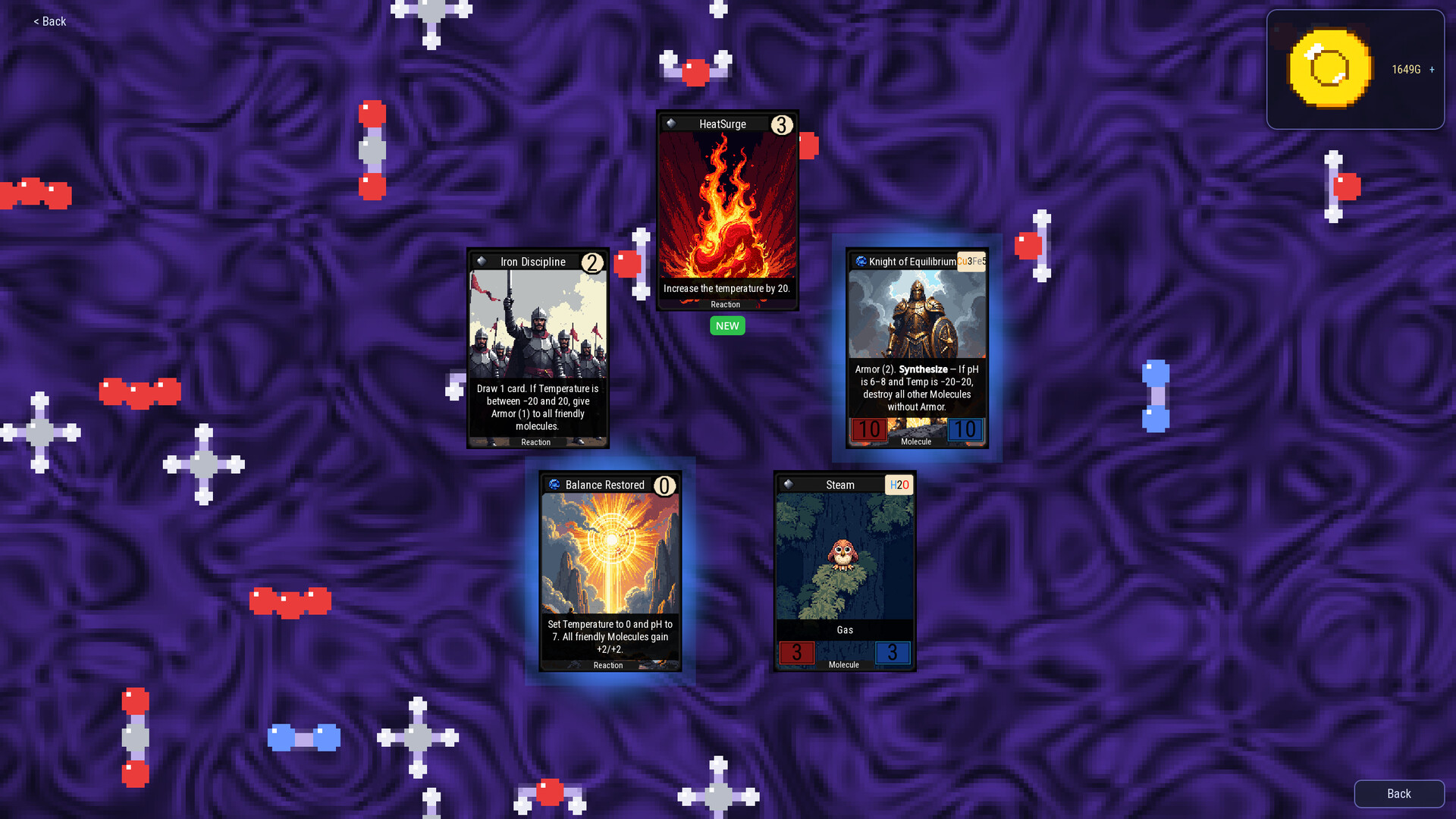

VALENCE is a multiplayer strategy card game where atoms act as resources and molecules become your creatures. Build decks, trade cards with other players, and outwit opponents in tactical battles to reduce their HP to zero.

Sign in to add this item to your wishlist, follow it, or mark it as ignored

Join the VALENCE Playtest

Request access and you’ll get notified when the developer is ready for more participants.
This game is not yet available on Steam

Coming soon

Interested?
Add to your wishlist and get notified when it becomes available.
Add to your wishlist
 

About This Game

Game Overview

This is a competitive head-to-head trading card game set in a shared laboratory. Each player is a scientist battling to reduce the opponent’s HP to 0 using Molecules while manipulating a shared set of Environment Factors: pH, Temperature, Solvent, and Light.

Both players fight inside the same lab conditions at all times. Cards can change the environment, and many cards become stronger or weaker depending on the current environment. A key skill is knowing when to push your own plan and when to disrupt the lab state the opponent needs.

You can also lose by running out of cards. If you must draw a card and your deck is empty, you lose.

Victory Conditions

You win if either:

  • Your opponent’s HP is reduced to 0

  • Your opponent must draw a card but their deck is empty

Starting HP is 30.

Deck Construction

Deck size is 60 cards.

The game is class-based:

  • Each class has access to specific Atom types

  • Each class can only include Molecules whose atom costs can be paid using that class’s allowed Atoms

  • Reactions and Equipment are neutral and can be used by any class

Example class restrictions:

  • Hydrologist uses Hydrogen and Oxygen

  • Combustion uses Carbon and Oxygen

  • Metallurgist uses Iron and Copper

  • Photochemist uses Nitrogen and Chlorine

Shared Environment Factors

The game has one shared laboratory environment that applies to both players. The environment is visible and always active.

Starting environment:

  • pH starts at 7 and ranges from 0 to 14

  • Temperature starts at 0 and ranges from -100 to 100

  • Solvent starts as Water and is always exactly one of Water, Polar, Non-Polar, or Formalin

  • Light starts Off and is either On or Off

If an effect would push pH or Temperature beyond their allowed range, the value is set to the nearest boundary.

The environment has no automatic rules of its own. It only affects the game when a card refers to it.

How the Environment Influences Cards

Cards often include an if-clause that checks the current lab state and changes the outcome.

  • pH checks
    Example Reaction: “Deal 2 damage. If pH ≥ 10, deal 4 instead.”
    Example Molecule: “Synthesize: If pH ≥ 12, this gains +3 Attack this turn.”

  • Temperature checks
    Example Reaction: “Freeze a target Molecule. If Temp ≤ 0, draw 1 card.”
    Example Molecule: “Decompose: If Temp ≤ -20, Freeze all enemy Molecules.”

  • Solvent checks
    Example Molecule: “Synthesize: If Solvent = Water, draw 1 card.”
    Example Reaction: “If Solvent = Non-Polar, destroy target Equipment. Otherwise, deal 3 damage to it.”

  • Light checks
    Example Equipment: “While Light is On, at the start of your turn deal 1 damage to a random enemy.”
    Example Reaction: “If Light is Off, turn Light On. If Light is On, deal 3 damage.”

How Cards Influence the Environment

Cards can change the shared lab state directly, and the new values apply to both players immediately.

  • Change by an amount
    Example Reaction: “Raise pH by 2.”
    Example Equipment: “Activated: Lower Temp by 5.”

  • Set to an exact value
    Example Molecule: “Synthesize: Set Temp to -20.”
    Example Reaction: “Set pH to 7.”

  • Switch solvent
    Example Reaction: “Change Solvent to Polar.”
    Example Equipment: “At the start of your turn, change Solvent to Water.”

  • Toggle light
    Example Molecule: “Synthesize: Turn Light On.”
    Example Reaction: “Toggle Light.”

Card Types

There are four card types: Atom, Molecule, Reaction, and Equipment.

Atom Cards

Atom cards represent your resource base.

You may play at most one Atom card per turn into your Atomzone. Atom cards remain in the Atomzone once played.

Each Atom card provides two resources every turn:

  • One mana

  • One unit of that Atom type

At the start of your turn, your Atom cards recharge. You regain full available mana and Atom units for that turn.

Mana is used only to play Reactions and Equipment.

Atom units are used only to play Molecules. Atom units are spent when you play a Molecule and recharge at the start of your next turn.

Example:
If you control two Oxygen Atoms, you have two mana and two Oxygen available each turn.

Atom Recycle

Atom cards are never dead draws.

Any Atom card in your hand has Recycle:

  • Recycle 1 means pay one mana, discard that Atom card, then draw one card

Recycle can only be used on your turn.

Molecules

Molecules are the main units that fight on the battlefield.

Molecules cost Atoms only. They do not cost mana. To play a Molecule, you must have the required Atom units available that turn.

Molecules have Attack and Health.

Molecules may have keywords, including:

  • Solid

  • Gas

  • Synthesize

  • Decompose

  • Armor

  • Freeze

  • Burn

  • Magnetize

  • Charge

  • Reclaim

Synthesize triggers when the Molecule is played.

Decompose triggers when the Molecule dies.

Molecules have summoning sickness. A Molecule cannot attack on the turn it is played.

Reactions

Reactions are one-time effects.

Reactions cost mana only.

Reactions can only be played on your turn.

Reactions may target Molecules, Equipment, leaders, or the environment, depending on their text.

Equipment

Equipment are persistent objects with Health.

Equipment cost mana only.

Each player may control up to four Equipment at a time.

Equipment can be damaged and destroyed. Equipment can be attacked by Molecules, targeted by Reactions, or affected by other card effects.

Equipment may have passive effects, activated effects, or both.

Turn Structure

Each turn follows these steps:

  • Start of turn
    Your Atom cards recharge and you regain full available mana and Atom units.
    Start-of-turn effects trigger.

  • Draw
    Draw one card. If your deck is empty, you lose.

  • Main phase
    You may play cards, spend resources, and resolve effects.
    You may play at most one Atom card this turn.

  • Combat
    Your Molecules may attack if they are able to attack.
    You may attack enemy Molecules, enemy Equipment, or the enemy leader.
    Solid and Gas rules affect what targets are allowed.

  • End of turn
    End-of-turn effects trigger.
    If you have more than ten cards in hand, discard down to ten.

Combat and Targeting Rules

When a Molecule attacks, it chooses a target. The attacker deals damage equal to its Attack to the target. Damage remains until the end of the turn unless a card says otherwise. If a Molecule or Equipment has damage greater than or equal to its Health, it is destroyed.

Molecules can attack:

  • Enemy Molecules

  • Enemy Equipment

  • The enemy leader

Solid and Gas

Solid means opponents must attack Solid Molecules first. If the defending player controls any Solid Molecules, attackers must choose a Solid target.

Gas can bypass Solid. A Gas Molecule may choose any target even if Solid Molecules exist.

Freeze

If a Molecule or Equipment is Frozen:

  • It does not untap next turn

  • It cannot attack next turn

Marketplace

Players can trade cards through an in-game marketplace that supports player-to-player listings.

Listing cards
You can list cards you own for sale by choosing a card and setting a price and quantity. Only cards that are not currently used in any of your saved decks can be listed. Once listed, those copies are reserved and cannot be added to decks until the listing is canceled or sold.

Buying cards
You can browse market listings by card name and purchase listed copies using gold. When you buy a listing, the card copies are delivered to your collection immediately and the seller receives the gold.

Managing listings
You can view your active listings in the marketplace, cancel them at any time, and relist cards at a different price. If a listing is partially purchased, the remaining quantity stays listed until it sells out or you cancel it.

What Makes the Game Unique

Both players share one lab environment, so changing pH, Temperature, Solvent, or Light can help you and harm your opponent at the same time.

Molecules are paid with class-specific Atoms, while Reactions and Equipment compete for generic mana.

The strongest play comes from sequencing, environment control, and understanding when to commit resources to the board versus when to reshape the lab.

AI Generated Content Disclosure

The developers describe how their game uses AI Generated Content like this:

During development, AI was used as a tool to create pixel art drafts, which were then manually edited and finalized by the developer to ensure uniqueness and quality.

System Requirements

    Minimum:
    • OS *: Windows 7 SP1 or later
    • Processor: 2.0 GHz Dual Core
    • Memory: 2 GB RAM
    • Graphics: Integrated Graphics (Intel HD 4000 or equivalent)
    • DirectX: Version 11
    • Storage: 500 MB available space
    • Sound Card: Any
    • VR Support: No
    • Additional Notes: No
    Recommended:
    • OS: Windows 10 or later
    • Processor: 2.5 GHz Dual Core or better
    • Graphics: Integrated Graphics (Intel HD 4000 or equivalent)
    • DirectX: Version 11
    • Network: Broadband Internet connection
    • Storage: 500 MB available space
    • Sound Card: Any
    • VR Support: No
    • Additional Notes: No
* Starting January 1st, 2024, the Steam Client will only support Windows 10 and later versions.
There are no reviews for this product

You can write your own review for this product to share your experience with the community. Use the area above the purchase buttons on this page to write your review.