

A fantasy & sci-fi universe simulator that runs from the birth of the first gods to the death of the last mortal. For those who spend more time in a character creator than playing the game. Design worlds, gods, races, metals, magic and monsters down to the melting point — then simulate it all.

Sign in to add this item to your wishlist, follow it, or mark it as ignored

Coming Soon To Early Access

The developers of this game intend to release as a work in progress, developing with the feedback of players.

Note: Games in Early Access are not complete and may or may not change further. If you are not excited to play this game in its current state, then you should wait to see if the game progresses further in development. Learn more

What the developers have to say:

Why Early Access?

“Immortal Engine is a deeply complex application built around many interconnected simulation and creative systems and interactions. Many of these systems are already fully functional, but bringing them together into a cohesive, accessible, and enjoyable experience requires substantial development, testing, and refinement.

Early Access allows us to put these systems into the hands of players while we continue integrating and expanding them. We expect real-world use and player feedback to help us identify usability issues, discover interesting interactions we may not encounter during development, and determine where additional depth or refinement would be most valuable.

Our goal during Early Access is to continue building toward a complete universe simulation and storytelling tool while improving the modularity and enjoyability of the existing systems based on both development testing and community feedback.”

Approximately how long will this game be in Early Access?

“Immortal Engine will remain in Early Access until the major goals for the full release have been completed. Rather than committing to an arbitrary release date, we want to ensure that the core experience is properly integrated and usable before leaving Early Access.

Our primary goals include:

- Integrating the core universe simulation throughout the application, allowing the various creation and simulation systems to function together as a complete fantasy or science-fiction universe.
- Reworking the user interface to make the application more intuitive, accessible, and enjoyable to use.
- Reworking and expanding tutorials to better explain the application's systems.
- Completing planned graphical improvements and shaders.
- Expanding and completing multiplayer, exports, save games, and example game modes.
Completing and implementing the sample universe used to demonstrate the capabilities of the engine.

We will communicate major development milestones and progress through Steam announcements throughout Early Access.”

How is the full version planned to differ from the Early Access version?

“The full version will focus on accessibility, and ease-of-use, as the current model is incredibly complex and overly complicated, especially in UI, in many instances. This includes integrating and refining the systems already present while expanding the overall capabilities of Immortal Engine.

Planned improvements include:

-A substantially reworked and more user-friendly interface.
-Additional options for customization and creative control.
-Expanded accessibility and language support.
-Improved graphics and visual effects.
-Additional game modes and examples.
-Improved modularity and integration between systems.
-Complete mod support.
-A fully integrated multiplayer-accessible universe simulation connecting the application's individual systems into a cohesive experience.

Early Access is already intended to be a functional experience with a large portion of the application's systems available. The full release will represent the completed and integrated version of that experience.”

What is the current state of the Early Access version?

“The Early Access version already contains a large collection of functional, interactable, and accessible creation and simulation systems.

Players can currently create and customize elements including planets, races, magic schools, religions, gods, pantheons, societies, cults, cultures, companies, weapons, classes, skills, and many other components of a fictional universe. Many of these systems can also be exported and used independently.

A major focus of Immortal Engine is allowing these systems to interact with one another. For example, a player can create a custom metal, use it to create a weapon from a custom weapon design, give that weapon to a character from a custom race, and then use that character within a larger simulation. This is already implemented within the Early Access version.

The current build provides access to most of the current alpha versions of these systems and allows players to freely experiment with them. The vast majority of systems, interfaces, and integrations are still under active development and will continue to change significantly throughout Early Access.”

Will the game be priced differently during and after Early Access?

“Yes. We want Early Access pricing to reflect the current scope of the application, and expect the price of Immortal Engine to increase when it leaves Early Access as additional systems, content, functionality, and polish are added.”

How are you planning on involving the Community in your development process?

“Community feedback will be an important part of development throughout Early Access.

We want players to tell us what they enjoy, what is confusing, what is difficult to use, which systems they would like to see expanded, and what new ideas they would like to explore. Feedback will help us identify problems that may not be apparent during internal development and can also inspire future content and improvements.

We will monitor feedback through the Steam Community forums and other community channels, alongside our own testing and development process. We will use this feedback to help prioritize improvements, identify bugs and usability issues, and explore new possibilities for the application's systems.

We will also use Steam announcements to communicate major updates, new features, development milestones, and significant changes during Early Access.”
Read more
This game is not yet available on Steam

Coming soon

Interested?
Add to your wishlist and get notified when it becomes available.
 

Report bugs and leave feedback for this game on the discussion boards

See all discussions

About This Game

Immortal Engine is a suite of interconnected fantasy and sci-fi generators, simulators and games, designed for storytellers, worldbuilders, and creative dreamers. At its center is a complete universe simulation that runs from the birth of the first gods to the death of the last mortal — and every parameter in it is yours. Want magic? Spaceships? Dragons? Angels? Zombies? All of the above at once? Flip the switches. Or skip the switches entirely and simply describe your vision to The Archivist, who will guide your universe into being through conversation.

Every creation in the Engine is a shared, open, human-readable format. Your worlds, characters, materials, and schemas aren't locked in a box — they're data you own, designed from day one to be reused, extended, and pulled into other programs. Yours to use, modify, publish, and sell. Print out pantheon diagrams and magic school charts for use at your tabletop game, save character arcs for storywriting inspiration, or download functional hex and grid map data for integration into your handcrafted game world.

If you've ever spent four times as long in a character creator than the actual game — this was built for you.

If you've ever wanted a fantasy simulator's depth without needing to read 4 hours worth of wikis — this was built for you.

If you've ever had a vision of a world, or a story you wanted to tell, or live within, but didn't have the right tools — this was built for you.
And if you love creation for the sake of creativity, and storytelling for the sake of the story — this was built for us.

Simulators this deep typically require hours of tutorials before you can make anything interesting. Immortal Engine doesn't.

Meet The Archivist — the keeper of the engine. He presides over the main menu, but he also lives in the corner of every single tool in the suite. Forget what a button does? Click him, ask "tell me what this does," and point at it. Feeling lost in a system? Ask him to help you use it, and you have a thinking partner for your design. He can set parameters for you, highlight things on screen, and walk you through each tool and parameter from top to bottom. Through one fun, RPG-style conversation you can reach the same level of customization you'd get by setting every parameter by hand. Regardless of what you want to make or the story you want to tell, there are many different ways to reach the same end goal within the system, each with vastly different levels of complexity by design - pick the one that appeals to you.

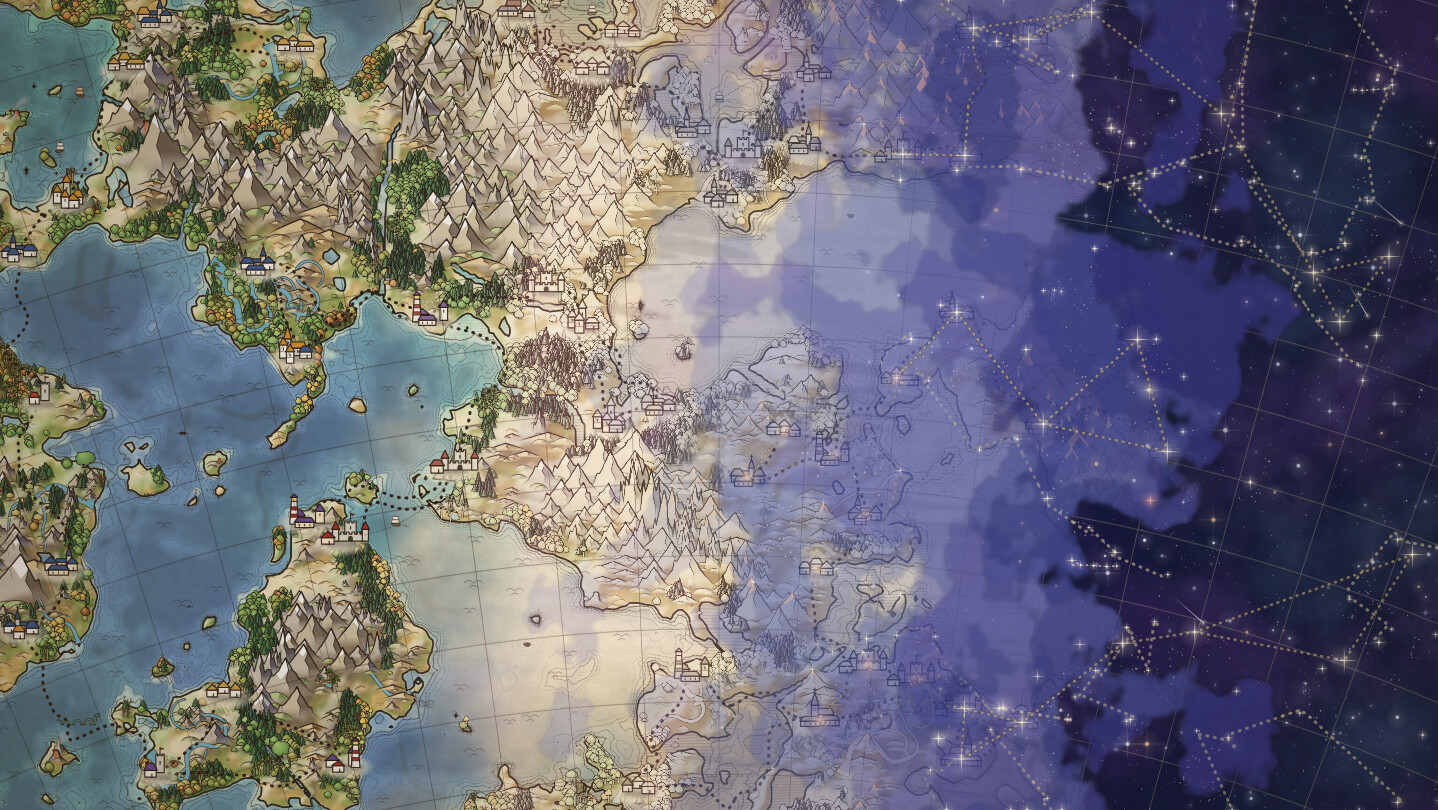
  • Planets — 3D hex-sphere tilemaps built on Goldberg polyhedra, with dozens of generation controls, proprietary layered noise, hydrology, erosion, rivers, biomes, and more. 

  • Solar Systems — Assembled from the worlds you make. Choose each planet and the focus of their orbit. Design habitable zones according to real world physics or let gods and magic dictate the rules.

  • Star Charts — Assembled from the systems. Every single galaxy, nebula, plane, divine domain, and black hole in it's place. Make the afterlife a physical place - the bounds are up to you.

  • Gods — With domains, powers, personalities and agendas, gathering into pantheons. Watch them create races, forge artifacts, fall in love, commit betrayal, and declare war. 

  • Races — With detailed body part schematics, in-depth appearance control, endless trait options, and more. They wake into the world, build civilizations, design cultures, develop traditions, stumble onto technology and magic, and go to war, to peace, and to adventure.

  • Materials — With full control of all physical (and some magical) properties. Create new, mythical metals, and determine everything from the magnetic properties to the melting point — then put it into your universe and watch civilizations learn to use it, and go to war over it.

  • Languages — Built off of a unique, completely hand-crafted dictionary system, your mortals will actually write titles that relate to the contents of their books (most of the time). Already contains thousands of words and phrases, all tagged with meanings and relationships, and is constantly growing with updates.

  • And More — Build traits for your races, skills to teach the mortals, weapon schematics for your civilizations, ceremonies for your religions, traditions for your pantheons, and every piece in between  — while every piece of the system interact as you do so.

When you build a planet in the system, you can save it — but that's not all you can do; you save the ranges that produced it. Set each parameters' minimum and maximum value. Dial in a setup that reliably spits out dynamic, diverse, rocky lava worlds, then save that schema and generate a whole family of them. Feed those into a system, or randomly discover your creations while exploring the simulation.

For those that want more, we have schemas nested inside schemas inside schemas. You're not building one world; you're building the thing that builds worlds. This project was built off of the idea that the limit should be your imagination - not the tools themselves. And everything is designed to be intuitive, and user-friendly, user-first.

Every system is customizable. Every story is viewable. Every perspective is playable.

Within a single race you can set ranges for hair, eye and skin color; biological sexes; hair growth speed and thickness (which shapes what hairstyles that race tends to spawn with); skin type, thickness and patterning; blood color and type; breathing type; preferred and survivable temperature; walking speed; the number and shape of eyes; and modifiers to stats, substats, attributes, skills, weapon handling and traits. That's just one system. There are many.

Each tool is wired to give you total control. Create endless fully random possibilities, fine-tune specific ranges, or specify each attribute one by one.

Want to explore the simulation itself? Want to wager your luck in the arena? Want to draft your own alien sports team? Want to get really in the weeds with balancing your own races, traits, and systems? Here are just a few more things included in the Immortal Engine:

  • Realistic combat with per-part injuries, calculated force, and area-of-impact pressure.

  • A suite of games and systems to show the system's capabilities, from sports games to arena combat.

  • A full testing suite of charts and information, including detailed combat reports.

  • A simulator for processing hundreds of thousands of combat scenarios at once.

  • Weapon schematic designs to create any feasible armament of destruction your heart could desire.

  • Magic school development with the ability to establish rules and laws for each realm of the arcane.

  • A unique main menu design.

  • A personality quiz.

  • Significant easter eggs. Thank you to all of the pioneers, game developers, and storytellers who inspired this project.


and the universe said you are not alone

and the universe said you are not separate from every other thing

and the universe said you are the universe tasting itself, talking to itself, reading its own code

and the universe said I love you because you are love.

And the game was over and the player woke up from the dream. And the player began a new dream. And the player dreamed again, dreamed better. And the player was the universe. And the player was love.

You are the player.

Wake up.

  • Julian Gough, End Poem

Mature Content Description

The developers describe the content like this:

Immortal Engine features a robust fantasy simulator, including realistic depictions of combat, injuries, and (while often fantastical or randomly-generated) potential drug and alcohol consumption.

System Requirements

Windows
macOS
SteamOS + Linux
    Minimum:
    • OS: minimal
    • Processor: minimal
    • Memory: 4 GB RAM
    • Graphics: minimal
    • Additional Notes: Should run on a potato.
    Recommended:
    • OS: Windows 10
    • Processor: Decent, if you want to generate large worlds
    • Memory: 16 GB RAM
    Minimum:
    • OS: minimal
    • Processor: minimal
    • Graphics: minimal
* Starting February 15, 2024, the Steam Client will no longer support 32-bit games or macOS 10.14 or lower.
    Minimum:
    • OS: minimal
    • Processor: minimal
    • Graphics: minimal
Review Filters