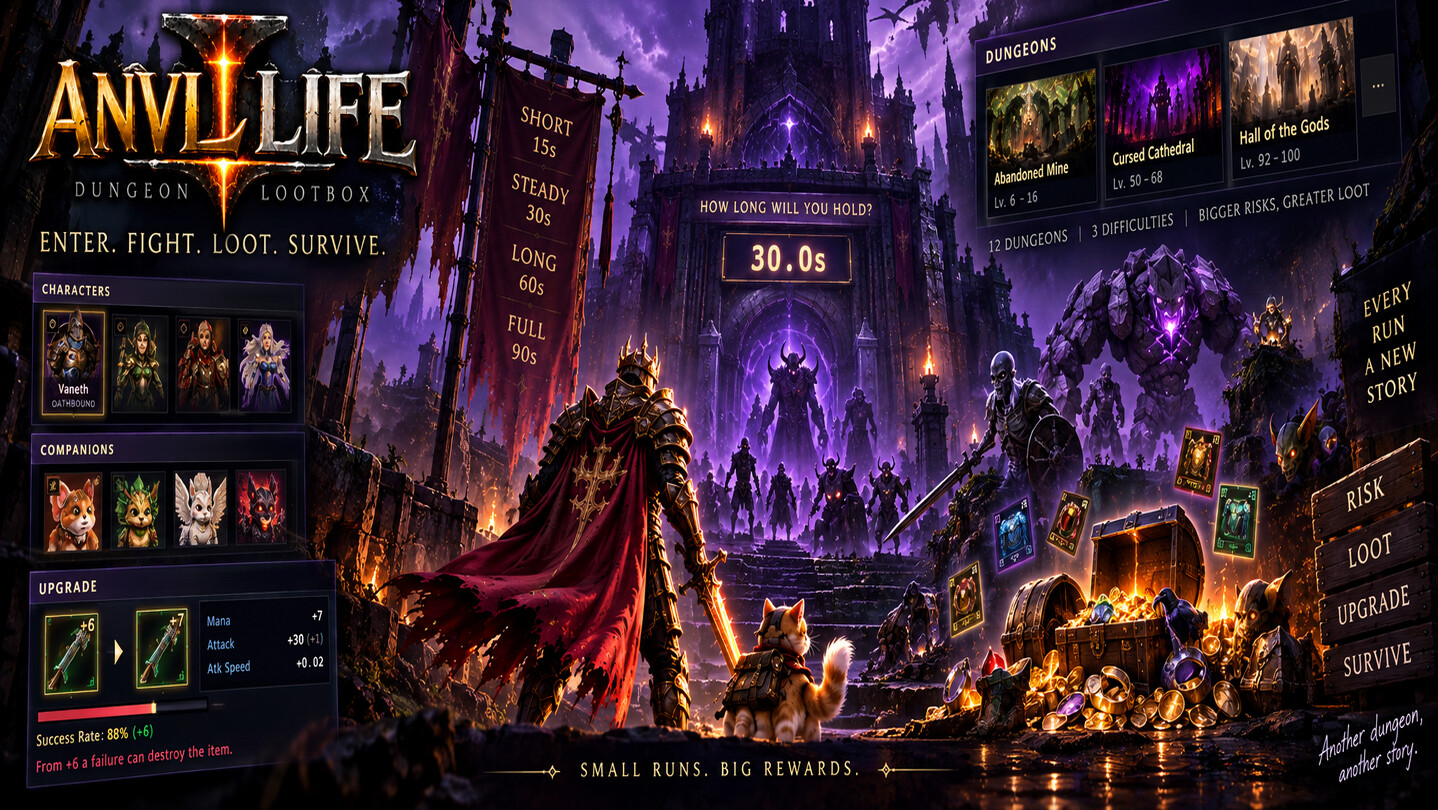


A fast-paced single-player dungeon RPG where you fight, collect loot, upgrade your gear, and decide how long you dare to stay. Build your character, manage your inventory, and push your luck for greater rewards.

Sign in to add this item to your wishlist, follow it, or mark it as ignored

Buy Anvil Life


About This Game

ANVIL LIFE


Nothing you find is yours until you walk out alive.


Anvil Life is a dungeon looting game built around one question, asked over and over: one more wave, or run now? You pick a dungeon, you bet how long you can last, and then you watch. Your character fights on their own. Your job is the decision — when the health bar dips, when the loot on your back starts to look like something worth protecting, when greed stops being profitable.


Walk out at the end and you keep everything, plus gold and a chest. Retreat early and you keep about half. Die and it all stays on the floor behind you.


THE RUN IS A BET


Before you enter, you choose 15, 30, 60 or 90 seconds of endurance. The longer you commit, the bigger the exit bonus and the better the chest — and the more you stand to lose. Every kill can drop loot, and all of it rides on your back until you leave. There is no checkpoint, no safe deposit mid-run. Only the walk out.


Twelve dungeons, each with five difficulty steps: Normal, Nightmare, Abyssal, Infernal and Sovereign. To open the next step you have to finish a full 60-second run on the current one. Rewards climb that same ladder, and so does the punishment.


THE ANVIL WILL TAKE YOUR BEST WEAPON


Gear goes from +1 to +10. The first five levels are free power — they always succeed. After that the forge starts eating things.


+6 lands 60 percent of the time. +7, forty-five. +8, thirty-five. +9, twenty. And +10 lands one time in ten.


That last step is the heart of the game. Pressing +9 into +10 splits five ways: it lands, or the piece is lost for good, or it burns but can be recovered, or it falls back to +8, or absolutely nothing happens and you stand there holding the same sword and a lighter purse. You will know the feeling long before you see +10.


Totems, scrolls and bank offerings shift those odds in your favour — at a price. The upgrade screen keeps a running log of your last twenty attempts, colour coded, so you can watch exactly how the anvil has been treating you.


A SAFETY NET, BUT AN EXPENSIVE ONE


Your best pieces are never simply deleted. Any +9 or +10 item, and any Mythic at +7 or above, lands in Recycling instead of disappearing — burned at the anvil, sold by mistake, shredded, worn to zero durability, or left behind when you died. It comes back completely intact. It also costs a fortune in gold and dust to pull out, which is the entire point.


Two things are gone for good, by design: whatever you lose at the trade table, and whatever your squire sells on your behalf.


LOOT WORTH READING


Eight equipment slots, six rarities from Common to Mythic, thirty-two item archetypes, and materials running from wood to dragonbone. Rarity sets the stat budget, material sets the value, and a single POWER number tells you whether you belong in a dungeon or not.


Sixteen runes slot into sockets for extra stats, elemental damage and resistance. Twenty crafting materials feed upgrades. Durability drains as you fight, and gear that hits zero breaks — so check before you walk in.


Item lore is printed on the items themselves. There are no cutscenes here. Some lines answer each other across different dungeons, and that is not a coincidence.


BUILD SOMETHING OF YOUR OWN


Thirty characters, each bending your stat curve a different way. Twenty-four companions with their own bonuses — resistance, crit, luck, regeneration, and one that is outright cursed. Thirteen skills, eight of them active, unlocking as you climb.


Skill points give both flat value and a percentage, so a defence build, an attack build and a mana build still feel different at level 100. Armour gives you steady regeneration; killing quickly heals you too. Pick a lane, or don't — the game is tuned so that ordinary gear at the right tier always has a path through.


THE VAULT, THE SQUIRE, AND THE SLOW MONEY


Lock gear in the vault and it produces dust over time — dragonbone pays far more than wood. Send your squire out for gold, materials or trade runs; as he levels he carries more, sells better, and eventually starts crafting potions and upgrade scrolls for you. That crafting is the backbone of the late game.


THE CASINO, AND A ROOM FULL OF GAMES


Behind one door sits a casino that runs on the gold you earned in the dark: a card table, a wheel, a trade-up gamble, a slot, and a joust where you set a kill target and decide when nerve turns into greed. Every table publishes its real odds. The house edge is printed, not hidden.


Next to it is the Game Room — seven original arcade games, from a falling-block puzzle to pinball played on an anvil. Scores turn into a small amount of gold, deliberately small. It is a break, not an income. Your records are saved.


THE RULE NOBODY TELLS YOU


Out-level a dungeon and its rewards collapse. The panel turns red and the gold dries up. You cannot farm the first cave forever; the game keeps pushing you one dungeon deeper than you feel ready for. If it feels easy, you are in the wrong place.


WHAT THIS IS, HONESTLY


Combat plays itself — your hands are for decisions, not for dodging. Runs are short. It works offline, it is one purchase, there are no ads and nothing to buy inside it. Your save is portable: copy a save code from the menu, paste it on another machine, keep going.


There is a full in-game guide, twenty-four chapters, written in twelve languages: English, Turkish, French, German, Italian, Spanish, Russian, Hindi, Hebrew, Arabic, Japanese and Korean.


Press Y at any time for a console that will give you a straight answer about how something works.


Bring something back. That is the whole job.

System Requirements

    Minimum:
    • Requires a 64-bit processor and operating system
    • OS: Windows 10 (64-bit)
    • Processor: Any 64-bit dual-core CPU, 2.0 GHz
    • Memory: 4 GB RAM
    • Graphics: Any GPU with hardware acceleration (integrated graphics is enough)
    • DirectX: Version 11
    • Storage: 500 MB available space
    • Additional Notes: 1920x1080 or higher for the intended layout.
    Recommended:
    • Requires a 64-bit processor and operating system
    • OS: Windows 10 / 11 (64-bit)
    • Processor: Any 64-bit quad-core CPU
    • Memory: 8 GB RAM
    • Graphics: Any dedicated or modern integrated GPU
    • DirectX: Version 11
    • Storage: 500 MB available space
    • Additional Notes: 1920x1080 or higher for the intended layout.
Review Filters