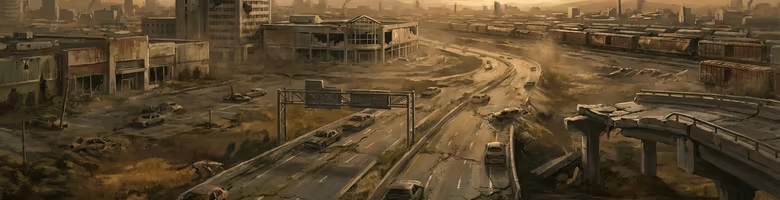

Command a party of survivors against the zombie apocalypse in this turn-based deckbuilder roguelike. Four heroes, four decks, one shared energy pool that grows as you push deeper. Earn cards in the wasteland, unlock perks between runs, and bring down the Overlord before it's too late.

Sign in to add this item to your wishlist, follow it, or mark it as ignored

This game is not yet available on Steam

Planned Release Date: Aug 20, 2026

This game plans to unlock in approximately 1 day

Interested?
Add to your wishlist and get notified when it becomes available.
 

About This Game


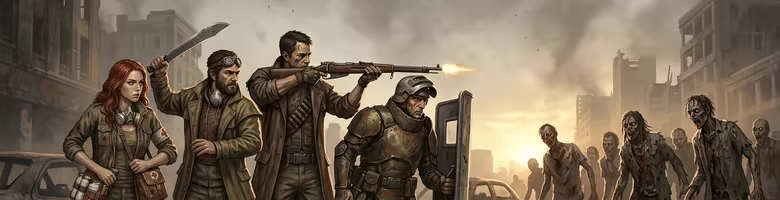
Most deckbuilders hand you one hero and one deck. Deckalypse hands you four survivors and makes them share. A Tank to hold the line, a DPS to break it, a Ranged hitter to control the field, and a Support to keep everyone breathing. Each one builds their own deck and draws their own hand. Every turn you decide who acts and who watches.

One energy pool. Four hands. Never enough.

Eight cards land in front of you every turn, two per hero, and you can afford maybe three of them. Energy is shared across the whole party and it grows the deeper you push into a region, then resets when you move on. Early turns are small and surgical, with heroes passing entire rounds because the Tank needed that point more. Late in a region you finally have the room to chain all four together and delete a board in one turn. Then it starts over.

Position is a weapon.

Your party holds a front and a back row. Enemies close on you through three distance bands, and every card checks both, so where a hero stands decides which cards are even legal. Root something at the far band and it can never reach you, but now only ranged cards reach it. Taunt only works from the front row, so your Tank has to stand exactly where it hurts. Pull a bleeding hero back to save the run. Shove the Tank forward to win it.

A wasteland full of cards.

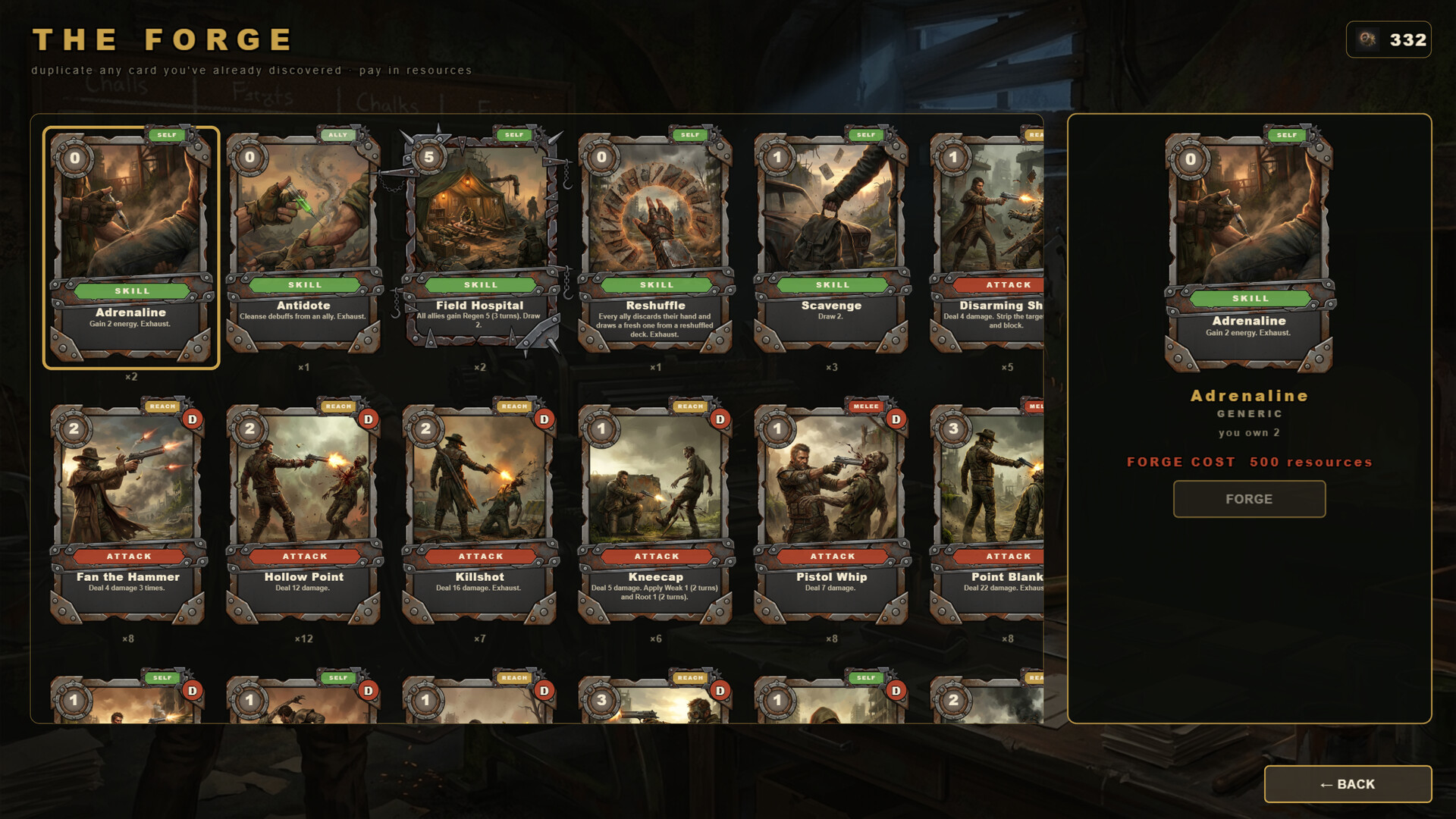
More than 130 cards are out there, picked up from combat rewards, traded in scavenged shops, torn off bosses who drop them nowhere else, and assembled from fragments scattered through a region. Decks cap at fifteen cards, so a full party fields sixty at most and you never see half the collection in a single run. Between bosses you can reshuffle which cards belong to which hero, or take them to the Forge and change what they do.


One bite and they are on a clock.

A common enemy called the Biter starts every fight already in your face. Its bite does damage, and it starts a fifteen round timer that does not stop when the fight ends. Resting will not clear it. Every round infected takes another 5% off that survivor's damage, all the way down to 90%, so your best fighter slowly stops being able to fix their own problem.

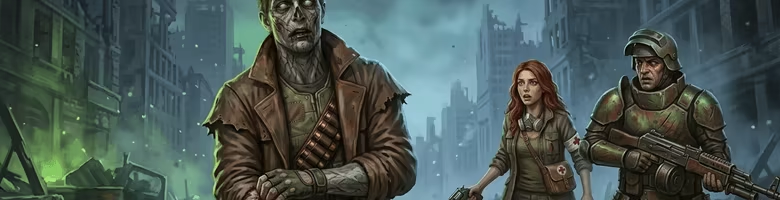
When the timer hits zero they turn. One HP, impossible to kill, target or control, clawing at the people beside them with a chance to pass it on. They are not dead. They are a problem you carry into the next fight, and if the last one standing is the turned one, the run is over. Block stops the bite from ever landing. Two cards and two items are the only other way out, and only one of them brings back somebody who already turned.

The trader deals in supplies, not cards.

You already earn cards from fighting. The trader stocks the things that keep you alive: medkits, damage and block stims, defibrillators to get a fallen survivor back on their feet, and the cures. Everything you buy goes into a satchel you carry on the map, usable between fights, with your party's infection status readable at a glance. Your gold and your supplies survive your death. The wasteland takes your run, not your savings.

Nothing you earn is lost.

Every enemy you kill drops resources that outlive the run. They go back to a permanent camp where you raise the party's energy cap, card draw, health and damage, rebuild a wrecked vehicle part by part into permanent bonuses, and trade your kills at the Gambit's Trade for relics that pay off the debuffs you were already stacking. Boss kills earn perk points for each hero's tree, respecced freely between fights. Sharpen the DPS into a glass cannon, turn the Tank into a wall, push the Support toward heals or hard control. You get stronger every time you die.


Six regions. Eighteen bosses. One road out.

The Streets, the Hospital, the Mall, the Parking Lot, the Rail Yard and the Highway, three procedurally laid out acts each, every act ending on a boss that can end your run. Bosses transform at half health with new patterns, new art and new energy, and the ones at the end of a region hex a hero on a cooldown with a curse that fires the turn after it announces itself. Clear a region and the ones behind it get harder. The road ends at the Overlord, one of the rotting kings that turned the world into this. Kill it, or join it.

There is something under the map.

Six hidden areas sit beneath the six regions, each locked behind a key buried somewhere in that region's second act. Down there is a mini-boss that is not in any encounter pool and a card that exists nowhere else in the game. Underground runs always start at a fixed seven energy, so the upgrades you bought upstairs will not save you.

Three crates a day.

The Spoils Den runs one skill minigame at a time and swaps it at dawn. Piece a torn photograph back together, walk a minefield by its numbers, or haul live cables to their breakers in the order the panel arms them. Win and you pry open a crate. Most spill resources, some are stuffed with junk, and a rare one hides a shot that sharpens your entire next run. Lose and you waste the crate, so play sharp.

A new run every day, the same one for everybody.

One seed, one region and a rolling set of mutators, handed to every player in the world at midnight UTC. Retry it as often as you like, because your best score for the day is the one that stands, and scoring counts the gold you earned rather than the gold you hoarded, so spending at the trader never costs you points. Steam leaderboards run per date and per region with your friends' scores in the rows beside yours.

Any run at all can be packed into a shareable code that carries the seed, the region and the mutators, so a friend plays your exact run instead of one that merely resembles it. Friends who are playing right now show up as live pins on the frontier map. The ones who are not leave a ghost where they were last seen.

Features

  • Four heroes, four decks, four hands a turn, one shared energy pool

  • Positional combat with hero rows, three enemy distance bands and range that actually matters

  • An infection that survives between fights and ends with one of your own turning on the party

  • More than 130 cards, with rare drops gated behind specific regions, bosses and hidden areas

  • A supply economy and a satchel that both persist through death

  • Permanent progression across camp upgrades, a rebuildable vehicle, debuff relics and per-hero perk trees

  • Six regions with eighteen bosses, phase two transformations and boss curses

  • Six hidden areas with their own mini-bosses and exclusive cards

  • A daily challenge with Steam leaderboards, plus shareable codes for any run you want to pass on

  • An in-game compendium and a 48 entry bestiary that fills in as you meet what lives out there

  • English, Portuguese and Spanish at launch

AI Generated Content Disclosure

The developers describe how their game uses AI Generated Content like this:

A solo dev made this game. Some of the art was created or refined with AI tools; the design, code, UI, music (using fruit loops), writing, and everything the game actually does are hand-built.

System Requirements

    Minimum:
    • Requires a 64-bit processor and operating system
    • OS: Windows 10 64-bit (version 1809 or later)
    • Processor: Intel Core i3-4170 / AMD FX-6300 or equivalent (dual-core, 2.4 GHz)
    • Memory: 4 GB RAM
    • Graphics: Intel HD Graphics 4000, AMD Radeon HD 7000 series, or NVIDIA GeForce 400 series
    • DirectX: Version 11
    • Storage: 1024 MB available space
    • Sound Card: Any DirectSound-compatible audio device
    • Additional Notes: Hardware mouse cursor recommended for card drag-and-drop feel.
    Recommended:
    • Requires a 64-bit processor and operating system
    • OS: Windows 11 64-bit
    • Processor: Intel Core i5-8400 / AMD Ryzen 5 2600 or better (quad-core, 3.0 GHz+)
    • Memory: 8 GB RAM
    • Graphics: Intel Iris Xe, NVIDIA GeForce GTX 1050, AMD Radeon RX 560 or better
    • DirectX: Version 12
    • Storage: 1024 MB available space
    • Sound Card: Any DirectSound-compatible audio device
    • Additional Notes: Hardware mouse cursor recommended for card drag-and-drop feel.
Review Filters