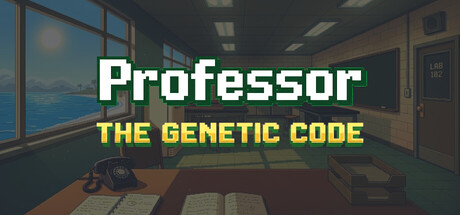


The first and only strategy game built on real science. Run a 1960s lab, hire the misfits, design experiments, publish or perish, and crack the genetic code. Relaxed turn-based mechanics, the madness of academia, a surfboard by the door. No STEM degree required, but it might take you half-way there.

Sign in to add this item to your wishlist, follow it, or mark it as ignored

This game is not yet available on Steam

Planned Release Date: December 2026

Interested?
Add to your wishlist and get notified when it becomes available.
 

About This Game

The first strategy game built on real science!

It is 1961. Nobody knows how a gene becomes a protein. Somewhere between the chalk dust and the scintillation counter, the greatest cipher in biology is waiting for someone to master it, and a handful of labs are racing to break it. One of them is yours. Professor - The Genetic Code is a turn-based lab management game in which the strategy is the science.

Not science-themed. Not inspired by. Not a puzzle with a science skin.

The four experiments at the heart of the game are the four that actually cracked the genetic code between 1961 and 1967, simplified enough to run inside a game, faithful enough that the logic is the real logic. Every hypothesis you chalk on the blackboard is one the pioneers chalked too.

But that's not enough! Manage and run the lab. All of it.

  • Hire and retain a team of researchers with their own drive, experience and frustrations. Put them on developing, methods, on key experiments, or to support grant applications.
  • Develop the assays, stock the shelves with reagents, then stage the key experiment: which synthetic RNA, which labelled amino acid, how many reactions, which controls.
  • Read the results, form a hypothesis, chalk it on the board, and write the paper. Reviewers can be cruel. Scoops happen.
  • Spend reputation and money to keep it all going: grants, conferences, committees, and your life. Publish or perish is the whole economy.
  • Keep going until all sixty-four codons are on the board and the code is deciphered. But beware! The clock is ticking, the competition doesn't sleep and this game can throw some pretty unusual genetic codes at you.
  • Recruit powerful visiting professors. The real scientists of the era pass through as visiting stars, with epic buffs, their real quotes and their real quirks. The history is always accurate, unless where that's not fun.

The most beautiful detective story in science!

The genetic code was deciphered with no sequenced gene, no known tRNA structure and no way to isolate any natural messenger RNA. The people who cracked it painstakingly made synthetic RNAs from scratch, fed them to cell extracts and reasoned backwards from which radioactive amino acids came out. The experiments are small, cheap and devastatingly clever, and the game lets you relive each one: the first synthetic polymer, the phage mutants that proved the code was read in threes, the repeating polymers, the triplet binding filters. When the logic clicks, it clicks for good.

But if you don't know what any of this means, fear not.

No biology degree is required to play this game. The classroom down the corridor teaches everything from the first base pair to the last codon, module by module, with a lecturer who does not mind being heckled. Start the game knowing nothing and you will finish it able to explain the genetic code at a dinner party. Start it as a biologist and you will still have to earn the grant money and decipher unusual genetic codes. Three difficulty settings change the hidden code itself: the real human code, a human-like variant, or a fully random one that nobody has ever cracked before you.

The world of science, then and now.

The 1960s laboratory is not as far away as it looks. Loyalty oaths and politcial overreach, funding that follows the headlines, a Cold War running through every conference, committee meetings that eat the afternoon, a public that wants cures by Christmas, and in the middle of all of it, astonishing progress made by small groups of stubborn people. Professor - The Genetic Code is as much about the science and as it is about the world the science has to survive in, and the two have not changed as much as we like to think.

At a glance

  • The only strategy game whose core mechanics are real scientific experiments
  • Relaxed, turn-based: one month per turn, 1961 to 1967, no clock, no reflexes required
  • Mouse-only, pixel art, turn-based, slow but brainiac
  • A hidden genetic code that is different in every playthrough
  • Three difficulties, four playable professors with their own backstories
  • A surf minigame with hidden abilities to unlock
  • A save system that respects your difficulty choice
  • A full in-game player's guide for those who want the whole history or know what the heck is going on

AI Generated Content Disclosure

The developers describe how their game uses AI Generated Content like this:

Generative A.I. was used for elements of in game artwork.

System Requirements

Windows
macOS
SteamOS + Linux
    Minimum:
    • OS: Windows 10 64-bit
    • Processor: Any dual-core from 2014 or later
    • Memory: 8 GB RAM
    • Graphics: OpenGL 3.0 capable (integrated graphics are fine)
    • Storage: 2 GB available space
    Minimum:
    • OS: macOS 14 Sonoma or later
    • Processor: Apple silicon or Intel
    • Memory: 8 GB RAM
    • Graphics: OpenGL 3.0 capable (including integrated graphics)
    • Storage: 2 GB available space
    Minimum:
    • OS: Ubuntu 22.04 or equivalent, 64-bit
    • Processor: Any dual-core from 2014 or later
    • Graphics: OpenGL 3.0
    • Storage: 2 GB available space
Review Filters