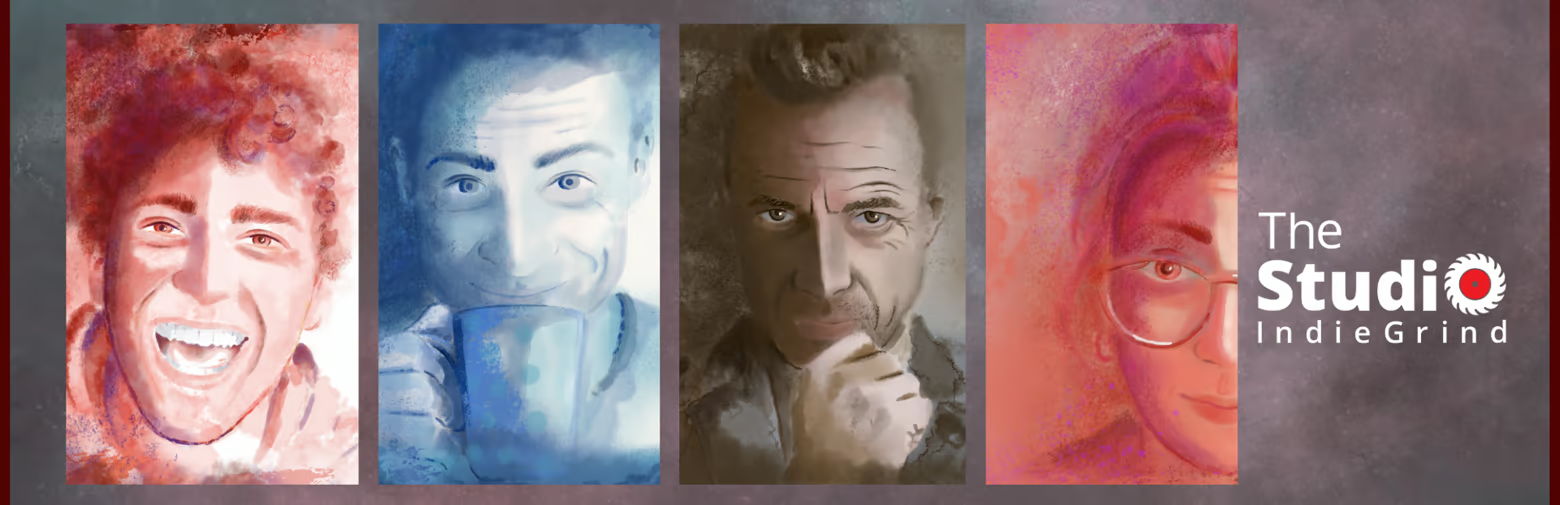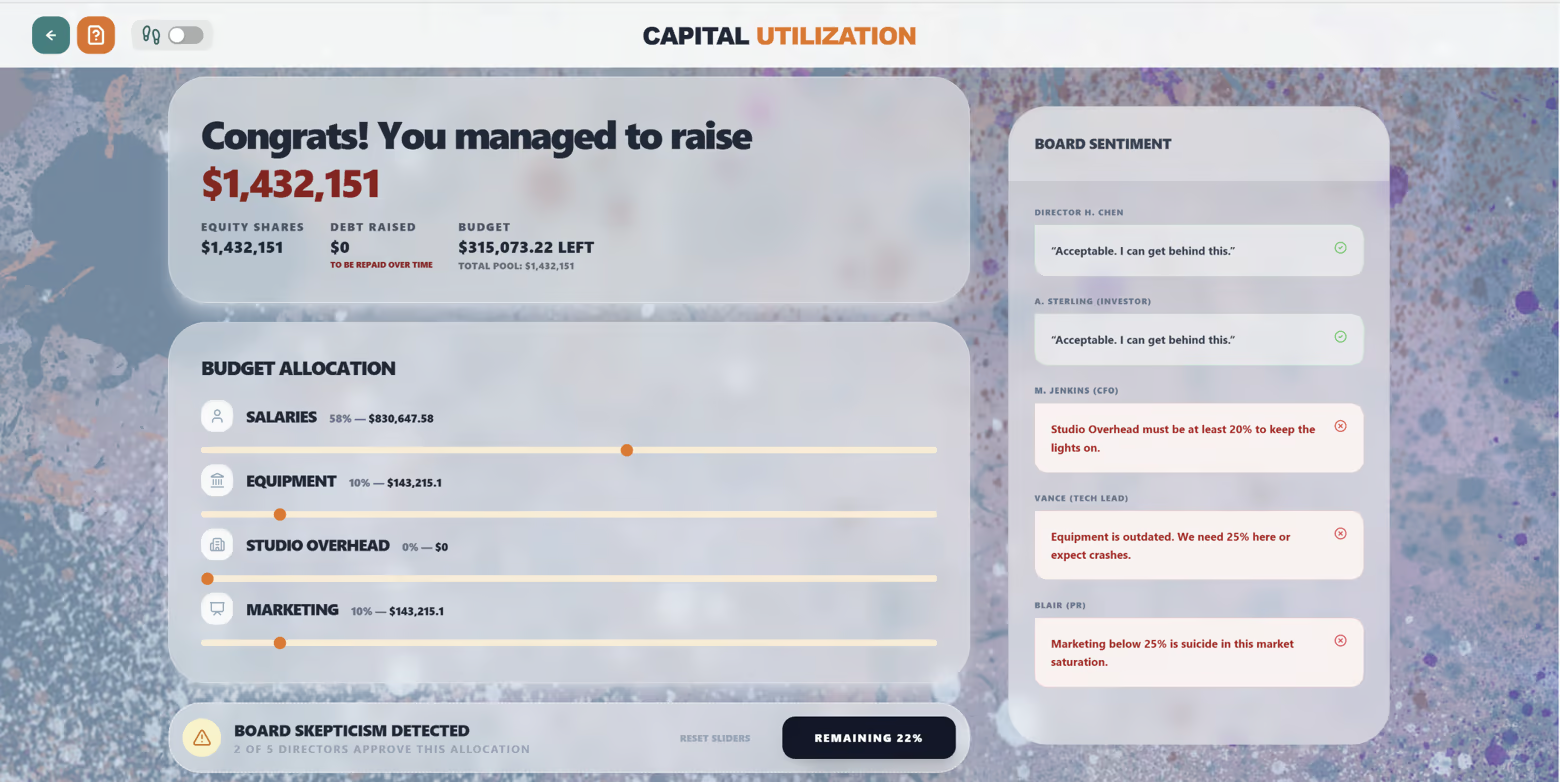

Build a game that generates a million dollar in revenue. Or sell a million units. 10 turns is all you get. Raise capital, hire a team, pick a genre, manage productivity, run launch, clean up the post launch mess. All in a days work. How hard could it be? Minimalist, 2D, Turn based strategy.

Connectez-vous pour ajouter cet article à votre liste de souhaits, le suivre ou l'ignorer

Français non disponible

Ce produit n'est pas disponible dans votre langue. Veuillez consulter la liste des langues disponibles ci-dessous avant de l'acheter.

Démo gratuite

Jouer à The Studio - Indie Grind Demo

Découvrez le jeu complet


À propos de la démo

The Studio is a minimalist, 2D, text based strategy simulation about building games. What does it take to design, build, collate, publish, launch and distribute a game. Imagine a small team with two to four resources that just opened doors for business. What do you do to get past that first milestone? Your first published title.

It is an underdog story. How hard could it be? How high will the sales for your title go? What can you do to make them go higher, faster? 

No frills. No fancy 3D assets. Just numbers. A lot of numbers. If numbers give you anxiety, walk away now. 

When we started thinking about building the Studio, we wanted the game to reflect our own journey. What did it take for us to take a step on the wild side and bet everything on building the game? Where did we get stuck? Our biggest challenges? The most troubling of hurdles? The questions that generated the wildest and longest debates? The wall we could never breach?

Raise capital, hire resources, do market research, pick a genre, a market segment, a target language, debate design decisions to death, pick the right playtest and launch model and then let the simulation run. 

Take launch as an example. it is not one single decision. It is a sequence. 

Direct launch or playtest first? Playtest and early access, or just playtest? How long should the playtest run? Who runs it? Your place or mine? In person or remote? How long? Which specific piece of collateral will make the biggest impact? What if you only the budget for one? Marketing? Organic? Build in public? Or Agency? Inhouse or get an outsider to help?

What about pricing? $4.99 or $6.99? What is the dollar impact? Are we leaving too much on the table? Will we turn off customers if we act too greedy and opt for $19.99?

See how well or not well you do, Tweak your resource mix to eck out higher productivity with the team you picked. What happens when you are ready to ship the game? Do you keep everyone on the payroll? Or do you fire everyone to extend your runway? How low will you stoop to survive?

The core game loop is trying to get to the finish line without dying in the process as a business. Rather than bullets,arrows or axes, its running out of runway that gets everyone in the end. As the Indie studio owner you make the decisions and own the outcomes. The same decisions don't always lead to the same outcomes.

There are only two simple rules. 

a) Don't run out of cash

b) Don't miss the shipping deadline. 

Without violating these two core rules, ship a game that makes players happy, that makes them want to play it for hours at end, and generates enough money to recoup costs and pay for your next title.

There is a world within those two simple rules that many of us haven't seen or live through. The only way to explore is to dive right in. You don't need an MBA to work through this. Just need to understand where you are spending the money and how long will it last. its basic budgeting and house keeping. Can't ship a game if you don't know how to balance your checkbook. 

Before you get into the world there is a small matter of capital. Can you get someone to write you a check? We know that is not how it works in the world of Indie, but access to capital is better than using your own savings to build a game. Given a choice, the opportunity and the network, would you know how to answer questions a game industry investor is likely to ask? Afterall games remain the best counter bet against AI. The last stand of humanity and creativity against slop. A little bit of ammo in your bank account may prove useful for the coming war. 

You have ten turns (years) to ship your first title. You can never raise enough capital, so what do you do when you run short? Who do you turn to? The games you want to make and the games you can afford to make are two different planets. Which one do you choose? Each comes with different milestones, a different probability of shipping, survival and success? Do you think you have in you to beat the data and the mode? By cutting against the grain. 

To ship a game you have to track and improve productivity. The game's economy feeds off productivity token. A token is a unit of work produced by a resource. it adjusts for resource quality and output and benchmark againsts a standard unit of work. Quality resources produce more tokens. A great product and project manager improves productivity. Quality equipment gives it a boost. Management interventions can nurture it or kill it, depending on how good or inept the leadership team is. 

What happens when you are finished building? Who do you keep on payroll and who do you let go?

What if instead of a pot of gold at the end of rainbow, we end up with a game that falls flat. How do you resurrect your title from the dead?

The game forces you to make choices at each stage. Capital and turns are finite. They run out. The challenge is to build and ship a game that generates enough revenue to break even at the end of your quest. Each attempt is scored so you get a sense of how far off from the finishing line you were when the ball dropped. The objective is to not just reach the line, but to cross it in style. 

If you do, cross it in style, doors open for you to fly higher.  How high is high for you? 2, 4, 6 or 60 milliion. What does the path for that kind of a hit looks like? What did you change in the mix to go from 2 to 6 million dollars. 

Unlock Asad, Ed Gazillions and Super Ed if you keep score with dollars in the bank. 

Asad - Raise and spend two million with nothing to show for it. We all know someone who matches this profile. 

Super Ed Gazillion.  Title sells a few million copies in the first month of launch.

Asad raises over 2 million dollars and still fails to ship a title. Was that skill, luck, bad choices, or the wrong employees? Ed on the other hand, sells a few million copies in a week. How do you change your gameplay and style to generate this wide variation in results. Is real life like that? You bet.

Based on data from the real world and thirty years of building products. May not look real, the numbers may not add up but when you do ship that first title for the first time, you feel the thrill of making the model work for you just the same. 

It is harder than it looks, but easier than you think. 

A game is not about downloads or playtime, rankings, sales or technology. It is more than resolution, levels, frameworks, tools and technology. Like everything else we value, cherish and appreciate, games are about meaning. Sometimes about seeking meaning; sometimes about redefining it.  How do you convert a click, or a set of pixels into a portal to a different dimension of imagination. How do you link that click to the higher purpose of finding meaning? What happens when you do that?

The Studio tries to answer a very simple question. What does it take to build a game? Can one feel all that goes into building one with a game driven by just numbers? Hyper realistic numbers, but still numbers at the end? That is the challenge we were trying to solve. No high end world models here. Just a simple story backed by a real world simulator that uses our own experiences, the history of the game development industry as context and a surprisingly powerful  desire on our part to win.

You decide if we managed to do what we wanted to do. Did we do it well or failed miserably?

Would you like a guide? Helpful hints?

Make small mistakes, not big ones. Break things. Ship early. Playtest sooner than later. Raise more capital than less. Take risks, live a little. In the end it is just a game.

We built it because we thought it would be fun. It was. You should play it because we thought it would be fun to have something like this again in the world. Real and yet not real at the same time. You should, it is.

There is no grand design or lore behind it, other than the desire to make something that we would want to play ourselves. Playtesting it for the last two months, we can tell you it hasn't worn out its welcome yet. We hope you have as much fun playing it as we had building it.

Thank you for trying out the demo and playtest version of the game. It means the world to us. 

Configuration requise

Windows
macOS
    Minimale :
    • Système d'exploitation : Windows 11
    • Processeur : i5, i7, i9
    • Mémoire vive : 1600 MB de mémoire
    • Graphiques : No GPU required
    • Espace disque : 850 MB d'espace disque disponible
    Recommandée :
    • Système d'exploitation : Windows 11
    • Processeur : i5, i7, i9
    • Mémoire vive : 1600 MB de mémoire
    • Graphiques : No GPU required
    • Espace disque : 850 MB d'espace disque disponible
    Minimale :
    • Nécessite un processeur Apple
    • Système d'exploitation : 15.2
    • Processeur : Apple Silicon
    • Mémoire vive : 1600 MB de mémoire
    • Graphiques : No GPU required
    Recommandée :
    • Nécessite un processeur Apple
    • Système d'exploitation : 15.2
    • Processeur : Apple Silicon
    • Mémoire vive : 1600 MB de mémoire
    • Graphiques : No GPU required
Filtres d'évaluations