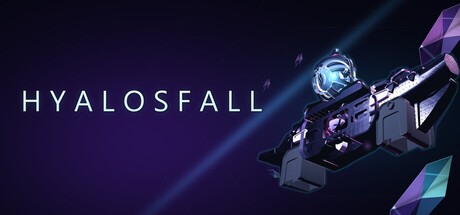

Glass doesn't crack here. It detonates. Pilot the AEGIS through the Prism Vaults, return the Photonic Core, and turn every chain into PRISM: push the wall back, cash the flare, or buy your way out. 200 screens, 8 acts, 5 elements that react with each other.

Sign in to add this item to your wishlist, follow it, or mark it as ignored

Buy HYALOSFALL

INTRODUCTORY OFFER! Offer ends 23 October

15% off. 385 руб. normally, discounted to 327 руб.
 

About This Game

Glass doesn't crack here. It detonates.


The Prism Vaults have been growing inward for centuries. Two hundred chambers of corrupted crystal, stacked into eight acts, and one way through: the AEGIS, a phase shield riding a magnetic rail, and the Photonic Core you send into the formation. What comes back depends on where you hit it. There are no fake bounces: the contact point decides the angle, and learning to read it is the whole game.

The wall comes down. You decide what it costs to push it back.


Every few seconds the formation drops one step. Whether you're breaking crystal or not. The only thing that lifts it is REFLUX, and REFLUX is paid in PRISM: the energy crystals release when you chain past the maximum multiplier. You have three ways to spend that reserve, and two of them never fit at once:

  • REFLUX — lifts the wall one step and buys you the full timer back.
  • FLARE — cashes the entire reserve in points. It pays more the higher the wall sits… which is exactly what forces you to spend on REFLUX. That's the decision, and it's tight on purpose.
  • WILDCARDS — the only spend that keeps. POWER hands you a power-up on the spot; EASY SCREEN rewrites the screen you're on, in exchange for paying less.

Five kinds of crystal that fight back


The Lattice shatters. The Bulwark takes three hits and cracks open as it goes. The Anchor never breaks: use it as a wall or play around it. The Volt Cell detonates and takes its neighbours with it. And the Drift Vane moves while you're aiming.

Five elements, one cannon, and the reactions between them


Ember, Cryo, Lithic, Tidal and Vortex. Each loads the AEGIS cannon with its own ammunition and its own destruction geometry; each leaves a mark on the crystal it touches, and another element on that mark reacts. Vortex also pulls everything falling toward you and bends the core toward the crystal. Add Expand, Magnetic Anchor, Bulwark Field, Fission ×2 and ×3, Pierce and Calm: twelve pickups, and not one of them is "more of the same".

Eight acts that don't sound alike


Antechamber, Foundry, Garden, Bazaar, Dunes, Current, Corona and Core. Every act has its own light, its own echo and its own music. In the Garden, the rhythm blooms in 3+3+2; in the Dunes, time stretches out beneath the haze; in the Core, the heartbeat turns urgent and unstable. Each of the 8 acts holds a melody of its own: eight recorded pieces, one per act, plus the two title themes and the victory piece.

Forty sectors, and gates to skip them


40 sectors × 5 screens = 200. From Act II on, finishing the second sector of each act opens a branch gate: spend a core — never your last — and skip the whole next sector, five screens, PRISM intact and a bonus waiting on the other side. And from Act II on, 33 screens — always the middle one of their sector — carry an optional challenge — Time Trial, Few Launches, Never Lose the Core, Hunt — that pays extra and never punishes.

Everything is reproducible


Every screen is generated from a fixed seed: identical in every run and on every machine. Nothing is random, so you can memorise a screen and replay the line. And the daily run is the same for everyone that day, with its own table.

Three difficulties that genuinely play differently


Relaxed, Standard and Expert change cores, shield resilience, top speed, drop rate, assistance and scoring. It is not one damage multiplier wearing three names. And all 200 screens are proven completable on all three — not assumed.

Built not to let you down


  • Thirteen languages, the whole interface, not just the menus.
  • Keyboard, mouse, touch and gamepad, all four tested.
  • Real accessibility: high contrast, damage marked by pattern and not colour alone, reduced motion and reduced flashing, adjustable shake, interface scaling and separate volumes.
  • Your save survives: versioned saves that migrate themselves and quarantine a corrupted file instead of swallowing it.
  • If the game decides something for you, it says so. If it lowers the frame cap because it found an integrated GPU, you get a notice. It never degrades quietly.

The technical part, without the smoke


Rendered with WebGPU, with automatic fallback to WebGL2. On integrated graphics the game applies the 60 FPS cap by itself — measured: with the factory cap it dropped between 27 and 129 frames per thirty-second window; with the 60 cap, not one — and it changes not a single pixel of the image to do it. Every other power-saving setting sits behind a button you press yourself, with "Factory settings" next to it to undo the lot.

Original, all the way down


Name, setting, code, levels, art and audio are all generated in its own repository.

AI Generated Content Disclosure

The developers describe how their game uses AI Generated Content like this:

HYALOSFALL uses generative AI in part of its audio and text.

Music. The eleven soundtrack recordings were created with Suno by the developer, under a paid subscription that grants commercial rights. The fallback synthesiser melodies — played when a recording is unavailable — are derived from those same pieces.

Translations. The in-game text was translated into twelve languages with AI assistance. The Spanish source text is written by hand.

Store and marketing material. The trailer music was created with Suno, and the studio intro animation with Grok.

Everything else is not AI-generated. The 3D models, textures, visual effects, sound effects and level designs are produced by the project's own code and tools.

Nothing is generated while you play. The game ships no AI models and makes no network connections.

System Requirements

    Minimum:
    • Requires a 64-bit processor and operating system
    • OS: Windows 10 64-bit
    • Processor: Intel Core i3-1215U or AMD Ryzen 3 5300U
    • Memory: 8 GB RAM
    • Graphics: Intel UHD Graphics 770 · NVIDIA GeForce GTX 1050 · AMD Radeon RX 560
    • DirectX: Version 11
    • Storage: 1 GB available space
    • Sound Card: Any Windows-compatible sound device
    • Additional Notes: On integrated graphics the game applies a 60 FPS cap by itself and tells you; image quality is unchanged. Keyboard, mouse and gamepad supported.
    Recommended:
    • Requires a 64-bit processor and operating system
    • OS: Windows 11 64-bit
    • Processor: Intel Core i5-12400 or AMD Ryzen 5 5600
    • Memory: 16 GB RAM
    • Graphics: NVIDIA GeForce GTX 1650 · AMD Radeon RX 6500 XT · Intel Arc A380
    • DirectX: Version 12
    • Storage: 2 GB available space
    • Sound Card: Any Windows-compatible sound device
    • Additional Notes: Measured at 1920×1080 on WebGPU.
Review Filters